
Where Have All the Ethics Gone? Long Time Passing.

James Meek reports in the London Review of Books ( 7 June 2012) that Viktor Yanukovych, the brutish Prime Minister of Ukraine, has hired Burson-Marsteller to promote his government’s case abroad of having imprisoned former Prime Minister Yulia Tymoshenko for her efforts to switch her country’s energy supplier.  The politics behind the case, and its doubtful merits, are beyond my scope; that Burson-Marsteller accepted this assignment, however, should shame even the fiscally venal Sir Martin Sorrell, whose WPP owns the public relations firm.  It’s well known that Burson-Marsteller, together with its  WPP sister firm Hill and Knowlton, has served the political interests of more than one shady–at best–regime.  The Yanukovych episode is but one of such assignments over the years, though its happening in 2012 should leave a sick feeling in the pits of our stomachs.  It does in mine.

Public Relations.  It sounds like a community action committee formed to effect dialogue between opposing interest groups, as for example in the recent brouhaha in San Francisco when the Board of Supervisors attempted to limit the number of dogs the city’s many dog walkers could walk to six.  The walkers wanted eleven.  In marketing, PR at its best creates stories to connect a promising new thing–an idea, a product, a venture, a rising star-to those most interested in hearing about its existence.  The channels through which these stories travel become their influence ecosystems, whether promoted by bloggers, traditional media, or from one person to another on social media platforms.  The best PR professionals are masters of words to describe their topics with urgency, importance and sometimes charm.  (Our wonderful PR maven at Isis Biopolymer last year was a masterful crafter of words and stories, not to mention a daily joy and delight. It isn’t for nothing that she calls her company Big Mouth Media!)

However, it’s a slippery slope between genuine promotion based on honest attempts to make a buck to unadulterated public manipulation.  Sometimes entire industries collude to hide the truth and misguide consumers.  Tobacco companies’ egregious use of false science to trick smokers into believing their behavior was safe is one, albeit notorious, example among many.  Big Pharma loves PR.  Beauty and cosmetics companies couldn’t exist without the steady stream of dubious, often false, stories of their products alleged effectiveness.  Dow Chemical loves PR.  In the realms of politics and religion, so unfortunately combined in our country, opinion manipulation is the name of the game.

One of the most ridiculous PR practices is the ubiquitous use of celebrity spokespeople.  The USA isn’t alone in this mass exercise in duping and silliness.  I say “ridiculous” only in the sense that what sane person could possibly be motivated to buy a product solely because of its association with well-known people.  The practice isn’t ridiculous from a sales and profit perspective because it rarely fails to work.  So much for sanity in the marketplace. It’s one of the age old forms of promotion, especially when there’s no inherent product benefit.  And everyone’s in the game. Even the guy I admire most, Roger Federer, stoops to tout watches and Swiss banking.  Money always has a way of talking.  The illusion that because I wear a Rolex I might be more like Mr. Federer is a powerful motivator.  Never mind a lifetime of practice, inspired talent, good looks, and a Swiss passport.  The stars are co-opted as much as their publics.

A humorous, if rueful, incident unfolded in my Westchester County driveway some years ago directly as a result of a tragic incident involving Burson-Marsteller–the latter maybe more telling of B-M’s role in the world of power and politics than even the results of its campaigns.  A few weeks before the event in my driveway, an executive at Burson-Marsteller had been killed at home by a bomb disguised as an ordinary parcel mailed by the Unibomber.  The man’s name had recently been in the press in an article about his involvement with a technology campaign.  It so happened that at about the same time, my name was included in a New York Times advertising column about the pitch I led at DDB resulting in the agency winning the global Digital Equipment Corporation business.  (Now, that dates me!)  Consequently, my former wife decided that our family was at similar risk and was suspicious of any package arriving at our house not from a known sender.

On the day in question, a UPS truck delivered three large cylindrical boxes, big enough to hold a medium sized child. The return address was a mysterious, Arabic sounding name in Cleveland, Ohio.  My wife panicked and called the police.  The boxes were carefully opened, only to reveal they contained rolled up newspapers.  Everyone was perplexed, and worried about what this could mean.  Fears had not been squelched.

A day or two later, our very good Greek friend called from Cleveland to tell my wife he might have forgotten to let her know he was shipping three boxes, allegedly containing Turkish carpets, to avoid paying Ohio sales tax by shipping out of state.  My wife, while relieved, was justifiably furious.

The longer I’m in the industry, the more suspicious I am of what I read in the media promoting everything from brands to people.  I’ve seen too much from the inside.  Somewhere there’s a PR agency spinning a story to convince me to believe in its validity.  The only difference between PR and advertising is that advertising is up-front with its claims, whether make-believe or accurate, whereas PR operates behind the scenes.  That’s why the Ukraine government can hire Burson-Marsteller to spread its version of the truth.  No one will know.  An ad in The Wall Street Journal would look immediately self-serving.  It’s all relative. Even small firms in Silicon Valley work tirelessly to turn minor achievements into major news.

It’s hard to know anymore what to teach marketing students about the morality of the craft.  I’ve proposed a course to Stanford on the Ethics of Marketing, although I’m not at all sure yet what the content will be.  Will there even be enough content?

Late breaking news:  Stanford turned the course down, suggesting that perhaps UC would be more interested in ethics than they are.  Their exact reply is worth quoting:

Further, while the topic may be of great interest to you and a number of articles are appearing, we doubt that this is a course that will ever make the cut in future quarters.  Thank you for your interest.  Maybe another extension operation, like UC, will be a venue that takes you up on this subject.

I guess Stanford was a poor venue for the subject of ethical marketing.  Why didn’t that occur to me?
Man Therapy

You don’t often see a campaign designed for suicide prevention featured in the Advertising column in The New York Times.  But on Monday (July 9, 2012) the Times reported on a Colorado suicide prevention effort aimed at men, featuring PSA’s, YouTube videos and a website, ManTherapy.org.  The campaign uses humor to capture men’s attention and engagement with the site to open them up to the options of talking to a doctor and therapy.

I wonder about this.  I wonder if using online user experience strategies and engagement tools will attract seriously depressed guys in the first place and convincingly persuade them to seek help. If someone is contemplating suicide, will he really be deflected by a PSA or quizzes on a website?  The mock doctor portrayed on Man Therapy is gently humorous, folksy and not threatening.  I doubt that many would initially connect his easy-going style and message with suicide prevention.

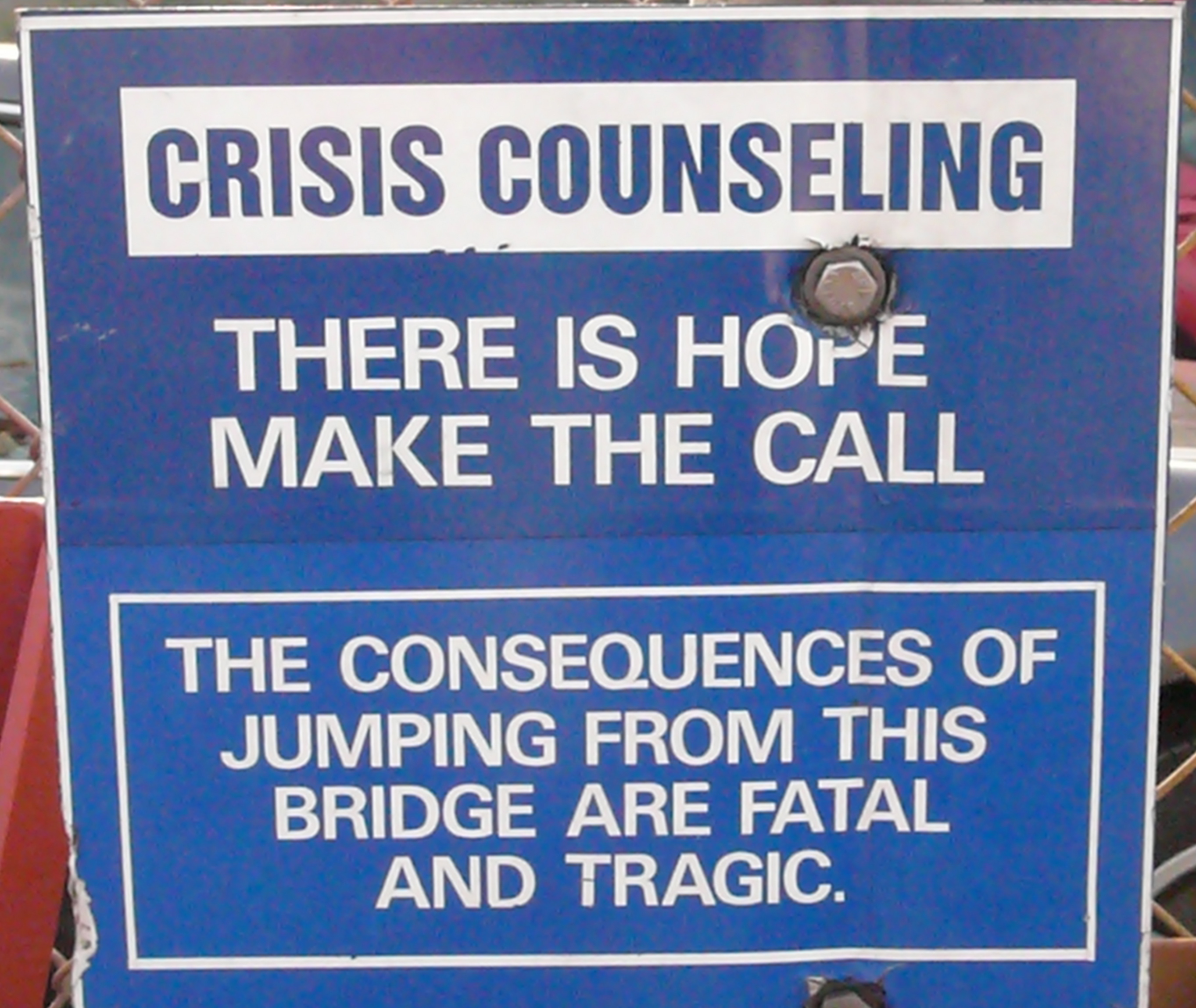
I wonder, too, about the signs on the Golden Gate Bridge: “The Consequence of Jumping from This Bridge are Fatal and Tragic.”  The jumpers know that.  That’s why they’re there.  Do the signs deter many?  From watching the movie “The Bridge”—cynical and heartbreaking—it would appear that indecision, perhaps fear, cause some to hesitate, although in the end they all jumped.  [It was a mistake to have watched it.]  And the San Francisco Police Department no longer publishes the number of bridge fatalities so as not to attract even more.

The Times article states that women are three times more likely to attempt suicide, but the fatality rates for men who attempt are four times higher, or 79 percent to 21 percent.  31 percent of men jump. Among active duty servicemen in Afghanistan, as of June 1, more died of suicide than killed in action.  Would they have been helped by logging on to ManTherapy.net?

I’m reading the MIT psychologist Sherry Turkle’s latest book, Alone Together: Why We Expect More from Technology and Less from Each Other.  She writes, “Technology is seductive when what it offers meets our human vulnerabilities.  And as it turns out, we are very vulnerable indeed.  We are lonely but fearful of intimacy.”  Having risked intimacy, I once told someone I wasn’t fragile but I was very vulnerable.  The danger wasn’t technology, rather love.  When that vulnerability was pierced, like my heart, the Golden Gate Bridge, for a moment, beckoned. That moment passed and history didn’t repeat itself, although the vulnerability remained. Technology has proved no balm, however my sons and friends have.  Fellowship works.  Turkle’s book strongly suggests that younger people often seek that possible balm in virtual worlds, in social networks, in relationships defined digitally rather than personally.  In Chatroulette, a “relationship” typically lasts no longer than a few seconds.  There’s very little heartbreak when someone unfriends you on Facebook. [Wanting to limit my Facebook friends to 150, I have unfriended more than 500.  I hope they haven’t been heartbroken.]

Someone must be studying the relationship between new technology and suicide.  My own unscientific opinion is that technology may play a role of withdrawal, but it’s the same old forces of love, hate, money, affronts to self-esteem and alienation that pull the trigger.  Speaking of triggers, the Times article also states that one reason men are more successful at killing themselves is because their gun ownership is much higher than women’s—a statistic I’m sure the NRA ignores.

Are the Man Therapy PSA’s and its linked website advertising?  The Times article is in the Media section, headed “Advertising,” so the paper clearly believes it so.  For decades public service announcements have advised us not to drink, not to smoke, not to light fires in the woods.  The most horrifying five minutes of film I know is a PSA from the Victoria (Australia) Transport Accident Commission graphically showing the consequences of drunk driving, set to R.E.M.’s “Everybody Hurts.”  The first time I saw it I couldn’t watch it to the end. Try for yourself:  http://www.youtube.com/watch?v=Z2mf8DtWWd8

The eminent Jungian psychologist James Hillman, in his Suicide and the Soul, describes what we call emotional suicides, performed under the domination of an overriding passion.  “Here would belong revenge against one’s enemies, to give others anguish; to manipulate the world, in rage at frustration; humiliation over financial ruin, shame over public exposure; suicides of guilt and conscience, of anxious terror, of the melancholy of aging, of loneliness, of abandonment, of grief, of apathy and emptiness, of drunken despair and despair over failure, especially failure in love.”

I suspect the men who may look into ManTherapy.com might well be suffering from one of these emotional states.  Frankly, who at times hasn’t?  I don’t believe any man would, however, wish to believe he had been manipulated by advertising.  Maybe that’s the beauty of the campaign—it’s in stealth mode.

Maybe one thing the campaign could accomplish—being an even greater good—would be to change ManTherapy to man therapy.  For the most part it’s true that depressed men don’t like to talk about their depression.  And yet, the fellowship of guys is a powerful force.  Even talking to just one friend can open up the possibility of brighter times.  Over the past year the most effective therapy I’ve experienced has been the support and friendship I have with other men.  Sure, there have been women friends, too, who have been there and offered their own friendship and perspective, different from my close group of men, and therefore welcome and valuable.  Only another woman could read an email and declare it “fifty paragraphs of crap!”

I was once asked by an allegedly “important” psychiatrist if I had read Camus’s The Stranger.  The question was odd and was asked with more than a bit of showmanship.  He was making a point about psychological barriers and behavior patterns.  Friendship has been the antidote, not the medical profession.

If the ManTherapy campaign helps only one man, it will be worth it.

The Way of the World

I once knew a woman who gave up a man who loved her deeply to pursue what she called her “personal legend.”  Having taken The Alchemist to heart, the lady believed there was a yet-to-be-realized achievement in her future and the quest for this achievement was incompatible with love, at least love with the man in question.  I don’t know why, but this came to mind today while watching the finals of the 2012 European Championships.  Spain won, spectacularly, 4-0 against Italy.

Earlier in the day I told a friend I was heading down to North Beach to watch the game in one of the many Italian cafes, sure of finding a crazy scene of avid fans. (I did.)  My friend said, “I never could get into soccer, there aren’t enough goals to make it exciting.”  This is a problem only in the United States, where sports fans are never more thrilled than when their team wins by factors of ten.  Imagine a Super Bowl score of 6-0.  You can’t.  Or an NBA Final Four finish of 12-2.  But in soccer, a shut out of 1-0 is a terrifically exciting game.  It’s all about the play: the passing, the footwork, the speed and agility of the players, the goal keeper’s saves, the headers, the near misses, and yes, spectacular goals.  It’s not called the Beautiful Game for nothing.

Americans always want more: more goals; more cars; more TV’s; more everything.  If it isn’t growing, it’s dying.  The stock market is predicated on this principle of growth.  Everyday life is predicated on acquisition and personal “growth.”  Some people are even willing to walk away from the only unconditional love they will ever know to seek the chimera of a personal legend.  As with all pursuits of growth, it’s a fool’s mission, founded on the fear of emptiness.  We are a society that fears emptiness, so to compensate, rewards growth at all costs.

Marketing is the toolbox of growth.  Advertising is its hammer.  Everything we do is designed to persuade more, sell more, influence more.  Now we also connect more, share more.  We create social ecosystems that spread like viruses. We achieve status by the number of “friends” we have, Robin Dunbar’s How Many Friends Does a Person Need notwithstanding.  Is there a limit to this?

Our greatest philosopher Ralph Waldo Emerson wrote, “What is the remedy? Is it not the chief disgrace in the world, not to be a unit; –not to be reckoned one character; –not to yield that peculiar fruit which each man was created to bear, but to be reckoned in the gross, in the hundred, or the thousand…Not so, brothers and friends—please God, ours shall not be so.”

I’m afraid we are reckoned in the gross.  And everything we reckon is in the gross.  There’s no singular achievement in a social network.  Charles Pierce in Idiot America writes that the value of the crank, once a valuable—and local—counterpoint to the status quo, has been set free by television and the internet to spread fraudulence and stupidity at light-speed to an ever more uninformed and gullible audience. The growth of bad ideas has become exponential.

I wonder if there’s an answer since there’s no turning back.  Americans are never going to learn to love professional soccer.  Or be content to maintain a stable business.  Or find happiness in the here and now and not in an elusive legend.  The Alchemist is, after all, a work of fiction.

When the pursuit is growth for growth’s sake, what is left behind?  Sometimes it’s failure, which is proper however unfortunate.  Sometimes as a business or an industry grows it fails to adapt, to look at “today” squarely.  Digital Equipment Corporation grew to the point its hubris blindsided it to the future—and it failed.  As a teenager in Pittsburgh, I witnessed the last days of the steel industry, when survival was no longer an option, much less growth. These are simplistic analogies, I know, but with these, people are left behind, too, as they are when lost in love. Most never recover.

I wonder tonight what the Italian National Team must be feeling. 4-0 is a stunning victory in championship soccer.  It was an historic win for Spain. I know, too, how that man feels having lost to another kind of victory. Detroit feels that way.  Undoubtedly Greece feels that way.  The problem with all these examples is that romance always fails.  It’s the way of the world and we make it so.

Roadkill

In this week’s New Yorker, Ken Auletta writes about the complex class-action lawsuit being waged against Apple and five publishers for allegedly colluding to fix prices of ebooks.  To date, the DOJ has sided with the plaintiffs and three of the five publishers have settled.  It’s well recognized that the lawsuit is a sideshow in a larger battle for digital dominance among giants Google, Apple, Amazon and Microsoft.

Auletta ends his piece with a quote by John Sargent, CEO of Macmillan Books, one of the five publishers that has refused to settle.  “Books,” he says, “ are in danger of becoming roadkill in that larger war.”

Every reader of my posts (ten I believe, three of whom are my sons) knows that I love books: printed and bound, physical books.  I love to hold them, read them, collect them, make them.  I’m old school enough to believe, like Jefferson, in the idea of a personal library.  I love all books, from beautifully bound hand printed books from small presses to Penguin paperbacks.  I know this is antiquated and for sure presents a problem of shelving in my apartment.

I also have a Kindle and a Kindle app on my iPhone.  I recognize it as a legitimate and efficient source of reading material. Its content is delivered simply, conveniently and cheaply. It’s great for travel and for acquiring something to read when no bookstores are nearby and there’s no opportunity for an Amazon shipment (a source of last resort.)  But it is not a book.

I rarely read novels on my Kindle, or any book that I think has lasting value, that I’d like to pull from a shelf and read again.  I know this makes no sense since you can do the same thing with digital content, minus the shelf.  Primarily I read business books on my Kindle, books I need to read to stay current but date as quickly as stale bread.  Used book stores rarely buy business books for the same reason so there’s not even a second life opportunity.  Kindle’s crowd-sourced underlining feature is a key benefit to skimming a business book that ought to have remained a HBR article, which is usually the case.  (I guess this says as much about my attitude to business books as it does to my feelings for ebooks.)

The victims of this squeeze on traditional publishing are first novels, poetry, most non-fiction, essays and criticism—all books with limited revenue opportunity.  These books used to be funded as prestigious loss leaders.  Publishing houses can no longer afford such luxuries, just as they can no longer afford their once-upon-a-time brick and mortar bookstores.  Who remembers anymore Scribner’s beautiful store on Fifth Avenue?  It’s now a Sephora.  I wonder how long Rizzoli will be able to maintain its showpiece store on 57th Street.  Their store in San Francisco closed years ago.

This is a generational lament dating from antiquity. Early Greek dramatists bemoaned the decline of oral traditions with the advent of written documents.  Nevertheless, it’s said that Alexander the Great slept with his copy of the Iliad, annotated by his tutor Aristotle.  The world moves on in magnificent ways.

Digital content has inevitably led to digitally based education. This is clearly a boon to spreading knowledge in places where no institutions of learning exist and to those who cannot afford the opportunity to sit in classrooms once occupied by classmates Nathaniel Hawthorne and Henry Wadsworth Longfellow.  As someone who regards himself a liberal egalitarian, and who also laments the great dumbing down of America, I embrace digital education.  I’m thinking of enrolling in one of MIT’s online courses in physics given my interest coupled with woeful scientific knowledge.  Classroom-less language instruction has been the norm for decades, starting with tapes and CD’s.

I’m not troubled by my conflicting emotions about the decline of traditional publishing and the rise of digital.  At the end of the day, reading is reading and all reading is a good thing.  Digital formats will continue to improve.  First novels will be easier to publish.  Book reviews will be easier to access.  Books are already easier to buy. Sharing enthusiasm for a writer or book can spread like wildfire.  Specialty books will continue to be printed. The Morgan Library will continue to exist, though likely not your local public library.  This blog, after all, exists only in digital form.

Still, I’m reminded of Wordsworth’s On the Extinction of the Venetian Republic: “Men we are, and must grieve when even the shade of that which once was great has passed away.”  It’s a pathetic sentiment, I know.  That doesn’t make it any less heartfelt.  I’ve long given up the quaint idea that my sons will want my books when I’m gone and plan to sell or donate them first so they won’t have that burden with which to contend. I know they will continue to read which is the only thing that counts.

The Perils of Advertising High

I’m reading with dismay Stuart Elliot’s adverting column in yesterday’s New York Times: “The First Graduates from Advertising High.”  The Brooklyn school, named the High School for Innovation in Advertising and Media, is supported by the Interpublic Group (McCann-Erickson, Draftfcb, Deutch,) the Advertising Club of New York and the American Association of Advertising Agencies.  It’s aimed mostly at minority groups, which in itself, is a worthy objective.

 But what does this mean for the future of advertising?  Assuming these graduates are hired at the kind of top agencies supporting this enterprise—considering Madison Avenue’s dismal history of hiring minorities—are we simply perpetuating a self-fulfilling perspective that ignores the larger realities of the industry’s effect on the culture at large?  Where will broader thinking come from if all students learn is within the confines of advertising and media? 

 The days are gone when account people needed an MBA to get a top agency job–agencies could not compete financially with the manufacturers and consulting firms. I once had an OTC consumer products client tell me there was no way their product managers would take our account executives seriously.  Their educational and experience backgrounds were simply not the same, to the detriment of the agency’s staff.  So how will an agency fare on this score with people only schooled in the trade?  It’s a closed loop and relegates agencies to true vendors, not strategic partners.

 To be clear, I’m not criticizing the objective of providing minority students with opportunities they may not have had before.  I’m wondering, however, if such a narrow educational focus will truly provide opportunities for advancement and success, or if this focus will reinforce the divide between those that do and those that lead.  One consequence of the lack of junior agency expertise is that clients only want to deal with senior people.  At my last agency here in San Francisco this caused considerable financial pressure, spreading many assignments across the senior staff while limiting the time they could spend with any one client and pushing most of the work to junior, less experienced personnel.  It’s an unworkable model for long-term success.  The opposite can also result in the same kind of pressure: I’m working now with a very senior group of people, with no junior staff at all.  It’s great for our clients. But, this means highly paid individuals are spending time on functions easily handled by less experienced people.

 In my ideal agency, small multi-disciplinary teams would handle assignments based on knowledge and interest sets.  No team would be fixed.  Teams would come together to fulfill specific roles and projects and then reform to meet the needs of the next new thing.  Design firms often work this way, such as Ideo.  In my agency we would have anthropologists working with writers, historians with art directors.  Solutions would be developed holistically—not piecemeal.   Nothing would be integrated because everything would be seamless.  Concepts such as large and small or simple and complex would not exist.  For the most part, virtual would not work—sparks rarely ignite when people aren’t together.  Humanistic values would be pervasive across and within the organization.  Diversity and geographic differentiation would be the norm. The Christian Right need not apply.

 The first question to any job candidate would be, “What have you done to prepare for this role that isn’t related in any professional way to what this role may be?” “What are the last ten books you’ve read?” “If you could save the world tomorrow, what would you do first?”  “If you weren’t sitting here, where would you rather be?”

 In every job interview I’ve ever had—every one—the two things on my resume that provoke the most, and usually first, comments and questions are the two things that have the least to do with marketing or communications or advertising: the fact that I worked on a Mississippi River tow boat in college and, later, earned an M. Lit in Anglo-Irish Literature at Trinity College, Dublin.  No one ever remarks on the MBA.

 My hope for the graduates of the Advertising High School is that they look beyond these niche studies and find diverse interests to fill in the gaps.  With this undergraduate background, their likely next pursuit will be to earn a degree in business, or communications, or even advertising: in other words, more of the same.  This may very well be enough to land a job. I also hope they will push for more.


Can Humanism Be Saved?

Last Saturday my son Adam graduated from Bowdoin College in Brunswick, Maine.  The class of 2012 was Bowdoin’s 212th graduation ceremony.  My oldest son David graduated in 2005.  I graduated in 1973. (Sam, my middle son, bucked the tradition and happily graduated from New York University in 2008.)

Adam majored in neuroscience and plans on becoming a physician after working in a lab for a year or so.  He plays Schubert on the piano; reads Haruki Murakami; collects mechanical pencils; was captain of the college ultimate frisbee team.  David is completing a Ph.D in physics education at Columbia and teaches 8th grade science and math.  Sam will enter his third year of law school in the fall, clerking this summer for the Massachusetts Attorney General in Boston, making watches in his spare time and coaching figure skating to earn his keep.

I’m thinking about my boys while reading Susan Jacoby’s The Age of American Unreason, a book David recommended as a “must read.”  The book chronicles the dismaying history of how the United States, unique in the Western World, has ended up with a population majority that doesn’t read, is largely anti-intellectual and anti-science, prone to fundamentalist religion, clueless to the country’s history, against national education standards, reveres the rich more than the educated.  Since the beginnings of the country, the South is much to blame for this, but attitudes and beliefs developed there have drifted across the country.

A liberal, humanist eduction is one of the few bulwarks against this tide.  But as a recent article in The New Yorker pointed out, even at some of the nation’s most elite universities–Stanford for example–the trend is away from the humanities in favor of the quicker route to fame and riches offered by electrical engineering and computer science.  In Asia and developing countries, this trend is exponentially greater.  Very very few aspiring students in China or India want to waste precious time taking classes in history, philosophy, classics or literature.

Maybe this is vital to the future; certainly it’s necessary in our contemporary connected society.  But where does it leave an open-eyed humanist, still pursuing Enlightenment goals?  Many, such as my sons, have integrated their interests into a mix of personal and professional objectives combining specialization with a foundation in the humanities.  They know, however, that they’re in a privileged minority even as competition within their peer groups remains intense.  Their lives have been enriched, their minds opened, but will they get the job?

Advertising has played a significant role in dumbing down American mass culture. The linkages between advertisers’s need to reach the largest audiences, the ads created to reach them and shows like American Idol are obvious and insidious.  More Americans are likely to vote for their favored singer than for an American president.  Who receives more media coverage in America: the Kardashian sisters or the eight Supreme Court Justices?  Admittedly, Ruth Bader Ginsberg is unlikely to sell many copies of People magazine, though therein lies the problem.  (Thurgood Marshall may have in his day.)

I don’t see a way out of the pact with the devil between advertising and advertisers.   The advertising industry tends to breed cynical fellow travelers.  Pseudoscience markets itself as legitimate research; the lowest common denominators of consumer opinion rank higher than the opinions of experts; media planners direct dollars to the trashiest shows in a vicious circle to reach the largest audiences.  The list goes on and on. I’m chagrinned to have been involved. I’ve scripted a higher-ground narrative on the premise that my principles have never been compromised by working on less than savory businesses.  Who could object to persuading consumers to purchase an HP laptop or take a holiday in Bermuda?  But this is just self-rationalization to assuage feelings of guilt.

I don’t mean to promote the prejudices of a highbrow elite against lowbrow taste. (Progressive middlebrow values have been on the wane for decades.)  I do mean to bemoan a culture lacking serious and national secondary school standards; a culture that favors superstition and hope over evidence based proofs; a culture that would rather the US president be popular at a BBQ than smart in the White House; a culture that defines celebrity on the basis of being famous for the sake of being famous.

I’m writing this in the kitchen of a grand and beautiful 19th century Columbia County house overlooking a wide expanse of the Hudson River.  My host and her guests represent the  loftiest levels of New York culture, taste and erudition.  My friends for forty years. No one comes from the Christian Right; everyone believes in evolution (why is this even debated in the 21st century?)  The galleries of the Metropolitan Museum are as familiar as the sidewalks of the Upper East Side. The environment and historic preservation are serious concerns. High level education is assumed; Kansas is very far away.  This is an outpost of the liberal, humanist tradition in American culture.

I suspect these old-school, rarified outposts will last indefinitely, though undoubtedly growing smaller and fewer.  In many ways the cultural attitudes here are at odds with the Democratic principles evidenced in the voting booths.  (Vintage posters of “FDR for President” hang in the back stair hallway.)  At dinner last night we discussed the future of art books.  The conversation began with the assertion that art books were a poor substitute for viewing the actual works, and that no one should think they have seen the Mona Lisa after looking at a reproduction in a book.  The question of art book survival was actually aimed at the transition from the printed page to electronic media.  Around the table most regarded this future with a combination of distain and horror.  The only one who didn’t was the director of a Gilded Age museum, whom I least suspected to be open and supportive of wider exposure to the best examples of art, music and literature. –surely a sign of hope.   I wish we had had a few twenty-five year olds at the table!

I’m going to put my faith in my sons and try very hard to believe their future will be different.  It’s difficult to see, and anyway too late for me and the boomer generation. (Susan Jacoby has more recently published an equally distressing book on the fallacies of “youthful aging,” the latest euphemism for growing old.)

My greatest joy is that my sons inhabit both of these worlds: at home in Silicon Valley and MOMA; a science lab and the Muse d’Orsay; a criminal court and immersion in the old Bohemian court of Rudolf II.   It’s the old nature versus nurture argument.  We need both, and a liberal education is the foundation of the second.  Yet, I see no way for the country as a whole to remake itself in a more humane, open–yes, civilized (in the original meaning of the word)–manner.  There is no civil discourse in American politics, no higher aim to improve the way the country “thinks.”  The promulgation of high culture is almost solely in the hands of parents, since art and music and the work of DWM in pubic schools have largely been abandoned as unnecessary frills.  One huge problem most liberal humanists face is that we tend to speak only to each other, and the same is true for conservative fundamentalists.  Few Southern Baptists are likely to be reading the liberal press, just as I am unlikely to tune into Rush Limbaugh.  Our worlds are self-defined and self-contained. There’s no conversation at all.

Sitting here on the patrician side of the Hudson, the Catskills in the distance, among my friends, I feel like a man living on one of the last, remote outposts of the British Empire, clinging to a memory long gone from the modern realities of the world and no boat to return to that imagined home. Then I reprimand myself.  It’s the responsibility of all who believe in liberal humanist values to transmit them to as many others as we can. It’s what I’ve done for my sons. We need to do more, to move beyond our comfort zones, to challenge the status quo of indifference or worse.  We need to listen, too.

Without Memory

What would we be without memory?  Would we be happier?  Would we never regret the passing of the past?  Would everything we see, everyone we know, remind us of nothing?  The great Alexandrian library and museum took its name from the fact that it was dedicated to the Muses, the nine daughters of Zeus and Mnemosyne, goddess of memory.  A museum holds the memories of our past, as our brain holds the memories of our life.

In his memoirs, the Vicomte de Chateaubriand wrote,

Memories lie slumbering within us for months and years, quietly proliferating, until they are woken by some trifle and in some strange way blind us to life.  How often this has caused me to feel that my memories, and the labours expended in writing them down are all part of the same humiliating and, at bottom, contemptible business!  And yet, what would we be without memory?  We would not be capable of ordering even the simplest thoughts, the most sensitive heart would lose the ability to show affection, our existence would be a mere never-ending chain of meaningless moments, and there would not be the faintest trace of the past.  How wretched this life of ours is!—so full of false conceits, so futile, that it is little more than the shadow of the chimeras loosed by memory.”

 I often wonder about the consequences of memory when contemplating popular and undoubtedly prudent sayings such as “living in the moment,” or the self-attention advocated in The Power of Now.  I understand these principles in theory but rarely in practice.  I’m not a Zen master and always get overwhelmed with memories from the past and anxieties of the future whenever I attend mediation sessions.  I have a friend who is a Buddhist monk at Tassajara who says this is normal, and that one should think of these in-coming thoughts as tennis balls that simply need to be lobbed out of one’s mind.

I even wonder if the notion of living entirely in the present is an excuse for a lack of knowledge, perspective and insightful anticipation.

While I hesitate to draw a commercial comparison, brands could not exist without memory.  Existing in the minds of consumers, brands are the accumulated thoughts and experiences people have with brands.  Think of Apple, the preeminent brand today.  Many of us are old enough to remember pre-Mac Apple, and Apple’s famous anti-IBM 1984 TV ad.  I had an MBA student last year who didn’t know who Elizabeth Taylor was on the day she died, but could describe the 1984 ad in detail despite its single airing happening before she was born.

Great brands trade on our memories of them: Chevy, Ivory Soap, Coke, Michelin, Crest, Kirin…  New TV shows like “Pan Am” trade on our memories of even a long defunct brand.  Edsel continues to connote failure, a joke. Even internet brands evoke their beginnings.

And that’s the fallacy of companies attempting to create a brand from scratch, simply by asserting that certain benefits will be appreciated by consumers viewing its advertising.   Bricks are laid one at a time and the house doesn’t come to life until all the walls are up.  A brand isn’t a product or service, distinct from the world it lives in.  I’ve recently seen a “brand” strategy that includes among its many objectives the desire to produce a feeling of gratitude among people who see the ads as they imagine how they might feel after they buy and use the product in question.  This might be very hard to accomplish!  I don’t know how to feel grateful for something I’ve never experienced, regardless how wonderful that something might be.

Back in the Dark Ages of my career, I remember sitting in a meeting at DEC after the launch of their Alta Vista search engine—lauded at the time—when someone asked whether anyone had heard of this new competitor with the kooky  name, Google.  It was dismissed as an upstart.  But then Ken Olsen, DEC’s founder, dismissed PC’s thus starting DEC’s demise.  No business school student I’ve had in the past three years has ever even heard of Digital Equipment Corporation, much less understood its importance in the history of computing.  DEC has been erased from memory, along with Silicon Graphics, Amdahl and hosts of other companies born and died in the Valley.  Facebook, now valued at $104 billion (how do you even imagine that?) sits on the former SUN campus.  History buffs may well be scratching their heads.  We know what happens to people who forget the past.

Facebook isn’t going the way of SUN anytime soon and has given the world a communication platform unlike anything seen before.  Along with Twitter and other social sites, Facebook may be one example of a brand that does, in fact, live very much in the present.  Not much lives in the past on Facebook; even less so on Twitter.  It’s about this moment, right now, and the anticipation of the next five minutes. A Google search, on the other hand, is all about delivering the past, to the eternal regret of people and companies who want their pasts forgotten.

With the vast surveillance capabilities of the US government, and their storage in what will be the world’s largest server facility being built in Utah, there will be no such thing as a forgotten memory.  The very idea will be irrelevant.  I tell my sons to consider every computer key stroke, every cell phone call, every site visited, bill paid—perhaps even every word spoken in public—will be known by someone, somewhere, sometime.  I still get unnerved today when I’m writing to a friend on Gmail about, say, a dog and simultaneously an ad for Purina Dog Chow is being served across the top of the page.  In other hands, this aggregation of key words and their linkage to advertisers who pay to know could have very different consequences.

I think, perhaps, there are situations in which we would be happier without memory.  A loss or a broken heart might be one.  In these circumstances evolution may have got it right giving goldfish their three-second memories. Why remember anything that produced pain and anguish.


Advertising Pseudoscience

I’m reading Carl Sagan’s wonderful The Demon-Haunted World: Science as a Candle in the Dark.  He writes, “At the heart of some pseudoscience is the idea that wishing makes it so. How seductive this notion is, especially when compared with the hard work and good luck usually required to achieve our hopes.”  Sagan is writing about the dangers of not knowing, or rejecting as the creationists do, the wonders of science in favor of ignorance, misinformation and certain religious belief systems.  How many more people can discuss with assurance the allegedly lost continent of Atlantis, for which no scientific evidence has been found, than able to discuss basic laws of quantum physics, or natural selection, or how viruses spread?

Pseudoscience prevails in advertising, too.  I’m thinking specifically of the pseudoscience of quantitative copy testing, but let’s face it, wishing and hoping things to be a certain way play an active role across the board.

Creative copy testing has had a long and disputed history.  From the now discredited Burke Day-After-Recall tests, to questionable Millward-Brown LINK tests, to account planning qualitative small group interrogation, the methods and “belief systems” are legion.  While all creative people hate copy testing, the majority of clients rely on quantitative results to aid, or in many cases, substitute, their own judgments.

I recently had a heated discussion with a client over “testing” to determine emotional content in television ads.  The methodology was Millward-Brown’s LINK tests.  Ignoring my opinion that all LINK test results are artificially derived under abnormal viewing conditions, and therefore of limited value in assessing true market place performance, my point was that if a person can’t tell something is emotional, then it probably isn’t.  And the converse is true: we know a commercial is emotional when we see it–when, after viewing it, we feel happy, sad, unnerved, elated, disgusted, moved to tears or laughter.  No one needed to test Apple’s famous “Think Different” TV work to know how emotional this combination of words and pictures was.  It still makes me tear up.  Or last year’s “Imported From Detroit” ad with Eminem to launch the Chrysler 300.  Or FedX’s hilarious “When It Absolutely, Positively Has Yo Be There Overnight” campaign.  Remember DDB’s classic “Spicy Meatball” commercial for Alka-Selzter?  Did you laugh out loud?  Did MVBMS’s “Survivors” campaign for Volvo stir strong emotions?  No one needed an unseen respondent to click a mouse when he or she felt “emotion.”  The emotion was there.

Conversely, creative advertising people aren’t immune from hope, from wishing things to have the impact they intend.  Often judgement is undermined by ego.  Passion and risk-taking have their place in ad development, when grounded in insight and reasoned, collective opinion.  Yet sometimes entire agencies get caught up in the novelty of an idea for the sake of its novelty.  This is often the case in new business pitches, when an all or nothing enthusiasm takes grip.  These pitches invariably fail.

Malcolm Gladwell describes in The Tipping Point the quixotic and serendipitous process by which the long ignored Hush Puppy shoes regained popularity.  Would Hush Puppy have uncovered this remarkable resurgence by testing ads for potential marketplace sales prior to these real life events unfolding?  Not likely.

More often than not, the purveyors of advertising testing market their methods as “scientific.”  No well trained scientist would assert this.  It would be better for these companies to define their strengths (if they have any) and limitations in realistic ways, rather than in dogmatic, deterministic language.  Clients could use this information as possibly providing one piece of the evaluation puzzle, not the entire picture.

One last observation: the most talented copy writer I know recently wrote a radio ad for a well-known product.  This copy went through no fewer than forty-five client requested revisions, that in the end removed nearly every word of the original language (excepting “and” and “the.”)  My copy writer friend called the finished ad the single worst radio ad ever produced.  Nevertheless, this was the only ad the agency ever created that received written commendation from the client CEO.  At the end of the day, it’s our job to make clients happy.  So goes life in advertising.

One Stroke of an Oar

Last Wednesday I had lunch with my friend Roz Savage.  Roz is an ocean rower.  She’s rowed the Atlantic, Pacific and Indian Oceans—solo.  Roz rows to raise awareness for the environment and cleaner oceans.  After Oxford she was a management consultant in London, when she decided her way of life wasn’t contributing to the well being of the planet or to her own soul.  She asked herself, “How can one person change the world?”  The answer was one stroke of an oar at a time.

It’s impossible to conclude anything other than the oceans are beyond real repair.  The rate of pollution, from garbage to chemicals, to thermal warming, combined with environmental abominations such as Japanese bottom scraping or BP oil rigs or the Exxon Valdez, all vastly outstrip the oceans’ ability to heal themselves.

Roz has rowed to the Great Pacific Garbage Patch, an area estimated to be twice the size of Hawaii with a weight of 100 million tons.  The Patch consists of submerged plastics, chemical sludge and debris trapped in the currents of the North Pacific.  The issue isn’t whether this vast area can ever be cleaned up—it can’t; the issue is what changes must occur in the commercial world to stop the proliferation of these pollutants in the first place. (We could elect more Republicans and hasten the dying process.)

What I find so depressing, and where marketing plays a significant role, is that for every one Roz Savage, there’s Exxon, P&G, Dow, BHP…the global list goes on and on.  Think for a moment about the amount of garbage, apart from recycling, the average household accumulates every day of the year. Think of entire industries such as cosmetics where packaging far exceeds product size.  Packaging that goes straight from the shelf to the garbage bin.   Happy Meal toys that capture a child’s attention for about fifteen minutes and have life spans of centuries.  Old tires, broken surfboards, dolls, nylon stockings, condoms.  They’ll be with us forever.

We live in a commercial, materialistic society.  Status is mostly pegged on things we own.  It’s too late to change this.   Entire industries are built on this premise.  Entire industries support the industries that build the products that we crave: law, accounting, consulting, advertising, marketing.  Everyone is responsible.

So where does charge start?  Do we need individually wrapped slices of the most ordinary cheese?  Do we boycott Kraft?  Do we stop shopping at Safeway?  Do we opt out of consumer society?

The most pervasive criticism of advertising is that it’s created to sell unneeded products to unsuspecting people.  Elementary school students are taught to distrust what they hear in ads.  Proponents argue that consumers are free to buy or not buy whatever they choose.  Advertising only makes people aware of a product’s existence and availability.  Yet any practitioner knows that this is only a partial truth.  The objective of advertising is to persuade someone to do something through a variety of tried and true creative means: emotion, sex, status markers, hope.  Elaborate methodologies have been developed to evaluate advertising effectiveness, down to analyzing second by second every word in a television commercial or tracking click-through, bounce rates, site navigation among many web metrics.   We know an awful lot about what motivates a consumer to make a particular purchase.

How many of us can become another Roz Savage?  Become a crusader for the environment, for the planet?  Probably not very many of us.  But what if everyone did just one thing every day to take a stand: chose an unpackaged brand over a packaged one; printed two-sided copies (or never print at all); took public transportation to work; let manufacturers know that their practices are unacceptable; let advertisers know that their ads are false, misleading or ethically questionable when they are.  Buy products from environmentally committed companies such as Seventh Generation.

Those of us who get paid to create the marketing strategies and advertising and social media campaigns need to apply our own personal standards to our professional activity.  This could mean fewer, or different, clients; less money.  My own standards might have been necessarily low by my career choice, but only once—my first account assignment– did I feel compromised by working to support a highly questionable product: cholesterol-free New Age Cheese from Anderson-Clayton Foods.  Coming in four “flavors,” these slices lacked any semblance of taste, were filled with artificial ingredients and when melted shrunk down to the size of a postage stamp.  In this case, consumers voted with their feet and the product failed.  So there is hope yet.  I should add, however, that my second account assignment was as the Assistant AE on P&G’s blockbuster product, Rely Tampons–of Toxic Shock Syndrome fame.  You heard right.

Meanwhile, we can all make a difference and support Roz’s mission for a cleaner environment and maybe help save the oceans of the world.  Check out her site: http://www.rozsavage.com/

And bring your own bag the next time you go to the grocery store.

Social Choice

I recently attended a panel discussion at CNET/CBS, moderated by my friend Paul Sloan. The topic was start-up funding.  The panel consisted of Naval Ravikant, Dave McClure and George Zachary.  The audience was mostly guys (few women) either in the early stages of a start-up, or hopefully launching an idea into a reality.  The best answer I heard to the many questions about how seed funding decisions get made was Naval’s “Surprise me.”

The discussion inevitably turned to Facebook’s IPO.  The consensus was that a rising tide lifts all ships, with the result that the hype and capital infusion would stimulate more start-up investment.  Then, Naval R remarked, “who really uses Facebook anymore?”  Serious people have moved on to Twitter and Pinterest, leaving Facebook for kids, housewives, and, by implication, the non-serious.  While I’m sure this would be a surprise to Mr. Zuckerberg and his investors–no doubt adding millions of users around the globe as this panel discussion progressed–I wonder if there isn’t some truth to what Naval had to say.  Natural selection is relentless.

Look at the trouble Groupon is in.  It seems like only months ago the site was the darling of the web, ushering in an entirely new platform for promotion and commerce.  It may now fall by the wayside, and I for one won’t miss it.  The promise of engendering repeat purchase and long term customer loyalty was always a false, untested proposition.  Rapaciously marketed to small and medium businesses, it proved to be a money loser at best and often a death knell.

I bought a Groupon once, an offer to get $60.00 of merchandise for $20.00 at a single proprietor, high end pharmacy in my neighborhood.  The place sells expensive European products.  I figured how could I go wrong, so with my offer I went in, selected my purchases and paid with the Groupon.  I asked the woman at the counter, who turned out to be the owner, how this deal was working for her.  She said, “It’s the worst business decision I’ve ever made.  I’ve lost so much money and haven’t ever seen anyone return to the shop.”  It’s a common story.  How rueful Groupon’s founders must be for not having accepted Google’s offer (and how happy Google must be that they didn’t.)

All of the social platforms we use today will be replaced in time, some sooner than later.

Despite the many frustrations, and often against my private instincts, I engage because part of being alive is to live on the wave, not be stuck on some retaining wall.  Yes, privacy is sacrificed; hacking is a nuisance; our keystrokes are aggregated and repackaged for marketing initiatives; the government conducts surveillance; Big Brother is watching.  But what, today, is the alternative?  I have a young friend, a college student, who is mortally against all forms of online sharing: no Facebook, no Twitter, no use of Google search, no downloading, no YouTube, no Netflix…  Gmail is a necessary evil.  He wears a specially protected wallet to prevent possible RFID scans.  He also attends Defcon and supports Julian Assauge.  His seemingly contradictory career goal is to work at Twitter in their security department.  To me, he has narrowed his worldview to a degree I find depressing and ultimately uninteresting.  Maybe he’ll turn out to be right and I will be on the losing side of the battle for personal integrity and privacy.  When “they” come, they’ll get me long before him.

In the meantime, we’re here to explore and evolve. And not be fearful of unknown destinations.  There’s too much uncertainly even to hope of controlling outcomes.

I come back again and again to the final passage of Michael Frayn’s play Copenhagen.  I’ve quoted this before.

Margrethe And sooner or later there will come a time when all our children are laid to dust, and all our children’s children.

Bohr When no more decisions, great or small, are ever made again. When there’s no more uncertainty, because there’s no more knowledge.

Margrethe And when all our eyes are closed, when even the ghosts have gone, what will be left of our beloved world? Our ruined and dishonoured and beloved world?

Heisenberg But in the meanwhile, in this most precious meanwhile, there it is. The trees in Faelled Park. Gammertingen and Biberach and Mindelheim. Our children and our children’s children. Preserved, just possibly, by that one short moment in Copenhagen. By some event that will never quite be located or defined. By that final core of uncertainty at the heart of things.

I read this and think about my sons and the world they’re inheriting.  They have a lot more optimism than I do, believing that when the really bad times come, there will be a solution.  Science has saved the human race before and will again.  No doubt rational forces will eventually win out in this country to replace the bigotry, self-delusion in the name of faith, anti-science, anti-women, anti-education populist beliefs that seem to be sweeping much of the nation.  After all, National Socialism had its downfall.

Many believe, Malcolm Gladwell notwithstanding, that social media has played a role in advancing social change.  Like wildfire, people get connected, informed, mobilized and united in common cause.  In retaliation, repressive regimes shut down social media portals, as has recently been the case in China.  The power of social platforms, such as Twitter, is recognized, understood and feared.  Just as marketing has shifted from the hands of manufacturers to the hands, and opinions, of consumers, politics is shifting from centralized control to decentralized communities of citizens.

Would we rather be part of these movements, or isolated in our own fears of lack of privacy and personal control?  “With Privilege Comes Responsibility.”  There will always be the irresponsible, the hackers of the free world.  And there will be those irresponsible to the status quo who will carry huge responsibility.  (Wikileaks may be one.)

Fear versus potential.  You’ve got to choose.