The Past Drawer

October 18, 2019.

Today would be my 5th wedding anniversary. While still technically married until the end of December, when the divorce my wife initiated becomes legally completed, this is not a day to celebrate. It’s a sad day. I intend to make it a hopeful day.

Without question my life benefited in many ways from my marriage to this woman. I am grateful to her for the many things now important in my life that she either facilitated or made possible for me. Yet, she chose to end our marriage, and with that declaration and act of ending, even without drama, there are consequences.

She doesn’t get a free pass to be part of my future community.  She chose to exit my life. I can accept her decision as “just what happened” only to the extent that it now exists as a piece of my past, and does not need to be carried into the future that I will create for myself.  She is being put in the “past drawer,” as Werner Erhard calls it.

I accept that whatever feelings I have for her—whether they are loving or bitter or both—are my own internal states. To be emotionless is to be dead. Equally, to let my emotions influence my behavior is to be histrionic and guided by passion rather than insight and intention.

She has disrupted my life in very consequential ways.  The disruption may ultimately be a good thing…but I will make it so, not because of what she did but because of what I do. She has traits that ought to have been fair warnings to me that either I didn’t see or saw and ignored. She isn’t my enemy, nor should she be shunned. But she is not my friend. Brenda remaining in my life does not improve my life. She had a time to play that part, and she did for a while, then she chose to exit the scene.  That play is over.

I do not wish her ill. I genuinely hope her decision to end our marriage, as distressing as it’s been for me, brings her some kind of peace. I doubt she will ever be happy, but that’s not for me to judge.

I will be more consequential not married to my wife.  I know that. Yet, knowing that is not the same thing as thanking her for dissolving our marriage.

For me, right now, the past drawer she where she will reside.

Put the past in the past.

R.I.P. October 18th.


The Gift Unwanted

I find myself in an ironic, conflicted state of mind. Despite the absence of sex and genuine affection, I liked being married to my wife. The status quo was OK.  I would have continued on for years in this state of —as Werner would say—tranquillized obliviousness.  Life had a routine, a comfortable sort of familiarity, its own petty pace.  It was almost like having a home.  Maybe I just liked being married.  As my wife let me know, married men live longer.

Now, on my own, my future is entirely in my hands.  Of course it always was. I let a relationship substitute for a future.  Having the possibility of creating a future for myself that wasn’t going to happen is a gift my wife gave me.  I didn’t want it, fought against it, suffered because of it.  I harbor complex emotions about her because of what she did. Instead I should simply be grateful.

Months ago I wrote in this chronicle about my gratitude to her for the many things in my life made possible by our relationship.  Her closest friend harshly criticized me for being “back-handed.”  That wasn’t my intention.  She opened the door to my near entire experience of California.  She introduced me to my best friend.  She re-introduced me to the joys of swimming in the Bay.  She initiated our adoption of a dog.  I’m even mostly vegan because of Brenda’s diet.

In the movie Beyond Rangoon, a Buddhist from Burma explains to a visiting American, “We are taught that suffering is the one promise life always keeps. So that if happiness comes we know it is a precious gift, which is ours only for a brief time.”

My happiness with my wife was a precious gift—which was ours only for a brief time. Being gone, the future is mine to write.

65435668_10214169248975757_6535347148127469568_n

Move on

Last Saturday at Heart’s Desire Beach a South Ender I hardly know said to me, “Your wife  told me once, before she ever met you, that she didn’t do relationships well, that she was always trying to get it right.” The woman who told me this not too surprising revelation—many others have told me similar– is a therapist, and conjectured why this might be the case.  Knowing my wife better than she I thought she was off the mark, though the “not doing relationships well” bit was true to my experience.

A much more enlightening insight came from a swim coach who only knew my wife slightly from holiday dinners. He observed that many perfectionist athletes often fail at relationships, that the relationship, just as their own performance, rarely lives up to their expectations. They keep trying to improve, and improve, and improve; yet are never satisfied.

Little did he even know of her serial approach to sport (as with men.) From ju-jitsu, to technical climbing, to cycling, to swimming, to marathon running, to rowing. Accomplish one and move on. Never satisfied.

There’s a pattern here: many sports/many husbands and lovers. Keep moving on. Never satisfied.

Maybe she’ll get one of them right someday.

Accidents and Happenstance

I am the ordinary son of an ordinary man. Which is pretty self-evident, I know. But, as I started to unearth that fact, it became clear to me that everything that had happened in my father’s life and in my life was accidental. We live our lives this way: viewing things that came about through accident and happenstance as the sole possible reality.

To put it another way, imagine raindrops falling on a broad stretch of land. Each one of us is a nameless raindrop among countless drops. A discrete, individual drop, for sure, but one that’s entirely replaceable. Still, that solitary raindrop has its own emotions, its own history, its own duty to carry on that history. Even if it loses its individual integrity and is absorbed into a collective something. Or maybe precisely because it’s absorbed into a larger, collective entity.

Occasionally, my mind takes me back to that looming pine tree in the garden of our house in Shukugawa. To thoughts of that little kitten, still clinging to a branch, its body turning to bleached bones. And I think of death, and how very difficult it is to climb straight down to the ground, so far below you that it makes your head spin. 

(Haruki Murakami. Translated, from the Japanese, by Philip Gabriel. October 2019)

TNYInterview-Murakami

imgres

Today my life is entirely up in the air, far up that tree above the ground, the ground I used to know as my reality. I have some points of contact, a general destination, an aim and an ambition. Much ahead is a leap of faith—not faith in a god that might guide a safe landing, but faith in myself to navigate a way forward, to find a new reality.

It seems foolish to spend much time worrying about any idea of reality. It’s just what’s happening now. Accidents and happenstance. It’s happenstance that my wife decided to end our marriage. Yet happenstance has consequences, too, which are real and chart a new basis of reality. The old reality no longer exists or has any meaning. “I shall not regret the past.”

I don’t have to like it, only accept it. I don’t have to like her anymore, only accept her as she is. Her decision has defined a new reality, for both of us. I don’t have to forgive her because forgiveness isn’t part of the equation. Nor do I have to condemn her because condemnation implies a moral high ground that I don’t, and can’t, occupy.

It’s all just happenstance, the way the world turns when you can’t ever see it turning. The points on the horizon looked the same to me. I never saw them growing fainter, more distant. Someone else was turning the wheels. Someone else was looking at a different horizon.

The idea of home is just an idea. Or no home. The reality of “home” exists in my head not in any physical building or place. It’s an idea I long for. I haven’t had a home in a long time, not even when married. Yes I had a place where I lived but never a home.

I was entirely replaceable; and that was only an accident and happenstance: absorbed into the collective reality of the dispossessed.

It’s time to climb down that tree onto firm ground, and not stay aloft, clinging to my branch, turning into little but bleached bones.

old-gravestones-i-dave-gordon

No heart for speech

…but a thought
Of that late death took all my heart for speech.

imgres

This morning I learned that the daughter of good South End friend was killed in a horrific car accident on the major highway running from San Francisco through Silicon Valley. The why is unknown but she was driving southbound in the northbound lanes and crashed head on into a taxi with two passengers. All four people involved were killed.

I have no words for this, no words for my friend that could possibly help. It’s every parent’s nightmare. I didn’t know the daughter, but my thoughts aren’t about her. She’s gone, tragically. My thoughts are with my friend her mother.

Coming on top of my own son’s cancer diagnosis last month only deepens the idea of loss, the feelings of helplessness and despair. Adam underwent his first chemo infusion last Friday and seems to be faring as well as to be expected; maybe even better than expected. His spirits are good, he’s maintaining his medical school routine, his life is being lived as normal. We had dinner together last night and all was as it should be. It’s a crisis that brings us all even closer together. As it should be.

We only have one another in this life, our family, our friends, our fellowships. To abandon those bonds in pursuit of some private aim is truly a moral failing, a failing of the universe to hold us together.

To abandon the man who loved her was my wife’s failing. What do we have if we don’t have one another? To not try, to reject love, to seek solitude and perhaps even loneliness…why?

I’m told over and over that she was never kind to me, that I was looking for something she could never give me, that the intimacy and affection I sought was never there and could never be there, that the damage my wife had endured in her life grew her protective armor only harder and harder through the years. There was no way, never a way, I could break through, and that my trying, and need to break through, drove her away.

Knowing this now, being alone might be better. But at times like this, in times of family crisis, and crisis with friends, having the support and simply being-there companionship of being married would be a comfort. Not to be.

Her vision was too clear to contemplate remaining together.

So tonight I remain alone; perhaps she is, too; or perhaps she’s tending to the needs of a former now gravely ill lover. Maybe he’s no longer living, I don’t know.

I’m listening to Jessye Norman sing Richard Strauss’s Four Last Songs. Jessye Norman, too, died last week. Strauss died before the songs were first performed. My friend Ray calls them the end of Romanticism. They are otherworldly beautiful.

There are many ends to the end of romanticism.

An empty seat


It’s always young women who offer me a seat on standing room only crowded BART trains or MUNI buses. Never young men, who remain seated, cocooned in their obliviousness by whatever screen they’re attached to. The young men never even look up, even when they’re sitting in the marked senior/disabled seats as they often are.

This courtesy however comes with the harsh realization that a kind young woman has regarded me as a senior; in other words, old. Of course I am a senior, in biological years, yet am always surprised when asked if I’d like to sit down. Of course I don’t want to sit down…or am ready to admit that a seat would be nice. I always decline.

Gertrude Stein once said, “We’re always the same age inside.” Inside I’m not a senior. Maybe…35? 45? Certainly not a teenager, or even twenty-something. To regain those years could only be contingent on knowing what I know now and applying that knowledge (wisdom?) forward. Maybe I would make the same mistakes, but it would be with some foreknowledge of the end game.

Being a senior comes with some relief, too. I’m not hopeful about the world in general to wish to be young today. I fear for my grandchildren. Irreversible climate change. Erosion of democratic principles and practice. Scarcity of needed resources. Environmental catastrophe. The lowering of civil discourse. Population growth. Resurgent nationalism. Cancer. Republicans. Trump.

The daily news is a heavy dose of depression and anxiety.

There’s heartbreak, too. Reading a story I wrote about another time and another loss, a friend of mine wrote the other day, “My sincere hope for you in this very difficult year is that these many reflections bring clarity and not disappointment and being disillusioned. You are walking a new path with new knowledge.”

Clarity. Disappointment. Disillusioned. New Knowledge.

Clarity and disappointment might be the same thing—though clarity is a word I never want to hear. It’s the word my wife used to confirm her decision not to try to find a new future for our marriage. Clarity of vision. Her vision. And yes, that was disappointing, heartbreaking.

Disillusioned? Love seems to be a disillusion. That it’s so ephemeral, inconstant, unsustaining. That marriage vows mean nothing, can be so easily broken. That one must be in love or out of love. That relationships require “equity” to be maintained, to make the effort “worthwhile.” My wife said our marriage had no equity, and therefore was not worth saving. That is disillusionment.

So perhaps, just perhaps, being a senior means not being disillusioned for too many more years. And finding a path to that new knowledge before it’s too late.

Look Through My Window

Look Through My Window

Written by John Philips, The Mamas & The Papas

And the rain beats on my roof

And it does not ask for proof

It’s not that lovers are unkind

She always said there’d come a time

When one would leave and one stay behind

We both knew people sometimes change

And lovers sometimes rearrange

And nothing’s quite as sure as change

And the rain beats on my roof

Look through my window to the street below

See the people hurryin’ by

With someone to meet, some place to go

And I know I should let go

She always said “I’m not like you”

“When love is dead, for me it’s through”

“And I will find and love someone new”

Look through my window, yeah, to the street below

See the people hurryin’ by

With someone to meet, some place to go

And I know I should let go

I must admit she knew her mind

And it will not take her long to find

Another place where the sun will shine

And the rain beats on my roof

If I still require proof

Well, the rain beats on my roof (She’s gone)

If I still require proof (She’s gone)

Well, the rain beats on my roof (Look through my window)

If I still require proof (All the people)

Well, the rain beats on my roof (I love her)

If I still require proof (She’s gone)

Missing

I miss my little white dog. I miss his boundless affection and companionship, his burrowing under the covers early in the morning, his sweetness and loyalty. Having been a rescue, he didn’t deserve another separation.

fullsizeoutput_386d

I miss the woman I married now nearly five years ago. I loved her, and I believe, at that moment, she loved me. Or she wanted to believe she loved me.

I do not miss the woman she became.

A year into our marriage she withdrew all intimacy and affection. It wasn’t replaced by rancor or anger or even ill feeling. It just disappeared, without much explanation. When I would hold her hand walking down the street she would quietly slip it away. Our bed became the place only where we slept.

Four years into our marriage she declared her intention to end our marriage. No rancor or anger, only a deadening fog of distance, deeper withdrawal, and sad loneliness.

That woman I do not miss. I’ve searched for meaning, for some explanation that would absolve her, and me. Last night a friend asked me, knowing what I know now, what would I have done differently? Would I have asked her to marry me? Would I have accepted her early withdrawal with the same equanimity? Would I have been content to go on living with not good enough? Would I have expressed myself more, my desires, my fears? Would I have said anything?

All of that is past, and not helpful to recount. It’s just what happened. As she told me, we were never trudging the road of happy destiny together. There was never a together.

More important matters concern me now. As I write, Adam is undergoing his first chemotherapy infusion. My close friend Ray is napping following his yesterday’s chemotherapy infusion. These are real life issues, not the artificial pain of divorce.

My former wife fades into a distant background, isolated in the clarity of her vision. May she be in peace.

Alone.

Being Here Together

An ordinary Saturday in Oakland.  It was and it wasn’t. I bicycled across West Grand Avenue to Adam’s and together we went to the farmer’s market, shopping for the last of summer’s tomatoes, pluots, peaches, plums. Lettuce appears still to be plentiful. Northern California has a bountiful harvest extending late into the autumn, at least autumn as perceived by an Easterner though not here.

Years ago, though it doesn’t seem like that many, we would go to a different farmers market, in Ossining, New York.  Adam was still in high school and I was still at home.  That was before the final upheaval, when life was only smoldering not yet erupted.

After we finished our shopping we went back to Adam’s and made a light lunch of tomatoes and basil leaves on artisanal seeded rye bread, listened to the somehow appropriate ethereal Sufjan Stevens, before deciding on the spur of the moment, to walk over to the Grand Lake Theater to see Once Upon a Time…in Hollywood. I had seen the movie already, and hadn’t liked the fictional fairytale portrayal of the real-life horrific murders. This time, knowing how it ends, I saw the deep nostalgia, the heart stopping sadness of all that was lost when those four were killed. Something died in America and it wasn’t only four innocent victims and an unborn child.

Adam drove me home in time to coordinate with Bowdoin friends he was seeing for dinner. Life lived as normal, even when it isn’t.

Normal in the face of calamity: this seems to be a theme this year. I lived for five months under a cloud of normalcy, blanking out the thunderous storm of divorce. My storm was a mere squall compared to Adam’s cancerous tornado. Yet we strive for routine to keep the fear and heartbreak away.

I hope my wife is finding all the satisfaction she desired in her dissolution of our marriage. Nature inflicts enough meaningless misery.  I hope the misery she inflicted has some meaning for her, some existential kind of happiness to justify her clarity of vision.

The coming week will be a turning point, the beginning of Adam’s treatment. Let it be a turn towards recovery and health. In which being here together is enough.

Light the first light of evening, as in a room
In which we rest and, for small reason, think
The world imagined is the ultimate good.

This is, therefore, the intensest rendezvous.
It is in that thought that we collect ourselves,
Out of all the indifferences, into one thing:

Within a single thing, a single shawl
Wrapped tightly round us, since we are poor, a warmth,
A light, a power, the miraculous influence.

Here, now, we forget each other and ourselves.
We feel the obscurity of an order, a whole,
A knowledge, that which arranged the rendezvous.

Within its vital boundary, in the mind.
We say God and the imagination are one…
How high that highest candle lights the dark.

Out of this same light, out of the central mind,
We make a dwelling in the evening air,
In which being there together is enough.

WS

Lost, in North Beach

Walking down Columbus Avenue in North Beach early last evening I was dismayed to see so many empty, boarded up storefronts. North Beach was the first neighborhood I grew to know when I moved to San Francisco in 2008. I lived in the soulless Golden Gateway apartments on Battery Street, and North Beach was a short walk away.

Nearly all my favorite shops and restaurants are gone, along with the people who owned them. A few favorites remain: Il Pollaio, with it’s grilled chicken and salad dinners, and Jimmy Schein in his antique print and frame shop on Upper Grant. City Lights Bookstore remains a beacon of literary civilization.

My friend Conor Fennessey abandoned his antique and design shop years ago, a victim of his own fate. Essentially a scoundrel and a thief—but oh what a charming scoundrel and thief!—Conor was blessed with exquisite taste mixed up with Irish wit and an unerring eye to detect an easy sucker to overpay for whatever he was selling.

o

Nothing in Conor Fennessey Antiques was priced, and everything was expensive. It was commonly understood that Conor would size up a potential customer and price the desired object in question accordingly.

His Yelp reviews were awful. People would come into the shop and ask the price of let’s say a chair and Conor would off the top of his head say $5,500. When the astonished customer would respond with something like, “wow, that’s really expensive,” Conor would look them up and down behind his large black glasses and reply, “well, then I guess it’s not for you.”

Once, when foot traffic and sales were lagging, Conor decided to have a sale, and posted a sign in the front window announcing 20% Sale on Selected Items. As always, nothing in the large store was priced or otherwise marked. Customers would walk in and not seeing any evidence of a sale, ask politely, “which items are on sale?” If Conor suspected the person was merely a tourist walking up Columbus from Fisherman’s Wharf, he would tell them, “the sale is over.” If they looked more promising, he might ask, “what are you interested in?” Then the dance would begin. The customer would point to an item, and Conor would say, “oh, that’s not on sale today.” Or, he might say, “that’s $1,200” to which the customer would come back, “is that the 20% sale price?” and Conor would confirm ,”yes.” All pricing was entirely arbitrary. Inevitably, the customer would become annoyed and muttering some insult, leave the shop.

Eventually Conor’s shady financial dealings with consignees caught up with him and he had to close the store. Nothing was ever the same after that, and too few years later Conor died of a heart attack.

Conor was a special friend, one who showed me a side of San Francisco I would never have known—from the 21 Club bar in the Tenderloin where the Fijian owner would hand me my Diet Coke as cheerfully as serving up hard liquor to the drag queens, prostitutes, and the near homeless regular clientele, to his fancy Pacific Heights friends like Dede Wilsey.

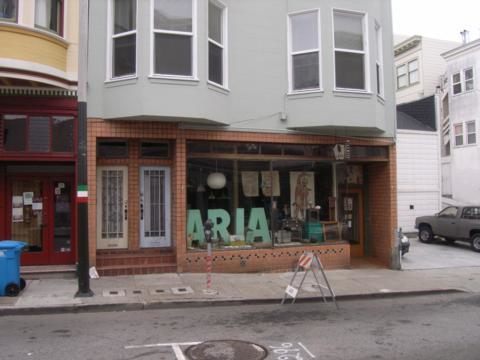
Bill Haskell’s quirky French flea market shop Aria on Upper Grant is gone.
7892818

Yone SF is gone—as one Yelp reviewer wrote: Yone is AMAZING!  Seriously, you rarely find places with as much character and uniqueness as this store.  Such a gem.  However, it is the kind of place you should only visit if you have a lot of time and are mentally prepared to fall into another world… totally fairy tale.

Rose Pistola—once the most famous Italian restaurant in the city—gone. So many others, too numerous to relate.

Washington Square is entirely closed and fenced for reconstruction that while not permanent gives the focal point of the neighborhood a desolate, unconstructed air.

I’m told it’s rising rents from greedy landlords, coupled with the length of time it takes to get permitted. The small independent shops can no longer make it.

I’ve been drawn to these tiny one-of-a-kind shops my entire life. And nearly all are gone, the most poignant, and painful, being my beloved Patina Antiques on Bleecker Street in the West Village in New York—gone now for decades.

The size of a shoebox, Patina Antiques was owned by a modest and quiet gay guy and his much younger handsome equally quiet lover. They specialized in small objects of unimaginable oddity and uniqueness.

Years after I left the Village—our apartment was on 5th Avenue at Ninth Street—I learned that the store was robbed and the young assistant murdered during the robbery. The day after, the owner shot himself in grief.

These losses weigh heavily on my heart, some, like Patina Antiques, because of the time in my life it occupied; and others, like Conor Fennessey, because of my friendship with him, and the time we together spent unearthing a city I didn’t know.

And one loss leads to another, the loss of my marriage with my wife weighing me down most recently, and sadly.  Inconstancy comes in many disguises.  When disguised as love, its appearance hurts the most.