Dreams

There are two varieties of dreams:  dreams that arise during the night and vaporize by morning.  Sometimes these dreams are remembered and assume an importance as portentous signs of life we only half know.

The other kind are the dreams we harbor within ourselves.  Dreams of peace.  Dreams of windfalls.  Dreams of happiness.  Dreams of love.  Sometimes these dreams come true, though more often they’re little more than disappointment and futility.

I’m reminded of DDB’s famous ad campaign for the New York State Lottery, “All You Need is a Dollar and a Dream.”  Who hasn’t dreamed of winning the lottery?  (This very successful campaign came to an abrupt end when a man on Long Island complained to the State that it encouraged poor people to waste their money on lottery tickets.  True enough since the odds of this dream coming true are infinitesimal.  I suspect Bill Gates has never bought a lottery ticket.)

I’ve had three sleeping dreams in my life that remain as vivid today as the nights I dreamed them. One occurred a long time ago when I was in my twenties.  I think I was still in college.  The other two have been more recent.  Each was frightening—though not nightmares—and each has indeed been significant to my understanding of my life within; also, lack of understanding.  Rich material for my therapist!  My last dream was terrifying when I dreamed it and hilariously comical when I recall it.  Two realities in one.

Of the latter kind of dream, I’ve had only one, and it’s been the same one since I’ve been a child.  After many, many years I thought this dream had come true.  It had, for a while, and then it was gone.  I won’t dream this dream again.  One shipwreck is enough.

Freud and Jung both wrote famously about dreams.  Freud infused dreams with sexual significance and Jung linked dreams to archetypes.  My own three dreams conform more to Jung’s interpretation than to Freud’s. At least that’s how I chose to interpret them, maybe a result of a year spent in Jungian analysis with the president of the Jung Society in New York—an extravagant indulgence that could have gone on forever without changing my life.

Is it the nature of dreams to be more lost than found?  Isn’t that what a dream is: something beyond our reach that we badly want and rarely get?  And if it’s imaginary, why is the loss so painful?

Alan Lightman in this month’s Harper’s writes about the immensity of the universe and the impossibility of comprehending it.  It’s a beautiful essay, emotionally overwhelming.  He writes, “We are living in an accidental universe.” I think our dreams are part of this search for meaning in a universe that we can’t imagine. Ultimately we don’t “mean” anything.  We are.  Yet we long to know ourselves, where we stand, where we’ve been and where we’re going. Dreams live in that projection, because they define the person we want to be.  Our dreams evolve, too.  We grow older and one unfulfilled dream folds into another, and another, and another.  I think the origin of sadness lies in this evolution.  It moves slowly, imperceptibly, and one day we wake up and discover that these dreams are in fact the dreams of sleep.  They didn’t have any reality at all.

Yet, some dreams do inspire greatness.  What drove Ulysses to endure countless challenges, drifting for years, but his dream of Ithaca?  Napoleon as a teenager still on Corsica dreaming his destiny.  Keats’ dreaming of Fannie.  Anne Frank.  Tony Manero almost—just almost– dancing his way to live his dream.

Cathy Freeman, the first Australian Aboriginal person ever to win an Olympic gold medal—when an entire country joined her dream of winning.  I defy anyone who watched her win the 400-meter race in the Sydney Olympics to confess they didn’t burst into tears.  I just watched it again on YouTube and again I couldn’t hold back tears.  Her dream came true, forever.

Yeats wrote that, “Sex and death are the only things that can interest a serious mind.”  When I read this in college I didn’t understand it’s meaning.  I didn’t believe it.  Sex, yes—but death?  But Yeats wasn’t writing about the young.  He was describing, I think, the agony of aging, when all the dreams we’ve lost take on bittersweet urgency as the years pass.  He was writing about himself.

Will we die with our dreams never fulfilled, or if they are, is it inevitable they fade away?  We’ll never know the answer to that question.

Hearts break because of lost dreams.  I wish I could close more optimistically.

Australia: Part One

Australia presents contradictions that still resonate. We were neither locals nor expatriates in the common understanding of that description.  Americans—Americans like us–were too close in background and shared Anglo culture to stand out as different.  We were not part of a tightly knit expat scene; in fact, I don’t remember even knowing any other Americans, and certainly not as friends.

Our children went to an Australian school; we went on Australian holidays; our baby was born in Australia and baptized in a uniquely Australian Protestant church.  The close friendships I developed at work were with Australians. Our social friends were mostly the parents of other children in our boys’ Australian private school.

Yet, we are not Australian and that difference was subtle, sometimes imperceptible, and a fact that made us both insider and outsider.  In Spain and Singapore we were clearly and only outsiders, expats, made all the more pointed by our transient circumstances.  We weren’t part of anything.

Individually, and as a family, we loved Australia.  We still do. David and Sam look back on their experience, even dimly remembered, as an idyllic time. Adam, who moved back to New York as a one year old, thinks of Australia as a home he once came from.

Melbourne was the safe haven afforded me by John Bradstock—whom I regarded as both mentor and guardian angel—and his former Needham colleague Peter Bennett.  I had been given the choice to relocate to either Sydney or Melbourne.  I chose Melbourne for personal rather than professional reasons and never regretted the decision.  Schools were easier to select; the suburban towns were pleasant and closer to the city; cultural life was more accessible; the restaurants were better.  I liked the idea of Victoria: the sheep farms and gold rush legacy.  Nearly everyone we met would within a few minutes say, “We were never a convict colony!”  As a city, Melbourne was, and remains, one of the most civilized cities in the world.  Its English heritage is more evident than in Sydney, or Australia’s other coastal cities.

Given its distance from Singapore, I had to select a town, a house and a school on my own.  It wasn’t practical to fly the family back and forth.  Guided by new associates in my office, I found a house in the bay side town of Black Rock—not as tony as nearby Brighton, but on the beach and convenient to anything we could want.  The house I rented on Arkaringa Crescent was large and well suited to our family, with a typical walled garden complete with an in-ground trampoline.  My wife was pleased with the choice—a small miracle.  Finally we were reunited with all of our furniture and household goods, which had been in storage in London and Singapore since our overseas adventure had begun.  We could at last have a settled life.

What has stayed with me from that time are several life-long friendships, a passion for Aboriginal painting, an envy of Australia’s more egalitarian and more democratic society, the pastoral beauty of the Victorian countryside, the great breadth and emptiness of the continent.  I love the stories that define Victoria and to some extent the country: Burke and Wills, Ned Kelley, the Melbourne Cup, the Australian Open. Driving through the giant fern forests of the Dandedong Ranges was like traveling back to the age of dinosaurs.  I often relive our trips to the sheep farming towns of Bendigo and Ballarat.  I think of Melbourne itself as the final jewel in the progression from tiny sheep stations to Gundagai–and its dog on the tucker box- to the next largest Victorian city Geelong.  Prince Charles spent time at Geelong Grammar, giving it a glamor over and above its fine academic reputation.

I was lucky to travel extensively across the country.  We drove across Victoria and New South Wales—stopping to see the giant radio telescope in Parkes that tracked  and televised the Apollo 11 moon landing—to spend Christmas at the Queensland beach resort Noosa.  (Half of Melbourne seemed to spend the Christmas holidays in Noosa.)  I remember one particularly vivid experience in a tiny, rough neck town near Byron Bay.  Finding no restaurant where we could have dinner, we stopped at a country bar that served typical Australian pub-grub meals.  It was the kind of place where only men hung out and all conversation stopped when strangers walked in.

We sat at the furthest table we could find and ordered dinner.  Over salad, David announced that he didn’t like the taste of carrots and lettuce in his mouth and immediately and copiously vomited all over the table.  I went over to the barman and asked for an extra napkin or two and when he gave me tiny cocktail napkins I said they would never do. He then discovered the problem and exploded with a string of expletives beginning with, “Jesus Holy Mother Fucking Christ…”  I threw more than enough money on the table and got us out as quickly as I could.

With work, I accompanied a country-wide television production for our client Telecom Australia that took me to places as diverse as the Capital Canberra, the Tidbinbilla Deep Space Communications Complex, Coober Pedy, the Blue Mountains, the Barossa Valley outside Adelaide, and many lonely places in between that had only Aboriginal place names, ancient rock formations, goannas and 1500 year old Baob Trees.

Australia also penned the first paragraphs of the final chapters of my marriage.  Though long, the steady descent from our final year in Melbourne led directly to the unfortunate events of 2007: another story for another time, perhaps.

We moved back to New York reluctantly.  I could have continued on at DDB Needham in Melbourne, but with the changed status from an international division employee to a local one. It would have been a seamless transition.  We thought about staying for a long time.  We liked Australia and our life in Melbourne.  We had made many friends. Our boys’ school was excellent.  Still, we were very far from our aging parents. My own career advancement was back in New York.  We were still American.

Leaving was emotionally difficult; we had many farewell dinners; our friends were sorry to see us go and we were sorrier.

We filled two entire ship containers with everything we moved back to the States, taking two weeks to pack up the house.  The boys cried the entire time.  Once home, we wept while we were driven from JFK home to Tarrytown.  We at once regretted our decision to return.

Abroad: Part 2

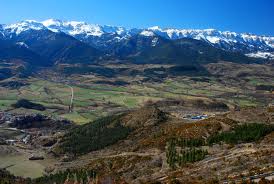
We left Barcelona after Christmas in cold and clear weather and arrived in Singapore in heat and humidity.  We had spent the holiday and New Year’s at the Hotel Boix in the mountains of La Cerdanya in the eastern region of the Pyrenees in northern Catalonia.  We had spent many weekends at the Hotel Boix during the summer and autumn.  The hotel was famous for its remote tranquility and Michelin starred restaurant.  We were always the only Americans there.

Spain had not been a happy time.  The uncertainty of where we would relocate, the merger, the lack of all of our household goods, our furniture, the boys’ toys, winter clothes, the false starts in London and Dusseldorf all lent to impermanence and deep discontent. Never good, our marriage was falling apart.  Singapore was perhaps the last place on the planet my wife wanted to be.  She felt trapped and expressed her unhappiness in extreme behavior that freighted the boys and terrified me.

Christmas was still in full swing when we arrived in Singapore.  The city was a blaze of lights.  Our boys were delighted driving through the walls of lights covering every building: Christmas amidst orchids and the red blossoms of Tamarind trees and native poinsettia.

I had made a trip to Singapore prior to our move, renting an apartment in a service hotel, anticipating a move to a permanent place.  We never left.  The Ascot, at the juncture of Scott and Orchard Roads—the heart of the city—was a high-end service hotel that catered to expats on their way to someplace else.  While not Spartan, it was nonetheless a hotel.  We had a kitchen, two bedrooms, a living room, a pool on the roof overlooking the lights of the city and a daily maid.  Our boys soon thought it was normal to have doormen, elevator men, a staff, twenty-four hour concierge, and a food court in the basement.

We enrolled David in the English Tanglin School.  It was closer, with a better reputation, than the American School. It proved to be a good choice, despite the bus ride each morning from downtown.  David arrived home a little ball of sweat in his Tanglin uniform.  Nevertheless his teachers were fine and the school itself was shady and outside the hustle of the city.  Sam was still at home.

The day before departing for Singapore I was told that my job had changed.  Instead of running an agency, I would be closing it.  Prior to my appointment, the local DDB office had already been merged with Needham.  Neither managing director would relinquish their respective roles.  Of course dual managing directors was doomed to failure.  Stephen Quinn, the DDB MD, left the agency, founding his own and against his contract taking most of his former clients.  I was told that Theresa Chan, the Needham MD, had decided to leave the agency and I was her replacement.

My first duty, on my first day, was to terminate the entire staff of fifty-five Singaporeans.  I was meant to meet the DDB Needham regional president, Alan Pilkington, who would support me in explaining the sorry situation.  He never showed.

The staff believed I was coming to turn around the fate of their seriously disrupted office.  Instead I was the ugly American who fired everyone.

In my entire career I’ve never known anyone who had to terminate an entire agency.  I was completely on my own.  Nothing had prepared me for this.  Unable to face the prospect of meeting individuality with each of the employees, none of whom I had ever met, I gathered the staff in our conference room and explained the situation trying as best I could to do this with empathy and compassion.  A decent severance package was in place contingent upon staying for three months to fulfill the terms of our client agreements.  Nevertheless by the next day half the staff was gone, including the CFO. I had no idea how much money the agency had and as it turned out nor did the regional CFO back in New York.  A young accountant from Ernst & Young was put in as the acting CFO.  He, too, knew nothing about the agency’s finances.  Together we would stay up to midnight studying the agency’s books, trying to figure out which clients owed us money, were our media commitments made, did we have enough money to pay out the severance.

My first month working in Singapore was worse than a joke. If I hadn’t lived it, I wouldn’t believe what happened.  Some of the drama was funny, some bewilderingly impossible.  I had been told we had one company car which was mine: a twelve-year-old green Mercedes-Benz.  The driver’s side door fell off the first time I used it.  But when my CFO investigated the books we discovered the agency owned more than ten cars.  I had no idea who had these. No one volunteered this information.  It was likely that many of the cars had departed with the ex-employees.  I spent a month searching car parks looking for matches to the license numbers we had on file.  Miraculously I located all but one.  This one I discovered was being used by an employee still at the agency. I remember Tang Eng Lock to this day.  More about Eng Lock and his car later.

On the morning of the mass terminations, our messenger, a young Malay with a limp, came to me and pleaded to keep the agency’s motorcycle in lieu of severance.  He had a family to maintain and said having a cycle was the only way he could be hired as a messenger somewhere else.  Of course I said yes.  How could I otherwise?  What I didn’t do was properly transfer the title resulting in a year’s worth of traffic tickets.  All the traffic lights in Singapore are monitored by video cameras, automatically issuing violations.  Apparently our messenger rarely stopped.

I had also been told the former MD would be around to help with the transition.  I had met her at a previous international conference.  She never appeared.  I had no idea where she was and assumed she was taking time off.  On my second day in the office I received a phone call from Theresa’s father, a senior government official.  He asked me who had decided to replace his daughter with me.  This wasn’t the story I had been told.  Barely holding back his contempt he told me Theresa had been fired.

With the office in shambles (all our video equipment, and even the bookcases flanking the front entrance, disappeared within the first few days) I had to go client by client and explain what was happening.  I remember one brunch during those early days at the Shangri-La Hotel with Alan Pilkington who nonchalantly claimed the closure would take maybe three weeks tops.  My wife, a corporate attorney, couldn’t believe this absurd assertion, and told him so.  In fact it took a year.

My first trip was to visit our client Swiss Air.  To say it was a frosty meeting would be an understatement. As I explained the departure of the former MD I was interrupted with the statement, “Don’t lie to us.  Theresa was at a Swiss Air marketing conference in Zurich when your Mr. Pilkington called to fire her then and there on the phone.  Please leave now.” Oh joy.

I remember these days as though they were yesterday.  I remember sitting in my office on the top floor of our building on Beach Road looking out over the Straights, local junks avoiding container ships from across South East Asia. And all day and night  F-16’s from the Singapore Air Force circled the tiny city-state in perpetual fear of an unlikely invasion by the Malaysians.  The office air conditioning was frigid, in contrast to the heat outside.  My office windows were tinted against glare which rendered the view as though at dusk.  I would wonder oh god where am I.  What am I doing here.  Where is my life going.  I was alone, out of touch, disconnected from reality.  My days at work were surreal.

Our office was adjacent to the old Chinese part of the city, its chophouses having narrowly escaped the wrecking balls that wiped out the rest of old Singapore. We were across the street from the then unrestored Raffles Hotel, whose fate was in the balance. It was a decayed relic of a lost time when Somerset Maugham lived there.  There were threadbare tiger rugs on the floor and tourists would come to drink their Singapore Slings on long tables outside in the garden.  Inside, its one restaurant still managed to serve its mid-day Tiffin Curry, a tame English version of what locals ate.

A month after my arrival I was notified by Singapore media that the agency owed more than $2 million to the government owned television network and print media.  We had barely the funds to meet our dwindling payroll.  Every client, without exception, refused to pay their bills, trumping up one excuse after another.  As the head of the agency I was told I was personally liable for the debt if not paid in four weeks.  I could be put in jail. I called our regional CFO who assured me I could access a $3 million line of credit at the Hong Kong-Shanghai Bank.  When I called at the bank I was told that the line of credit had been entirely used and the agency was in fact paying interest on it.  No one in New York knew this. The company wired funds to the media and the crisis was averted at the last minute.

All of our clients had to be sued to pay their bills.  These were for the most part major multinational companies.  With one exception they settled literally on the courtroom steps.  More unreality.

The exception was McDonald’s, the office’s largest client, the country’s biggest advertiser, and a major global client of the agency’s.  In Singapore, all the McDonald’s franchises were owned by a young and very rich man, Tommy Quan.  His father had bought him the first McDonald’s in the country and on its first day it instantly set the record for opening day sales.  Tommy then opened six more outlets, each setting similar sales records.  McDonald’s was phenomenally successful in Singapore.

To his lasting credit, Tommy and his wife befriended my family and me.  We would have dinner at his Hollywood caliber house, a house with no walls to the outside, surrounded by trees and water.  We would go out together.  They were lovely.  Tommy had an ulterior motive as it turned out, but one that had mutual attraction.  Rather than close the DDB Needham agency, he proposed that the agency buy the company of a friend of his.  In return he would give us his business.  This was an extremely attractive proposition.  New York agreed.  Tommy and I set about making the necessary arrangements.

Amazingly, my management in New York pulled out of the deal at the eleventh hour.  Without my knowledge they had been negotiating with the former DDB MD Stephen Quinn to buy his agency.  Only eight months before management had seriously considered suing Stephen for stealing clients. Now they were in bed with him.

Tommy was furious.  He knew I had been duped and vowed revenge.  Unknown to the regional management, Tommy’s first cousins owned all the McDonald’s franchises in Hong Kong and Taiwan. You can’t make this stuff up.  His cousins put the business in review with the eventual result DDB lost the accounts.  Tommy continued to be our friend and we corresponded for years afterward.  I wonder how he is now.

Our last days in Singapore continued, alternating between comedy and anxiety.  Our life back at the Ascot remained reasonably intact.  We had made friends with two families, one Chilean and one South African.  We spent a lot of time together.  I remember one trip we took with the Chileans to the beach on the China Sea in Malaysia. I wish I could remember their names.  We drove through rubber plantations. Monkeys ran everywhere across the roads.  The beach was so hot we couldn’t walk on the sand. Driving across the causeway separating Singapore from Malaysia was a trip from the 20th century to the 19th.  In each direction were signs saying Mandatory Death Sentence to Drug Traffickers.

My final drama in the office was getting Tang Eng Lock to return his car.  Every week was another excuse.  Finally I had to threaten police action.  On the day he was meant to return the car he called and told me I would never believe what happened.  He said a snake had fallen from a tree and slithered into the engine block. It would take weeks to repair.  I was furious and told him, “You may think I’m a stupid American but no fucking snake slithered into the fucking engine.  Get that car back here immediately.”  He did.

I still had two years on my international contract.  During my time in Singapore I had become friends with the former Needham regional president, an Australian from Melbourne.  He gave me safe passage.  We didn’t really want to move to Australia.  We thought it would be like the States in the 1950’s.  I made trips to Melbourne, once again renting a house and finding a school for the boys.  This was becoming all too familiar.  Flying from Singapore the plane crossed hours and hours of nothing but red desert. I flew alone, into the unknown.

I rented a fine house in Black Rock a block from the beach.  The house was owned by the captain of the recently won America’s Cup Race.  I enrolled our boys in Haileybury College.  Both decisions turned out to be the best I could have made.  We stayed more than three years. Australia wasn’t anything like we had imagined.  A degree of normalcy entered our lives.

Sandy Hits New York

It’s the morning after Hurricane Sandy hit New York and its surrounding areas.  The Jersey shore, Long Island and all city coastal areas have been badly affected.  All city mass transit is shut down and is in shambles.  The subways flooded causing long-term damage.  Only the Lincoln Tunnel is open, so with virtually no access into or out of Manhattan, it’s a surreal scene of empty streets.  A giant crane seventy-five stories up at a construction site on 57th Street snapped with a large portion dangerously dangling above the street, necessitating the evacuation of a few fancy hotels. More severely, NYU Medical Center lost power and had to move many very ill patients to other city hospitals. Miraculously everyone survived.  The Hebrew Home in Riverdale immediately took over two hundred patients.  Hundreds of tourists are on the streets wondering what to do or where to find an open restaurant.

I am unaffected in a hotel on 31st Street.  No Internet but that’s a very minor problem compared to thousands of others.  What we’re seeing here gives me pause thinking about what happened in Japan a year and a half ago.  Despite local tragedies here, there is no comparison.

Too often we indulge in self-inflicted negative thinking.  This or that is wrong with our lives; we’re in pain; we’re feeling victimized, unwanted and unloved. We believe we have no hope for a future filled with security and happiness.  I’ve been in this place.

W. G. Sebald wrote in a poem:

If you knew every cranny

of my heart

you would yet be ignorant

of the pain my happy

memories bring.

Then, we see true hardship inflicted on thousands and our own problems naturally pale.  These are moments in our lives.  The challenge is maintaining perspective.

Where do we find solace?  The perceived wisdom is to stay in the present.  Focus on today; do not regret or dwell in the past; don’t project future outcomes outside of our control.  For most of us this demands constant discipline.  Even those who practice meditation find such focus difficult.  I have a close friend who’s now in his third year at Tassajara, the Zen Buddhist monastery in the mountains beyond Carmel Valley. He says when thoughts come flying into your consciousness, think of them as tennis balls and gently lob them out of your head.  It’s a helpful metaphor.

Memory is a double-edged sword.  We choose to remember selectively from our mental libraries.  As much as we may try, we can never not remember.  Losing one’s memory is a tragic illness.  “What would we be without memory,” wrote the Marquis de Chateaubriand in his memoires.  He wrote this while remembering great unhappiness in his life.  I think we tend to remember painful times more than happy times.  Again, we may call this an act of will.  To regret the past is an addiction to misery.  I’ve suffered from this addition.  And I have realized that like all addictions, with commitment and the support of friends and family, this addiction, too, can be overcome.  Another act of action and will.

I’ve been thinking of times when I’ve been completely, absolutely happy.  Too often these times have been projected against a bittersweet background, but true and happy in themselves nevertheless.

My four years at Bowdoin were happy years.  I have happy memories of Ireland.  The birth of my three sons.  Seeing my sons prosper and grow.  Watching my son David become a father, the joy he experienced.  Falling in love for the first time, late though that came.  The pleasure literature has always given me.  Swimming.  The joys of travel.

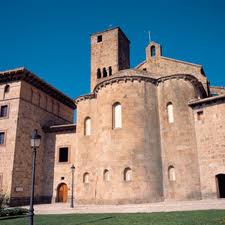
I wrote before of a pilgrimage I made to Roncesvalles in Spain.  It was a romantic idea, akin to visiting the Protestant Cemetery in Rome.  It was a very happy journey. I set out from Barcelona alone having enough time to stray from a direct route.  I stopped for a night in Zaragoza, the regional capital of Aragon; I visited the monastery of San Salvador de Leyre in northern Navarre, one of the most important religious sites in Spain, from 842.

I arrived in Roncesvalles in late afternoon.  The light was beginning to fade as I approached the ancient battlefield, now green and empty.  The low mountains beyond were already dark and misted.  I imagined the great battle there.  Charlemagne defeated in 778.  I had brought along a copy of La Chanson de Roland and read the scene in French when Roland was killed.  This all stood before me as an imagined memory—and seems silly now.

I stayed the night at a small local inn, where I was the only guest.  The proprietress eyed me suspiciously.  I ate alone in the dining room, which for some reason was cold and dark. There was no menu but course after course of wonderful local food was set down on the table.  I remember the waiter slicing thick cuts of jamon de serrano directly from the cured thigh. I had wild quail. It’s curious that I remember this.  It wasn’t an auspicious event.

It wasn’t an auspicious event but I’m a lucky man to have had it.  Many happy memories have no meaning at all beyond that they happened.  Some memories of time and place are heighted when we share them with someone we love.  I’ve had that experience with my sons, with a few friends and with the woman I loved:  Japan, London at night, Tassajara, Russian Hill. The deep regret Chateaubriand wrote of was born from memories of love lost.  Those happy memories are also lost, transformed to a different experience.  To paraphrase Heraclitus, the memory we remember is not the event we experienced.  It changes. It can change many times until it bears no resemblance to that original time.

The memory of this hurricane in New York will change soon enough.  Some memories stay with us forever. My memory of standing in the middle of 23rd Street on 9/11 watching the World Trade Center burn and collapse will never ever fade.  I remember being in a 5th grade math class when the announcement Kennedy had been assassinated was broadcast over the school’s PA system.  I can see the space shuttle Challenger exploding high in the sky on my TV.  Life events.

My grandfather fought in the trenches at Verdun and on rare occasions he was willing to talk about that experience.  He said he remembered it as though it happened yesterday.  He hated the memory.  His wife, my grandmother, remembered looking out at the black and unwelcoming sea when she crossed the Atlantic from Germany as a child to begin a new life with her family in America.

Maybe because they are far back in our pasts, early memories, though few, stand out more in significance.  I wonder what new memories I’ll collect in the years ahead.  How many more years will there be?  I joke with my boys that a bus could hit me at any time, though really it’s not about a bus.  It’s about the future.

It’s late afternoon here in New York and looking over to the West Side from my hotel there are no lights and almost no traffic.  Eerie.  The Korean restaurants on 32nd Street are packed being the only ones open. I wonder why they’re open and no others are?  Last night, when all of lower Manhattan was in darkness, and NYU Hospital was frantically evacuating patients to hospitals with power, the lights in the Goldman Sachs building were shining.  Should they ever know—which they won’t—I wonder if the 47% segment of the Republicans, which irrationally makes up the party’s base, sees any irony in this?  Or in the fact that Mitt Romney has said he will eliminate FEMA, when FEMA is needed so desperately.  Even Republican Governor Christie of storm ravaged New Jersey praised the President for eliminating FEMA”s red tape to provide aid quickly.  Aid he might never get if Romney becomes president.

New York will survive; the Jersey shore will be rebuilt.  There will be some who will remember what they lost in the storm, but most will forget.  It’s always the way.

October 30, 2012

Abroad: Part One

In the Fall of 1985, at the encouragement of my friend John Wren, then the finance director of Needham International, I put my name in the ring to accept a foreign assignment.  I wanted to be anywhere.  Going abroad was a sure route to advance more rapidly in the agency than remaining in New York, and the idea of expatriate life was appealing to both my wife and me. (Although later my wife would use our life overseas as a sharp criticism of her perceived loss of independence and ill-treatment at my hands.)

There were also more personal reasons to moving abroad than career advancement.  Traveling through Scotland and the Hebrides between my junior and senior years of college with a classmate friend had opened a window to the allure to being elsewhere, away from my family and its crushing mixture of disapproval, emotional dependency and cultural limitation.  Pittsburgh, with its history of industry and steel, and my father’s role in that world, was not a home I found either likable or the foundation to a future I wanted.  The private school I attended in Sewickley was a closed society of privilege and insolence in which I felt a visitor not a member.  My mother’s extreme behavior during Christmas holidays my freshman year in college, and her stifling, clinging behavior that resulted, only served to distance me further from any sense of home or familial security.

This culminated in my decision to pursue a graduate degree in literature outside the country, at Trinity College, Dublin.  I had written my senior thesis on Yeats and had all the images–and fantasies–of Anglo-Irish society and its romantic decline swimming in my head.  Not finding a flat near the college, I rented a nearly abandoned Georgian country house in Howth set in overgrown grounds above Dublin Bay, with the beam of Howth Lighthouse moving through my rooms with their curtain-less windows.  Very little furniture remained in the house and in a few of the twenty bedrooms the closets contained women’s clothes from the 1920’s.  I had no idea why these remained in the house or who had worn them.  That the entire situation was exactly what I wanted there wasn’t a doubt.  (The house had been built by John Jameson, of the whisky fame.) I felt distant and lonely and l liked it.  I read late into the night in front of the enormous fireplace which was the only source of heat and was the epitome of romantic isolation.  I longed, in fact, for real romance, but on the one occasion a possible girlfriend returned to Howth with me, the night ended in what I can only describe as failure and embarrassment. I remember her lovely Irish name and that experience (in too much detail) even today.

All those memories, and probably too many Henry James novels, formed the unspoken underpinnings of my active pursuit of an assignment outside the USA.

Advertising agencies rarely have an organizational policy of international training and rotation, unlike for example oil companies.  Assignments typically resulted from some crisis.  This was, in fact, my experience.  In December John, and his boss, the president of Needham International, John Bradstock (who would become my career-long mentor,) presented the opportunity to become the managing director of Needham’s agency in Barcelona.  The previous MD got embroiled in financial scandal.  An immediate change was necessary to stabilize the office and restore the confidence of clients.  I said yes to this assignment, not knowing then the drama that would unfold over the next five years.

I was needed in Barcelona immediately after Christmas.  My family could not move however, due to my wife being five months pregnant with our second child.  David, our first son, was not yet three at the time.  I made several trips to Spain alone, returning in early April a month before the expected birth.  Sam was born on April 23rd in Phelps Hospital in Tarrytown where we lived.

The morning after Sam’s birth, my wife’s younger sister arrived from Manhattan to see her new nephew, with a copy of that day’s New York Times with news that our lives were about to change.  The paper’s front page announced the creation of Omnicom, the first large communications holding company, formed by the global merger of Doyle Dane Bernbach, BBDO and Needham Harper and Steers.  This explained why, the day before, John Wren urgently called me to his office to sign my international agreement–an act for which I’m grateful to this day.

My new role, hardly begun, changed overnight. I was no longer stabilizing and growing a company.  I was negotiating on Needham’s behalf the merger in Spain.  There were no rules; it was the Wild West of corporate politics.  As a result of the holding company’s creation, senior leadership changed in all three agencies.  I no longer reported to John Bradstock, who was shifted to become the president of a new division of the company, Diversified Agency Services (DAS.)  John Wren went with him.  I now reported to John Bernbach, a man I had never met.  John was the charming though somewhat feckless son of the legendary Bill Bernbach, founder of DDB.  He was now president of DDB Needham International, having spent a large portion of his career in Paris and London.

Thanks to John Wren’s corporate generosity, and my lawyer wife’s skillful negotiation, my Needham contract protected me from reorganization and most likely termination along with my Needham role.  I returned to Spain for six weeks to begin the merger discussions, with my family moving in late June.  Although the company paid for daily help at home during these weeks away, I confess in hindsight that this wasn’t easy for my wife with a three year old and new born baby.

We moved into the large, empty apartment of the former managing director in an upper middle class neighborhood of Barcelona.  There were no other expats in that part of the city.  What furniture there consisted of left behind maids’ beds and several dozen what appeared to be ballroom chairs.  Most of these unceremoniously collapsed when sat on by an adult of any size.  The kitchen, having been designed solely for servants who shopped every day, had a nearly nonfunctional gas stove and cocktail size refrigerator.  There was a single unit washing machine/dryer that first scalded the laundry, then baked it.  Every item washed became two sizes smaller.  The kitchen windows looked out onto a back shaft that went the full height of the building, from which we could hear the other resident’s maids cleaning dinner dishes late into the night due to Spaniards’ late dining hours.  These kitchen arrangements became the source of tremendous marital discord, which badly colored not only the rest of our time away, but for the rest of our marriage.

Life in my office was similarly dysfunctional.  We simultaneously continued to service our clients and even–successfully–pitched new business, while I also met weekly with the management of the local BBDO and DDB offices, both larger than ours.  Another wrinkle at the time was that Needham was engaged in buying out the remaining shares of a local Catalan businessman.  This man, a banker with no experience or interest in advertising, became my savior and friend.  His name was Jose Gener and he had the looks of Cary Grant and an open-hearted generosity. He adopted my family as his own, to the extent that he even became my son Sam’s official godfather.  Jose enjoyed the role and delighted in the fact that as a nominal Catholic he stood in an Anglican church for Sam’s baptism.  He gave Sam the traditional Spanish (although he only and defiantly regarded himself as Catalan) godfather’s gift of a gold medallion engraved with Sam’s initials on a gold chain.  Thereafter he sent Sam a US Savings Bond on his birthday.

I’ll never forget my first client meeting in Spain.  It’s one of my favorite stories in my career in advertising.  We represented the country’s largest manufacturer of underwear: a line of men’s called Jim and women’s called Missy.  This client was located in the countryside  about an hour outside of Barcelona.  My first meeting with this client was scheduled to begin at 9:00am on a Monday morning in September.  As I possessed the only company car–a new red BWM 325i–we were all traveling together.  It was a large meeting involving both creative and media presentations. Five of us were attending.

I got to our office at 7:30 to be well prepared to leave by 8:00.  The office was dark and I was alone.  By ten minutes to 8:00 no one was yet there.  I was alarmed.  Around 8:00 my secretary arrived, seemingly unconcerned about the others’ absence.  I didn’t understand and asked her to call our client and tell them we would be late.  She said it wasn’t necessary, so in my bad Spanish I called and discovered the client’s receptionist spoke only Catalan.

Around 8:20 the others began to straggle in.  They, too, were unconcerned, telling me to relax.  I wasn’t relaxed.  We eventually set out at 9:00am, the time our meeting an hour away was to begin.  Only to humor me, our account guy phoned the client and reported our departure.  At least he said he did although probably didn’t.

My anxiety peaked when we arrived in the village–really just a crossroad–and my colleagues announced they had to have breakfast.  It was the 10:00.  I freaked and they said, well, go on ahead if I felt so concerned.  No way!  I had never met these clients and not only was my Spanish poor, my Catalan was nonexistent. We sat down in the only cafe where my workmates ordered the local staple, pan con tomat–thick cut toast rubbed with garlic and tomato–along with gulps of rough red wine poured directly down one’s throat from a long spouted leather wine cask.  Not to be prudish I, too, gave this a try and immediately spilled wine down the front of my suit.  Everyone thought this was hilarious.

At noon we finally walked into the client’s offices.  I had given up any hope of knowing what was going on.  I clearly wasn’t in New York anymore.

For the first half hour we had a spirited conversation about where to have lunch.  What type of food?  Which restaurant had the best of what we wanted?  That settled (open-pit grilled meat) , we proceeded with the business at hand for five hours.  “Lunch” began at 8:00pm.  I got home at midnight.  So much for a 9:00am client meeting!

There were compensations, too.  We lived in one of the most interesting cities in Europe–the home of Gaudi and Miro. We went everywhere.  During the late summer and early fall we spent many weekends on the Costa Brava at the wonderful Aiguablava Hotel on the rocky, pine-covered Mediterranean coast.  Later in the year we went several times deep into the mountainous La Cerdanya to stay at the Hotel Boix, which had a Michelin starred restaurant.  Once, to renew our visas in France, we drove over the Pyrenees, through Andorra, to stay in a tiny French spa town.  Hopes to have lunch in Andorra were foiled due to never finding a parking space in that miniature country.  The road over the mountains into France twisted and turned dramatically, resulting in David being sick in the car several times.  There was no place to pull off the road, making the situation worse.  By the time we arrived at the spa, my wife was not speaking to me.  David became ill during the night.  The spa doctor arrived, diagnosing an ear infection.  Together we drove through the deserted town to wake the pharmacist to get the necessary prescription.

During the time I was working in Barcelona before my family moved I made a trip to the northern part of Navarre to visit the ancient battlefield at Roncevalles.   This was the cite famous in history and legend for the defeat of Charlemagne and the death of Roland–giving us the French classic La Chanson de Roland–in 778.


Identifying my next assignment following Barcelona was a an exercise in random, often venal, corporate politics, monthly changes and at times humiliation.  Had I not had my family in tow, it would have been humorous–a roller coaster of false starts, set-backs, changing European management, and new and usually brief reporting structures.

My first destination was to be London.  John Bernbach had once run the office and in our only phone call he assured me that this would be a great place to work and move my family.

However, before the London arrangements were underway, I was summoned to Paris to meet with the President of DDB Europe, Pierre de Plas.  I had never met Pierre.  His office made the arrangements, booking me in to the Plaza Athenee.  I arrived for my meeting and Pierre kept me waiting two hours: offense #1.  Eventually he called me into office.  I felt like I had been ordered into Louis XVI’s private suite.

After thirty seconds of semi-pleasantries, Pierre picked up the phone, dialed a number, and said to whomever was on the other end (I didn’t know), “I have this American who’s been in Barcelona and was supposed to move to our London office but isn’t now, could you use him? No?  Thanks.”  Then he dialed another number, went through the dialogue, with the same result.”  I asked him what he was doing, and he said he was calling the managing directors of DDB in a few other European offices.  When I told him John Bernbach had already decided I would go to London, Pierre replied, “Oh yes, I know.  I was hoping to find an office that actually wants you.”

Every week for over the next two months I went to London to sort out office and living arrangements, never exactly sure what my job was to be.  Shortly before my arrival the London offices of DDB and Needham had been merged.  It was an unhappy and contentious merger.  DDB regarded itself, accurately, as a premier creative agency.  Needham London on the other hand regarded itself, accurately, as the more financially successful office.  This was a culture clash–played out across both global networks–in the extreme.  My snobbish French pal Pierre characterized the London merger to the press as a merger between “gentleman” and “plumbers.”  So much for a warm welcome at the DDB offices on Baker Street.  I was viewed as a mixture of a home office spy, a Needham interluder and maybe worst of all, an American hillbilly.  They were universally rude and I had not one friend there.

Critical to the transfer was finding someplace to live and a school for my son David.  The agency provided me with a car and driver and together we would drive around the London countryside looking for an unfurnished house to rent.  All of our household goods and furniture had been shipped to London, waiting in a warehouse.  ( Our goods hadn’t been moved to Barcelona since my tenure there was uncertain.This also proved to be source of family unhappiness.)

We spent weeks looking for a house.  My driver was a cheerful and friendly guy, and together we would eat lunch in pubs and sometimes even dinners.  I was away from the office entire days.  Later I found out that the office had paid the driver never to bring me back. Nevertheless we eventually found an appropriate house in the charmingly named village of Chalfont Saint Giles.  I obtained the required residency permits, found a school for David, obtained a car, and prepared the family to move.

We never moved to London. The day before we were ready to set out, my soon to be boss in London phoned me to say he had just been fired and I no longer had an office sponsor and wouldn’t be transferring to the London office.  I called my mentor back in New York John Bradstock and asked him what he knew of this situation and what was I supposed to do.  I no longer reported to John but he always knew everything going on and was well connected to Keith Reinhard, the former Needham CEO who became the CEO of the new DDB Needham agency.  John was a man of no fuss and few words.  He simply said, “I’ll get back to you.”  He called the next day and asked how long could I remain in Spain.  I answered as long as necessary, assuming I was still employed!  He assured me I was and we then remained in Barcelona another seven months–without our furniture, toys for the boys, or winter clothes.  The new CFO of the international division in New York took pity on us and wired enough money to outfit the family for the cold winter months.

A few weeks later, I got a call from a man who said, “My name is Nicolai von Dellingshausen, do you know who I am?”  Not skipping a breath, “Baron Nicolai von Dellingshausen! “ as though that would clarify it.  I had never heard of him.  “I’m Chairman of DDB Europe and I’m coming to Barcelona tomorrow. Who gave you permission to merge the agencies in Spain?”  Permission?  How about everyone.

Once again I called John Bradstock.  He said, “Humor him.  His role’s changing.”

Nicolai arrived and was charming. He immediately decided I would come to work directly for him in Dusseldorf.  When I pointed out I didn’t speak German he assured me that wasn’t a problem, all the clients spoke English.  So once again we prepared for another move.  My wife was reasonably happy since she had majored in German in college and spoke German, as well as her mother having been born in Germany.

We never moved to Dusseldorf.  On the eve of moving I received another unexpected call: “My name is Alan Pilkington, do you know who I am?”  Here we go again!  I said no I didn’t know he was.  “Im President of DDB Asia-Pacific.  We need you in New York tomorrow.”  When I asked why he told me I was not going on to Germany but instead I was being sent to be managing director of the agency in Singapore.  All along my remaining staff in the Barcelona office joked that at least I wasn’t been sent to China.  Well, now I was on my way to South East Asia–close enough.
 

Too Far

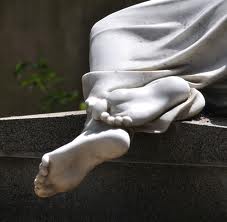
“I’d like to see the Protestant Cemetery,” Tom said.  “Keats is buried there.  And Shelley’s heart.”

“People don’t come to Rome to see a Protestant cemetery,” Sarah said.  “It’s a waste of time when there’s so much else to see.  It’s an indulgence.”

Tom and Sarah sat in the small green room, the room the Dutch nuns gave them in the pensione on the Piazza Navona.  They had been married a year. They couldn’t see the Bernini fountains from their room. Out their one window all they could see were the many angles of the rooftops at the back of the cathedral.  Still, it was a Roman view and the room was cool in the late afternoon light.

“But I’d like to see it anyway.  It’s just as historical as anything else.  These people came to Italy to experience life, to write, to love, and they died here.  We could visit the room above the Spanish Steps where Keats died of TB.”

“Who would want to see that?  You’re morbid.  It’s just an act, too, to make me feel less sensitive than you,” Sarah said.  “I don’t care.”

“But I think you are sensitive, Sarah,” Tom said.

“Please don’t start this.  I don’t want to go to the Protestant Cemetery.  Not today.”

“We could walk there,” Tom said.  “It’s too far away,” Sarah said.  “How do you know?”  Tom said.

“I know you didn’t look at a map,” Sarah said.  “You just think we could walk there to get me to go.  I don’t want to go.”

“If we could walk there right now, would you go?   The guidebook says it’s beautiful.  We could walk there before dinner,” Tom said.

“You think anything that’s sad is beautiful.  That’s your problem.  Sad isn’t beautiful.  It’s nothing.”

“I think it would take less than an hour to walk there,” Tom said.  ‘It’s next to the Aurelian Wall.  I see it on the map.”

“You won’t shut up unless we go, will you,” Sarah said.  She looked out the window at the terracotta roof tiles and sighed.  She hated Tom when he got all dreamy over something like a cemetery.

“You might like it,” Tom said.

“There’s nothing to like.  It’s a cemetery.  You know I hate Romantic poetry.   I’ll go if you just keep your thoughts to yourself once we get there.  I don’t want to hear anything about Keats or Shelley or anyone else who was foolish enough to leave home and die in Italy.”

The late afternoon sun was still warm.  In the Piazza a few tourists wandered around, some hand in hand, others in small groups looking in earnest at the architecture.  An elderly man had set up his easel, painting the center fountain.

“Look how cloudy the sky is,” Sarah said.  “It’s going to rain.”

“I don’t think so.  Not yet.  Not until later this evening.  We’ll be back at the pensione by the time it might rain.”

Tom and Sarah walked in silence.  The gray sky turned cloudy.  Tom set the pace, which was faster than Sarah liked.  Tom was afraid they might not make it in time.

“I don’t want to go if we have to run to get there,” Sarah said.  “I don’t want to go at all.  I don’t think you know where it is.”

“I do know.  I checked the map.  We just keep going in this direction until we get to the pyramid, the one built by Caius Cestius.  It’s his tomb.”

“Oh God,” Sarah said.  “I don’t want to see a tomb, then a cemetery.  This is too much.”

Tom led the way along the Tiber.  They met few other people on the sidewalk.  Now and then a cat cut in front of them, seemingly from nowhere.  Tom hoped they wouldn’t meet a black one.

“We’ve been walking for nearly an hour.  Where is it?  You’re lost.”

“I’m not lost.  It’s farther than I thought.”

“Everything is farther than you thought,” Sarah said.  “It’s raining, too.  I hate you.  You’re an idiot.”

“It’s just a little further.  Please don’t say you hate me.  I want to see this with you.”

“You’re entire life is like this.  I should have known.  I did know.  I’ve always known. But to stop the whining I agreed to come, thinking maybe for once in your sorry life you knew what you were talking about.  Of course you didn’t.  I should have known.  I never should have married you.  It was a mistake.  I knew it.  Walking to this cemetery is a mistake.”

“Get that taxi.  I’m not walking another step in this rain, “ Sarah said.  “ You’re hopeless.  I don’t know why I married you. I hate you. I didn’t want to marry you.  I only felt sorry for you.”

“Don’t say that, Sarah.  I love you.”

“No you don’t or you wouldn’t be dragging me to a cemetery in the rain.  It’s too far away.  You can’t even read a map.  Tell me the truth; you didn’t even look at a map, did you?”

” I did look at the map.  It didn’t seem so far away.  I’m sorry.”

“You’re always sorry.  That’s your problem.  You shouldn’t be reading Romantic poets anyway.  They cloud your mind, what little there is.  I bet you don’t understand Shelley anyway.”

“Yes, I do.  I love Shelley.  He drowned in the Gulf of Spezia and his friends burned his body on the beach.  They brought his heart back to Rome and buried it in the Protestant Cemetery.”

“You would know something like that,” Sarah said.  “Please get that taxi.  I’m not walking in the rain.”

Tom flagged the taxi and managed to ask to be taken to the Protestant Cemetery.  He knew little Italian.  They drove in silence.   “See, it’s much further away than you thought,” Sarah said.  Tom looked out the windows of the taxi, looked at the streets passing in the light rain.  The afternoon light was fading.  “I have no idea where I am,” Tom thought.  “Why am I even alive? “  Then he saw the pyramid.

“Look, there’s the pyramid, the tomb of Caius Cestius,” Tom said.  “The cemetery is just ahead.”

The taxi stopped near the entrance.  Tall pines and Cyprus enclosed the cemetery beneath the high ancient walls.   The gates were shut and locked.  “The cemetery is closed,” Sarah said.  Tom looked through the gates.  He couldn’t speak.  The tombs and gravestones stood in silence in the misty rain.  No one was there.

“We should leave,” Sarah said.  ““Tell the driver to take us back to the Piazza Navona.”   She looked out of the window of the taxi, rain sliding down the windows.  She saw the moss on the headstones, the locked caretaker’s lodge, the walls, the trees, the darkening light.  She knew their marriage was over.

Tom explained as best he could where they wanted to go.  They didn’t speak.  The air was cool and moist in the taxi as they pulled away from the cemetery.  Tom watched the gates of the cemetery recede into the evening mist until he couldn’t see them at all.

Tom started to cry.  He couldn’t stop the tears from flowing.  The world closed its arms around him.  Tears ran down his face, blurring his vision.  His heart hurt, as cut from his body as Shelley’s had been.

“It’s okay,” Sarah said.  “We’ll come another time.”

Still the tears streamed down Tom’s face.  He couldn’t stop crying.  He couldn’t speak.  The taxi drove on and on through the wet Roman streets.  Tom heard nothing.  He couldn’t look at Sarah.  They arrived and he paid the fare and silently they climbed the stairs to their room.  Tom sat down on the edge of the bed, still crying.  His desolation was absolute.  No other reality existed for him.

“Please don’t cry,” Sarah said.  “It was too far away.  We could never have made it.”

Tom continued to cry.  He couldn’t stop. The tears had no meaning to him beyond the despair in his heart. He knew everything was wrong.  His life, his marriage, his hopes…all wrong.

“Tom, please.  Let’s go have dinner. ”  Tom nodded.  He tried to stop crying.  He knew this life was over, the past was past and there would be no future.

“Let’s go,” he said.

Happiness

Is happiness overrated?  Is it a state of mind, or a just moment in time, caught on the wing and held close only for a minute or so?  Wikipedia calls happiness a fuzzy concept, a mental or emotional state of well-being characterized by positive or pleasant emotions ranging from contentment to intense joy.

My son Sam is a happy man.  He was born happy– a sunny, smiling boy.  He has the personality of a ray of sunshine.  I’ve seen him angry and disappointed on very few occasions and those emotions evaporate quickly.  My wife contends that unlike his brothers’, Sam’s delivery was so easy and effortless–one push and out he popped–that the trauma-free experience set his attitude for life.  Could be.

My own birth occurred nearly two months early by Caesarian section.  My idea of happiness has been equally thwarted.  Some people remember all of their happy times; others dwell on unhappiness.  When real unhappy events take place, they loom large.  All our behavior is set against these moments of despair.  My therapist calls this behavior making the best choices off a bad menu.

My sons have given me all the happiness I may ever need.  It’s deep, personal, joyful happiness.  It will last forever.

But is this the only happiness I’ll ever know?  Is being in love happiness?

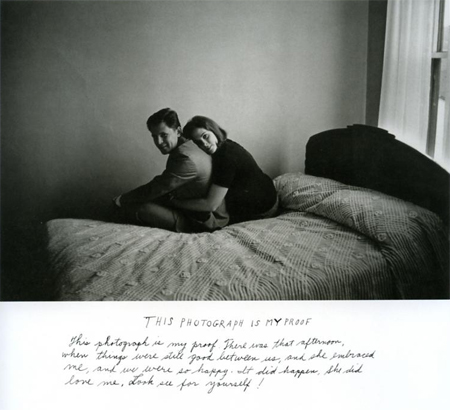
The photographer Duane Michals has a picture of a happy couple with these words beneath:

 This photograph is my proof. There was that afternoon, when things were still good between us, and she embraced me, and we were so happy. It did happen, she did love me. Look see for yourself!

 I had happiness that comes from love once.  It happened and then it was gone.  Disbelief devolved into abject misery.  Memories of happiness were too painful even to conjure up.  She asked me if it would have been better never to have had this joy in my life…and my answer was yes, it would have been better never to have met her.  It’s like asking a dying soldier whether he would have wanted to forego the joy of battle.

I’ve realized since that time that happiness may not be the goal.  Maybe serenity is.  Yet the loss of that human touch, the warmth of two lovers together, is irreplaceable.

 “But in contentment I still feel

The need of some imperishable bliss.”

 Now, the issue with happiness is that when you think too much about it, you inevitably question whether you were happy or not.  Was I really happy?  Will my joy last?  Happiness is in the experience.  Don’t dwell in it.  Live it.  Savor it.  Let it go.  William Blake said it best:

He who binds to himself a joy

Does the winged life destroy;

But he who kisses the joy as it flies

Lives in eternity’s sun rise.

Needless Disagreeableness

Why is it that human nature has to be disagreeable?  I’m hardly the first to ask this.  I read recently in the Harvard Business Review that cooperative, collaborative men typically earn 20% less than aggressive, combative men. (This was not so for women.)

In San Francisco we rarely see political advertising.  What’s the point?  Neither party needs to advertise because the outcome is a foregone conclusion.  On the other hand, here in Northern Wisconsin where I’m spending the weekend, every ad is a political ad, primarily Republican, all viscously attacking the opponents with no foundation in fact or party position.

Too many marriages devolve into the heartlands of disagreeableness.

I’m thinking however about the disagreeableness that plays out within companies, even within small working teams.  I experience this daily.  One would think that cooperation, patience, common goals, tolerance, realities and shared competency would advance the team effort, making achievement the objective.  Instead, it’s all adversity, territorialism, unreality, aversion to criticism, rudeness and lack of collaboration.  It’s one step ahead, two steps back.  We succeed in spite of ourselves.

Is it unrealistic to expect otherwise?  Given the evidence, it’s a lot to expect, probably futile.  Would outcomes be better?  At minimum, tension would be lowered, relationships improved.

The challenge within advertising agencies is even greater, given the diverse roles and often different, sometimes opposing objectives of all the parties.  Creative people want standout advertising based on personal talents and beliefs; planners want work that supports consumer attitudes and behavior; account people want to keep the process on track and the clients happy.  When these coalesce, the best results for everyone can be expected.  The road’s much bumpier when disagreeableness prevails.

Nothing spikes the drama like a television production.  There are high expectations, multiple parties, a lot of money, tight schedules and subjectivity.  Inevitably someone is disappointed.

The drama begins when a chaotic agency meets a chaotic client.  Every day is painful.  Internally and externally, tensions run high, everyone’s unhappy, frustrated and stressed.  Because there is no collaboration, expectations run higher than warranted. Spitefulness overtakes reality.  Unnecessary arguments replace shared solutions.  Compromise is impossible.  Everyone feels wounded, worn out.

The sorry outcome is that the work suffers.  People leave the team.  Agencies lose clients.

When disagreeableness and chaos exist on the client’s side, the only way an agency can effectively manage the situation is with superb organization, consistent behavior, united positions, logic and superior talent.

Often personalities are so set that there can be no other path than discord.  Personal territory is so precarious that its defense is inevitable. Skills and competency may vary to a degree that makes collaboration a daily headache.  When this is the case, one can fight; one can disengage; or one can leave.

Am I a Pollyanna to think there’s a remedy?  It has to begin with keeping one’s own side of the street clean.  Every time there’s an opportunity for a zinger (thanks Mr. Romney for making zingers a national sport) repeat the mantra: Does it have to be said?  Does it have to be said now?  Does it have to be said by me?  The answer is nearly always No.

I’ll try harder.

On the Russian River

Early morning fog rising though the redwoods on the Russian River.  Twenty-four guys in tents.  Only Thomas is up, preparing breakfast for the group.  We’re amazingly lucky that Thomas, a professional chef and restaurant owner, is along on the trip. He’s dicing potatoes and onions, frying bacon over the coals, slicing mango, whipping eggs, grilling sourdough bread.

It’s still early and some of the guys are sitting at the river’s edge, meditating.  It’s silent.  The morning’s calm and peaceful.  Krishnan rebuilds the fire from the night before; the day begins.

This is a fellowship of men with a common purpose.  Men who have come together from different life journeys.  Each will return to their own paths, connected by bonds of friendship and support.  Some of us are wounded; some are strong.  Some quiet; others full of jokes.  All of us have possibilities yet to be seen.

What does it mean to be part of a group–this group of men here on the Russian River, spending the weekend together for the third time in as many years?  The composition has changed a bit each year, but it’s the same group, enjoying the same fellowship.  Our time together is precious.  It’s larger than each of us on own own.  We sit around a campfire and tell stories, stories about ourselves, our secrets and pain, happy times, passions, our hopes, fears and dreams.

It’s early evening on the river.  Steelheads jump, flashing their silver bodies for just a moment, caught in the corner of my eye.  Dan casts his line into the cold dark water, slowing pulling in the line, a few tiny nibbles bobbing the fly.  Mike and Patrick try their hand.  No one catches anything, but that’s okay.  It’s a moment out of our everyday lives as the light fades into near darkness.  This is serenity–what we ask for and rarely experience.  The weekend is serene.  We don’t want to change anything.

Shall our blood fail?  Or shall it come to be

The blood of paradise?  And shall the earth

Seem all of paradise that we shall know?

The sky will be much friendlier then than now,

A part of labor and a part of pain,

And next in glory to enduring love,
Not this dividing and indifferent blue.

Wallace Stevens, Sunday Morning

The night air is cold.  I put on all my layers.  Tommy is roasting marshmallows, making s’mores.  He constructed a six-piece stick to move dessert along.  We’re twelve years old again.  It’s summer camp in the Adirondacks.  Everyone laughs–our jokes maybe a little more off color than years ago.  Our mood settles down, grows quieter.  More stories unfold.  Facing the fire we’re warm and glowing; behind it’s cold and dark.  There are stars in the sky, never seen in the city.  We listen and learn things about each other we never knew.  We grow closer.

Night ends and each of us make our way back to our tents.  No one stays up.  We’re not a rowdy bunch.

I’ve looked forward to this camping trip for a year.  It’s been a year since our last one.  At the last minute we had to scramble to find an alternative site, our booked accommodation having given up our space to a reggae festival. –of all events!  Rob called around and found the perfect campground, only a few miles away.  More perfect than Guerneville.  No panic; everyone found their way to Duncans Mills.  The weekend was more than saved.

I want to hold this time for another year.  Longer if I can.  There’ll be bumps and setbacks and many crossroads along the way.  But I want this time of fellowship to hold true, stay close to me.  I want to be reminded that this kind of peace and happiness is real.  It really does exist.  Is it bigger than my heartbreak?  When I was suffering at the beginning, I asked my therapist if the pain would ever go away.  He answered, “No.  But you will grow bigger.”

This is bigger.  Being with these guys, finding friendship and connection around the fire, walking in the redwood forests, knowing the river is flowing behind us, is bliss.  It’s bigger than I am, than any of us.

Sunday morning we have another stupendous breakfast, break camp, head home to San Francisco and the lives we left only two days ago.  I traveled up and back with Darren, as I’ve done the past two years. It seems to have become a tradition and we vow to repeat the ride again next year.  We talk about how grateful we are to be part of this group of men, to have had this weekend all together.

I can’t predict where I’ll be in a year.  It’s hard enough to predict tomorrow.  Maybe I’ll be lucky and make it.  I hope so.  I could be run over by a bus.  It happens in San Francisco!  I’ve flown over three million miles–two million on American alone, earning upgrades for life–and I wonder on which flight my number will be up.  I’ve had some close calls.  It’s not a thought that frightens me.  I’ve experienced worse.

Thank you guys for being there, helping me find this happiness.  I hope I’ve helped, too.  See you Wednesday.

The Land of Might-Have-Been

There’s a song by Ivor Novello called “The Land of Might-Have- Been.”  It begins:

Somewhere there’s another land

Different from the world below,

Far more mercifully planned

Than the cruel place we know.

Innocence and peace are there—

All is good that is desired.

Faces there are always fair;

Love grows never old nor tired.

Life has many might-have-beens, what-ifs, left turns and right turns, regrets, promises kept and promises broken.  There’s wisdom gained in hindsight that’s so often cold comfort for opportunities lost.  If we’re lucky we learn and move on.  Sometimes we get mired in painful nostalgia. It’s the human condition. It’s what pays the salaries of therapists.

When we’re able to take all our might-have-beens and call them milestones we gain a new freedom.  I’m reminded of a watercolor teacher who would say when my picture was hopelessly muddled, “I think it’s time to start a new one.”  When I declared a watery mistake, she would say, “No, it’s a new direction.”

Oh were love as simple as this!


We shall never find that lovely

Land of might-have-been.

I can never be your king nor

You can be my queen.

Days may pass and years may pass

And seas may lie between—

Shall we ever find that lovely

Land of might-have-been?


Where I find relief from all the might-have-beens is in friends and my sons.  My boys are all the joy I hope to have in my life.  Relationships that brought me happiness for a time, ended.  Friends endure, too.  It’s a deep pleasure having friends that go back more than thirty years.  And new friends point to an enriched and enlarged future.  I don’t seek the attainment of any personal legend outside of these truths.

I’ve spent the past month away from home, working with colleagues who are friends, staying with David and Sam, seeing my grandson Max, spending weekends with my longest-time friends, meeting many new people, traveling to old haunts and new territory.  I’ve been in Manhattan, the Upper Hudson Valley, Boston and its North Shore, and Vermont.  It’s been a month of richness for which I’m very grateful.  I’m a lucky guy.

What I find in fellowship is a power—a life force—that’s greater than myself alone.  I find this, too, in all the natural world: mountains and summer meadows, the sea, the rocky coasts of Maine, the sun yellowed hills of Northern California.  What we know the best we grow to love.  Once, when Adam and I were skiing in Zermatt, high in the Alps under the shadow of the Matterhorn, we looked out across the stupendous white vista and Adam remarked, “It’s not as beautiful as Camp Dudley,” situated on its quiet peninsula between the Adirondacks to the West and looking across Lake Champlain to the White Mountains of Vermont on the East.  It’s one kind of heaven.

I have my own heavens, grounded on the Earth, in the here and now.  Bowdoin College in Maine, where I’ve asked to have my ashes scattered under the Pines.  Tassajara, where I once found an unknown happiness.  Midwood, where hospitality, grace and friendship reside.  Howth, where I lived for a year on the edge of Dublin Bay, alone, in a large old Georgian house.  The jagged top of Montserrat.  The Victorian countryside.  The country roads out of Sewickley in Western Pennsylvania where my teenage friends and I learned to drive fast and formed bonds for life.


II

Why should she give her bounty to the dead?

What is divinity if it can come

Only in silent shadows and dreams?

Shall she not find in comforts of the sun,

In pungent fruit and bright, green wings, or else

In any balm or beauty of the earth,

Things to be cherished like the thought of heaven?

Wallace Stevens, Sunday Morning


I’ve always separated work from what I’ve regarded as “real life.”  This has been a mistake.  The problem was all the might-have-beens, those what-ifs.  What if I had become a college English professor, as was once my dream?  What if I had never gone to business school?  What if I had never taken up a career in advertising?  What if I had never moved abroad? What if I had never married my college sweetheart?  What if I had never risked love?

Yet, everything I have, everything I know, everything that makes me the man I am, is the result of what I did in the face of all these what-ifs.  I made choices, many of which I regretted.  But that, too, is a mistake in perception.  All pleasure and all pain came from those choices.  My sons came from a fateful choice that when viewed from that result can only be seen as the best choice in my life, regardless of other personal consequences.  My decision to take a left turn and pursue a career in business instead of teaching gave me an international life I would never otherwise have had, working and living in Spain, Singapore, Australia, France, Japan and traveling everywhere in between.  Advertising has provided friendships and exposure to a wide variety of industries, brands, consumers and creativity. (It’s also helped to develop forbearance and fortitude in the face of instability, setbacks and wacko personalities.)  Had I never risked the lightening bolt of love I would never have known what true love is; nor true heartbreak.  All pleasure and all pain.

This is beginning to feel like an obituary.  My friend Roz Savage, the ocean rower, tells a story of how she took stock of her life and made a decision to change it.  Out of Oxford, and working unfulfilled as a management consultant in London, she sat down and wrote two obituaries: one based on the life she was living and one based on the life she dreamed of.  She chose her dream and changed everything.

Change comes from choice and circumstances.  Sometimes life tosses us an unexpected curve ball and we are forced to make choices.  Sometimes we chose our dreams, as Roz did.  Sometimes we make choices that we know, in our hearts, will only lead to grief—but we make them anyway.  Sometimes we plan our choices.  Sometimes we trust what fate brings.  There are no guarantees.

Choice can be hard and it can be light and free. If I focus on today—doing the best I can just today, one day at a time—I can free myself from worrying about outcomes and all the might-have-beens.  It’s a worthy goal.