The Promise of Happiness


Stendhal wrote, “ Beauty is the promise of happiness.”  The promise of happiness…

Don’t we all want the promise of happiness?  Stendhal is talking about love and the beauty of women. There’s irony in his definition: love is but a promise.  A beautiful woman is but a promise.  Not happiness to be achieved, but promised.  It’s the carrot always just ahead of us.

url

I think everyone has a symbol of their promise of happiness.  It might be a beautiful woman, or handsome man.  It might be a place, a time, a job.  It’s in the future of our lives.  It’s what we want, what we hope for.  I wonder if it’s always out of reach, always a promise?

What’s mine?  I was asked that question once, not so long ago. It was the only time anyone ever asked me what did I want in my life, what would make me happy.  I had a ready answer, one that just entered my head at that very moment.  I hadn’t thought about this answer before.  I couldn’t have. It came from deep within my subconscious, the yearning for something I never had.  It was my promise of happiness.   I wanted the asker to be the answer.  On that day I thought what I asked for was possible.  It wasn’t. It never could be.

imgres


I wouldn’t answer the question in the same way today, regardless who asked it.   Experience since then has taught me lessons I hadn’t expected.  Life lessons. The epiphany I experienced on the ice in Lapland erased that earlier promise of happiness.  It just lifted away, leaving me so much lighter and freer.  My heart beats in a different way today. I’m clearer about where I am in the world and what I need—and want– in my life.  I don’t need anything more than I have.  I don’t want anything more. I’ve wondered, though, that if encased within this insight there’s not some resignation or regret.  Did I give up on ever achieving the promise of happiness I once sought?  I don’t know the answer. It’s very hard to understand one’s own heart.  All I know is that I’m no longer burdened with seeking that promise of happiness.  And that’s a relief.

This is part of a big shift I feel all around me. I don’t think I’m doing anything differently, but outside the world is shifting and I’m shifting with it. It’s all good—the creation of a future that doesn’t exist today; happiness that might not be a promise, but the thing itself.

I’m returning home to San Francisco on Saturday, having spent five weeks in New York.  It’s been a long time away.  Work has been the reason; family, many friends, culture, museums, food, restaurants, books, music, Shakespeare, grace and beauty on the Hudson, Science Night at the Bank Street School, The Alice Prize, Boston and Minneapolis, have been the benefits.  The weeks have been rich with life. Everything connects.

imgres-1

I’ve realized how small things can fill holes I used to see as unable to be ever filled.  Last Sunday I worked all day in our office, pulling together the final pieces of a business pitch to retain our agency’s largest client.  Despite having wonderful creative ideas and campaigns, incumbent agencies are rarely successful. [We were successful.]   I left the office, heading back to my hotel room feeling isolated and, for the first time on the trip, lonely. But then I stopped halfway to the subway and said to myself, no!  I can fix this.

I walked up Broadway to Astor Place and over to East 9th Street.  Sunday was the first evening of Daylight Savings Time.  At 8:00pm the sky was still silver and clear.  The cold March night air had the first hints of Spring.  I went into St. Marks Bookstore, browsed for nearly an hour, bought a magazine to read at dinner, and walked a little further down the street to Soba-ya, a favorite restaurant that never fails to delight me with its food, its traditional Japanese style and manner, and the happy memories I have of all the times I’ve been there before.  When Sam was a junior at New York University, I was taking two semesters of watercolor painting classes at Cooper Union, only two blocks from Sam’s dorm.  Both are close to Soba-ya.  Sam and I would meet there every week for dinner.  A few times Adam came to the city and joined us.  On one especially happy occasion, a work colleague, and friend, from Vienna came with the three of us.  We had the best time, despite the difference in all our ages.  Sam and Alex even went out to a club afterwards.  Remembering that evening makes me smile, and I remember it every time I step into Soba-ya.

imgres-2

Sunday evening was no exception.  Even though I was by myself, being in the crowded restaurant, having my favorite foods, watching the skillful Japanese woman behind the bar prepare the drinks and dishes, any thought of loneliness disappeared.  I walked back to Herald Square with a renewed outlook; happy to be alive, happy to have had the life I’ve lived.  Simple, renewable, pleasures that endure long after some bigger ones fade.

The promise of happiness.

No Explanation Needed


If you can’t understand it without an explanation, you can’t understand it with an explanation.  1Q84

My son David tells me that math explains everything. He’s a math and science teacher and knows much more than I do about the elegance of mathematics.  Without equations, though, understanding our own universe is often beyond words and sentences.  Explanations don’t come wrapped in gift boxes marked Life, Love, Sickness, Joy, Death.

In 1Q84 a remote and near silent father responds with the statement quoted above to his son’s questions about whether his mother was in love with another man, and whether that other man was in fact his real father.  If you can’t understand it without an explanation, you can’t understand it with an explanation.

I have many questions I’d like to ask my own father, but I don’t.  Maybe I don’t want to know the answers. “Why did you walk out of the house when my mother shot herself?  I was only nineteen.  Why did you leave me with her?”  “Why did you never tell me why you left our lives?”  “Why didn’t you come to my wedding?  My college graduation?”  “Why do you love your step-grand-children more than my sons?”

If you can’t understand it without an explanation, you can’t understand it with an explanation

My father’s an old man now.  He’s eighty-six and lives in Alabama.  He’s in good health, yet I know he’s slowing down.  What would I gain by asking him these questions?  Maybe he’s forgotten the answers.  Maybe he never knew them.  What would I learn with an explanation that I don’t already know without one?

But…there’s much that’s happy and joyful that we know without an explanation!  Music, a sunset over the Pacific, the very first leaves to fall in late August in New England, a star filled sky.  Who can listen to Die Forelle and not be happy? We all have our own experience of happiness.

I tend to associate my own moments of intense inner joy with quiet times, often when by myself.  I remember a walk I used to take when I was in college in Maine.  I called it The Transcendental Trek, and it went through the woods from Small Point to the far southern edge of Popham Beach.  I’ve walked the route in all four seasons.  Cresting the top of the final hill, with the Atlantic spread out in the distance, never failed to make my heart beat just a little faster—the ocean blue in the summer, steel grey in the winter, always with white caps breaking on to the beach.

imgres-3

Another time in Spain I rode the funicular to the summit of Montserrat near Barcelona and hiked well out across the jagged peaks.  No one else was there.  Freedom was what I saw.  No explanation required. (Another time I unwisely took my family there, Sam still in a stroller, and the trip was a disaster.)

imgres

Experiencing the lives of my boys, their births, their first small steps, their delights and laughter and so much more, have given me an immeasurably rich storehouse of happiness.  I can see the sunshine sparkle on Sam’s golden childhood hair, David standing for a saxophone solo in his high school jazz band, Adam playing the piano in our darkened living room when I felt dejected and low myself.  He brought light into that darkness.  I wonder if he knows that, since there’s never been an explanation.

I’ve already described elsewhere the transformative experience I had snowshoeing across the Arctic fells in Lapland.  I can’t explain what happened; it just did.

Falling in love has no explanation, while falling out of love might.  I hope it does, because mystery and misery are a bad combination.

vandyck13

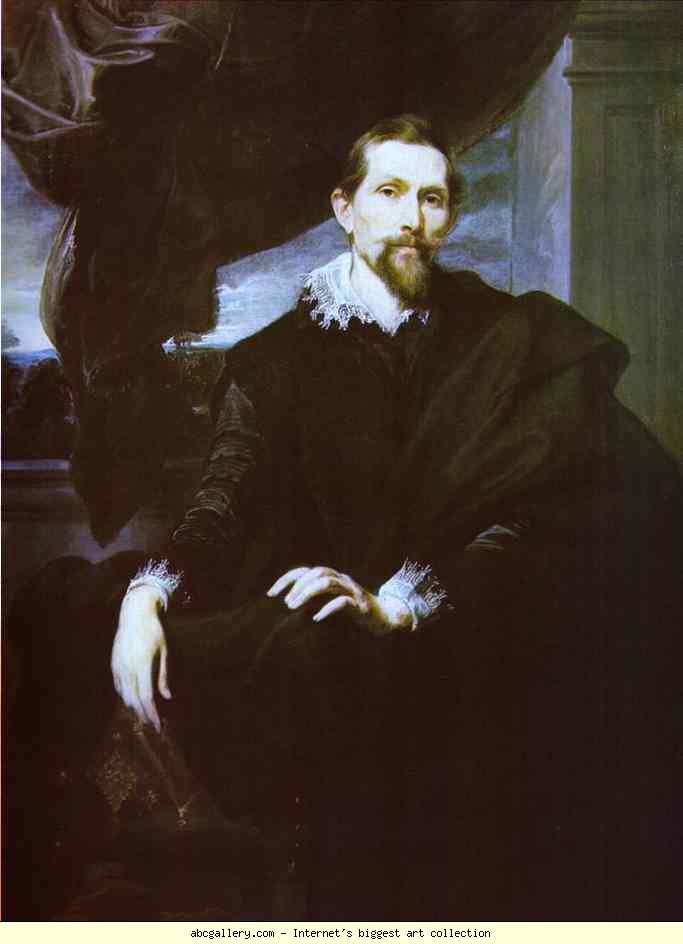
A few weeks ago I spent a Saturday afternoon at the Frick Museum in New York.  It was a cold day in January.  Not many tourists were out and about.  Can a painting elicit a moment of happiness?  Painting for painting, the Frick has what’s commonly regarded as the finest collection of Old Master paintings anywhere.  Hanging in those robber baron rooms, perfectly designed for the collection, each painting speaks directly to the viewer.  They spoke to me. Looking at my favorites—the Van Dyke portraits of the Snyders, husband and wife, the pair of Holbeins, the Vermeers and Titians—I marveled at their beauty and insight into the human condition.  The men and women in these portraits were once flesh and blood, happy or not (Moore and Cromwell not too happy.) I sensed their reality and I felt good to be alive, being there hundreds of years later.

Fellowship brings me special, deep-seated, peaceful joy and serenity.  Camping on the Russian River with a dozen other guys joined in common bonds of experience and friendship; sharing stories of pain and lives regained; no judgments, just a great blanket of security and hope; true friends.  We reach out and touch and feel a different kind of pulse.

photo

Within the past two weeks something special and completely unexpected happened.  A friend from many years ago, someone I haven’t spoken to, or even thought much about, for at least eighteen years, emailed me, having found me thanks to Google.  He had come across a letter I had written him when his wife had died.  He thought I might want to read it and asked if he could mail it back to me.  When it arrived I saw that it was postmarked January 20, 1993—my birthday exactly twenty years ago.  And before I had opened the envelope, a quote from Kierkegaard surfaced from somewhere deep in my subconscious: Life can only be understood backwards; but must be lived forwards.  In my letter to my friend, I had paraphrased the exact same quotation.

The universe was speaking, and there was no explanation.  Many of these moments of grace have been happening to me recently.  I’d like to know why, but have to understand with no explanation, because there is no explanation.  In my fellowship we talk about having a spiritual awaking.  I’ve not believed in this; I’m not at all sure that I do now. What I think is that this kind of awakening happens from within.  It doesn’t descend from the sky, like a bolt from Heaven.  When we become ready for what the universe has to give us, we don’t need an explanation.

On rare occasions—very rare in my life—being alone with someone you love is happiness out of time and reality.  These are moments of light, shining light, like fireflies on a summer night.  They glow for an instant and then disappear into the darkness.  Sometimes they twinkle and glow again.  We don’t ask an explanation of fireflies.

output_hd

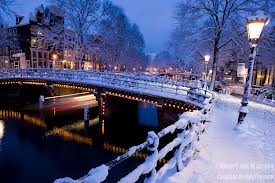
Place can make a difference.  It my case it was the difference that allowed the lights to burn brightly, if only for a moment.  Tassajara.  Amsterdam in winter.  On old streets in Tokyo.  They still glow in my memory, a foundation for another journey taken with the confidence of possibility.  Yes I did and yes I can!

No explanation needed.

imgres-1

The Lament of Books

If we lament our book-swamped age, it is because we sense that it is not by reading more, but by deepening and refreshing our understanding of a few volumes that we best develop our intelligence and our sensitivity.  We feel guilty for all that we have not yet read, but overlook how much better read we already are than Augustine or Dante, thereby ignoring that our problem lies squarely with our manner of absorption rather than with the extent of our consumption.

Alain de Botton.  Religion for Atheists.

books16_shiny-books

How often do we reread books, especially “great” books that impart, if we’re open to receiving them, moral lessons or insights into how to live a more soul enriched life?  Alain de Botton points out that a wealthy English family in 1250 would probably have had only three books: a Bible, a collection of prayers and a compendium of the lives of the saints.  And that they would have read their few books every day, a ritual of belief and comfort.

I’ve read John Kennedy Toole’s The Confederacy of Dunces eleven times, also for comfort, although I suspect not with the same intent as the Book of Common Prayer.  For me it’s a balm for anxiety.  It makes me laugh—laugh out loud reading in bed at night.  I love Ignatius J. Reilly and his outraged affront at the modern world.

In the shadow under the green visor of the cap Ignatius J. Reilly’s supercilious blue and yellow eyes looked down upon the other people waiting under the clock at the D. H. Holmes department store, studying the crowd of people for signs of bad taste in dress.  Several of the outfits, Ignatius noticed, were new enough and expensive enough to be properly considered offences against taste and decency.  Possession of anything new or expensive only reflected a person’s lack of theology and geometry; it could even cast doubts upon one’s soul.

I love that my friend John Leonard introduced me to his own favorite book, and gave me his much-read, well-worn copy, a paperback rebound in half-calf by an Italian bookbinder.  John wrote, “My favorite book, once a tattered paperback lovingly bound in Milan, now battered anew.” It’s a treasure.  Perhaps it does have much in common with that twelfth century book of prayers.

My son David has reread The Lord of the Rings as many times.  Most Tolkien fans have.  Frodo’s journey is an endlessly entertaining, and emotionally moving, parable of hardship endured, questioned, and overcome.  When David was a child I could always tell when he was anxious and stressed because he would be rereading his collection of David Eddings.  (I thought it was a step up in rigor when he moved on to Tolkien, not understanding the relief the Eddings provided.)

There are other books to which I return for reasons often apparent, sometimes not.  Since high school I’ve read the Iliad over a hundred times.  I’ve read The Magic Mountain five times; Women in Love, three.  There are poems that I’ve read, for years, more times than I can count: Sunday Morning; Among School Children; Voyages; For the Union Dead.   Reading aloud Kenneth Rexroth’s beautiful poem When We With Sappho to a woman I loved forged its meaning into my heart forever.  Words can do this.

books31_two-open-books_00

At Bowdoin I took a course called Literature as Philosophy, taught by the incomparable C. Douglas McGee. These books we read back in the ‘70’s have remained with me ever since, all reread several times at different junctures in my life, times when I needed them.  Thomas Mann’s Dr. Faustus.  George Santayana’s The Last Puritan.  Moby Dick. The Brothers Karamazov.  Henry James’s Portrait of a Lady.

I think we reread books for specific reasons.  Some comfort us, not only with their plots and characters but with their warm familiarity.  (Movies, too.  I’ve watched the Merchant-Ivory film adaptation of A Room With a View at least a dozen times because I like it; it makes it happy without the slightest uplifting message.  I’ve watched Ken Russell’s over-the-top adaptation of Women in Love as many times because the characters are so wonderfully acted. For years I wished I had been born Alan Bates as he played Rupert Birkin–who bore no comparison to the character in the novel. .  And only a few months ago I watched Gosford Park on five consecutive nights.)

I’ve read Brideshead Revisited several times to wallow in lost love, not to assuage it.  I read W. G. Sebald over and over because he only wrote four novels before he was killed in a car crash and their melancholy theme of memory haunts me.  He makes me think about my own memories and mortality.

“And yet, what would we be without memory?  We would not be capable of ordering even the simplest thoughts, the most sensitive heart would lose the ability to show affection, our existence would be a mere never-ending chain of meaningless moments, and there would not be the faintest trace of a past.”  The Rings of Saturn

Patrick Leigh Fermor’s A Time of Gifts sits at my bedside, as does M.F.K. Fisher’s Journals.  I understood immediately why Anthony Lane wrote in his New Yorker profile of P. G. Wodehouse that he reads “Uncle Fred Flits By” once a fortnight.  Some writing renews itself every time it’s read.

books01_dictionary

There are also books that are so well written, well constructed, with wonderful characters and high emotion, that I go back to them over and over for the sheer joy of reading: Wuthering Heights.  The Quiet American. The Turn of the Screw.  Billy Budd. Antony and Cleopatra. The Importance of Being Earnest.  Tom Jones. Howards End.

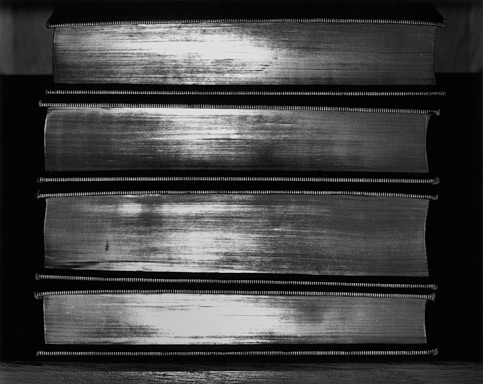
Rereading books, and the hope of rereading books, is my excuse for maintaining a “personal library.”  It’s obvious to me that this is a conceit, a vain imitation of some 19th century English gentleman.  I’ve used these physical books as a metaphor for me—I am what I’ve read and there I am on all those bookshelves!   The fallacy is that while I am, in part, a thinking adult as a result of all that I’ve read and absorbed, it’s not the physical evidence that counts.

books13_tall-bookcase

I’ll never convert my books to a digital library.  Nevertheless, I don’t need two-thirds of the books I own (and we won’t even speak of the ninety-seven cartons of books languishing in a Westchester County storage facility.)  A critical, spiritually necessary, task for 2013 is to pare down my collection to only those books I treasure for their content, their beauty, their personal significance.  I already know which books they are.  I won’t sell my complete collection of H. V. Morton’s or my prized thirteen volume early edition–beautifully bound–of Sir James Frazer’s The Golden Bough.  I have, in fact, read all of it. I watched the row of green bindings sit unbought on the shelves of Bell’s Books in Palo Alto for more than a year, hoping against hope no one would buy it, as I saved up to purchase it myself.

I’ll keep my collection of books about and published by Bowdoin College, and hope that David or Adam will someday want them.  I’ll keep all the Winslow Homer and John Singer Sargent art books because I think they inspire my watercolor painting (vanities of vanities.)

I have a plan for dispersing all of these books. I’ll sell all the art books at Russian Hill Books—this being a sneaky plan because I get 25% more in trade than in cash, so I have my eye on two rare and expensive books that I hope to get in exchange.

(I previously sold more than fifty cookbooks to Russian Hill. My test was if I hadn’t opened the book in five years it had to go.)  The owner of Russian Hill Books, Carol Spencer, is one of my neighborhood saints.  Her store is like a station of the cross: I can’t walk by without reverence and awe.  It’s an addiction.  I really need Book Buyers Anonymous!

Other books will go to Friends of the San Francisco Library.  Some will be, with luck, sold on eBay.  I hope to give my collection of Jargon Society books to Bowdoin College.  Some will be given to friends and to my sons.  I think the Pleasantville Library will benefit from the books in storage.

After all of this book reduction is accomplished, my spirit will be free, the chi will flow unencumbered through my apartment, artifice will be banished—and I’ll for sure have to take to my bed with The Confederacy of Dunces and reread it for the 12th time.  I’ll need my friend Ignatius more than ever.

books23_damaged-water

All photographs by my Bowdoin friend Abelardo Morrell.

Deutsch lernen

Following my recent travels in Mannheim, Cologne and Berlin, I’ve decided to teach myself German.  There are unquestionably better, more useful, choices, but German suits me right now.

Fraktur_alte_schwabacher

Despite nine years of Latin, five of French, and five–oddly progressive for a small school in Pittsburgh–elementary school years of conversational Spanish, I am notoriously bad at languages.  Whenever I carefully construct a sentence in French, most Frenchmen look at me with that Parisian look of contempt and puzzlement and, after professing to have no idea what I said, answer in English. In Rome with my children I had a difficult time translating the words on the base of columns. Surprisingly, when I lived in Barcelona, from somewhere deep in my crocodile brain I was able to resurrect 4th grade Spanish and make myself understood in shops and restaurants.

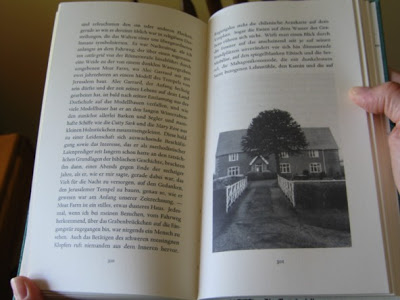
I’m beginning my German self-instruction by attempting to dissect the German original from its English translation of W. G. Sebald’s The Rings of Saturn. The late Sebald is one of my two favorite contemporary novelists, and this is my favorite of his novels. (Haruki Murakami is the other top novelist, but I concluded that side-by-side Japanese-English is way, way beyond my abilities. Most would say Sebald is, too.)

missing-from-rings

There are several motivations to this undertaking.   I’d love to understand the words to Schubert lieder. I’d like to be able to walk through a German museum and read the wall descriptions.  I have friends in Germany and Austria and it would be a sign of respect and affection to be able to comprehend a bit of what they are saying rather than resorting exclusively to English. And does Lodenfrey in Munich being my favorite store in the world count as a good reason?  Or sauerbraten? Currywurst?

Currywurst-1

Another reason is brain stimulation: I think I need it.  I forget where I put things five minutes ago. Or I know where I put something and fail to find it all the while it’s right in front of me.  Just last night I asked my son if he knew where my glass Chinese teapot was and he pointed to it on a shelf literally in front of my nose.  Earlier I had asked him if he had seen the latest James Bond movie Skyfall and he—kindly—pointed out to me we had seen it together. I’m worried.

Years before when I was married my wife would berate me at 6:00 am for filling our birdfeeders during the winter, rather than, for example, studying algebra.  She thought my mind had withered from reading too much Yeats. Learning a language as structured as German surely will be as therapeutic as math (math being a more hopeless mission.)  Since my former wife speaks German, and doesn’t read Yeats, I hope this recent undertaking has no Freudian implications.Bird-feeder-in-snow-low-res

In a college French class we had to translate the beginning of “Swann in Love,” checking, and comparing, our work against the Moncrieff translation. While I didn’t progress more than four or five pages, the exercise was enlightening.  Not only did it provide a window into the beauty and construction of the original French—and thereby helping to inform all remaining reading of Proust in English—it by design illustrated the qualities necessary to translate anything, an art in itself.

Swann_In_Love

Unlike, however, the French class assignment, I have zero knowledge of German grammar.  This is an impediment…duh! —as my boys would say. I’ll have to go beyond the German-English/English-German second hand dictionary I picked up yesterday at Russian Hill Books.  The best approach for me would be to find a German tutor.

Ancient Greek was another option.  I own fourteen different translations of the Iliad and often enjoy comparing one to another. Two years ago I took a Continuing Studies course at Stanford on the Iliad, taught by the chairman emeritus of the classics department. We simultaneously read the Robert Fagles and Richard Lattimore translations, each complementing the other.  It was one of the finest classes I’ve ever taken, in no small measure due to Professor McCall’s deep knowledge and lifelong passion for Homer. There wasn’t a dry eye in the class as we read Priam’s plea to Achilles for the return of his son Hector’s body.  No parent could read this without crying.

PriamAchillesHectr

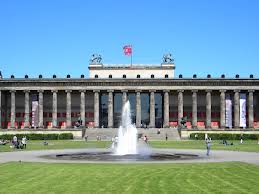
German scholars and archeologists have had a long association with ancient Greek culture. Heinrich Schliemann identified the site of Troy, and a week ago I was able to view at the Altes Museum in Berlin some of the Trojan treasures he and his team excavated.  It’s unknown whether Homer’s epic recounts actual events, but that’s beside the point. Troy existed.

images

In my dreams I’ll read all of Sebald.  I’ll read Goethe’s Italian Journey in the original.  I’ll read The Magic Mountain.  I’ll read Alexander von Humboldt’s accounts of exploration in the Amazon.  It’s said he was the last man to know everything there was to know at the time he lived.

About ten years when I was at Messner Vetere Berger McNamee Schmetterer/Euro RSCG, we had a partners meeting in Lenox, Massachusetts. Futurist Ray Kurzweil was invited to spend the weekend with us.  Among the many scientific predictions Kurzweil proffered, the one I most longed for was his vision of implanted microchips that give a person the ability to speak any language.  In Russia?  Switch on the Russian chip. Reading Murakami?  Turn on Japanese.

It’s a beautiful vision, though one not yet realized.

I’ll have to learn German the old fashioned way.

Alone. Not Lonely.

We plan trips two ways: consciously and subconsciously.  We plan itineraries, destinations, sights to be seen, events to attend, people to visit.  Then there’s what we experience inside, unanticipated, sometimes welcome, sometimes not, the things that are planned by the heart somewhere in the universe.  If we listen, we can hear the universe speaking.

IMG_0061

I returned to San Francisco last night having spent three weeks traveling to Finland, Estonia and Germany.  I planned this trip months ago, centered on Sam and Saga’s wedding in Turku, Finland on December 22nd.  Being grounded by this date and place, I mapped a journey both before and after the wedding.  Beyond wanting to visit a friend in Mannheim, Germany on my way to Finland, I didn’t have any objectives other than to see places I had never seen before.  After setting the dates for the beginning of the trip and its end—again, an arbitrary decision—I planned each day in advance, booking all hotels and inter-city travel.  I traveled on five airlines, two trains and one ferry.  There were to be no random decisions, or mid-trip change of plans, or serendipitous off the route adventures.  I considered many options.  I’m not sure what the motivations were for me to select the places I wanted to visit; they presented themselves as a hand unconsciously moves across a Ouija Board.  Once settled, I knew they were right.  I would fly to Germany, proceed to Finland for the wedding, spend Christmas in Finnish Lapland, take the ferry from Helsinki to Tallinn, Estonia and end up a week over New Years in Berlin.

_DSC1501

What I didn’t realize was that I had mapped a journey that would unfold in sequential chapters of ever-increasing self-awareness, insight and awakening.  And I couldn’t have realized any of these had I not been traveling alone.

Trips taken with others, whether one’s family, a friend, or a lover, provide their own special pleasures and perils.  With the exception of a week spent on my own in Puerto Rico during the depths of my divorce, feeling miserable the entire time, I had never traveled on vacation by myself.  I had always been with my parents, a friend, my family.  Since moving to San Francisco in 2008, all of my vacations had been with my former girlfriend, providing another kind of happiness.  I was afraid that on this trip I would miss the shared intimacies, the private space that exists when you travel with someone you love. Other people don’t exist then. My fears proved to be groundless.  What I experienced on this trip, by myself, was different, of course, but different in good, life-affirming ways.

Since ancient times, travelers have written about the joys of the open road when traveling alone. Patrick Leigh Fermor’s descriptions of walking alone from the Hook of Holland to Constantinople, begun in A Time of Gifts, remain the most deeply personal, and cherished, writing I know.

Traveling alone with an open spirit means never exactly traveling alone.  “Alone” is a choice.  It’s when we choose never to engage not only with other people, but with our heart.  If we’re closed to those possibilities there’s little point to setting out at all.  And we are guaranteed to be lonely.

I was fortunate that my trip began with a visit to my friend in Germany.  We walked the paths of Neanderthals in the cold, wet Neander Valley; we visited Christmas Markets in Cologne, Laudenburg and Speyer; we ate pig’s knuckles as big as our heads.  I also got to share my friend’s happiness being in love with his beautiful girlfriend, a love that had been saved over many years before blossoming to the reality that had always been there from the beginning.  I’m grateful he opened his own door to me at this time of turmoil and joy in his life, and, in so doing, giving me the gift of his insight into conditions of my own heart.

From Germany I moved on to Helsinki where I stayed three days with Sam’s fiancé Saga’s brother Jani.  We had met before in Boston and New York.  Getting my first impressions of Finland from a Finn turned out to be a special, significant treat.

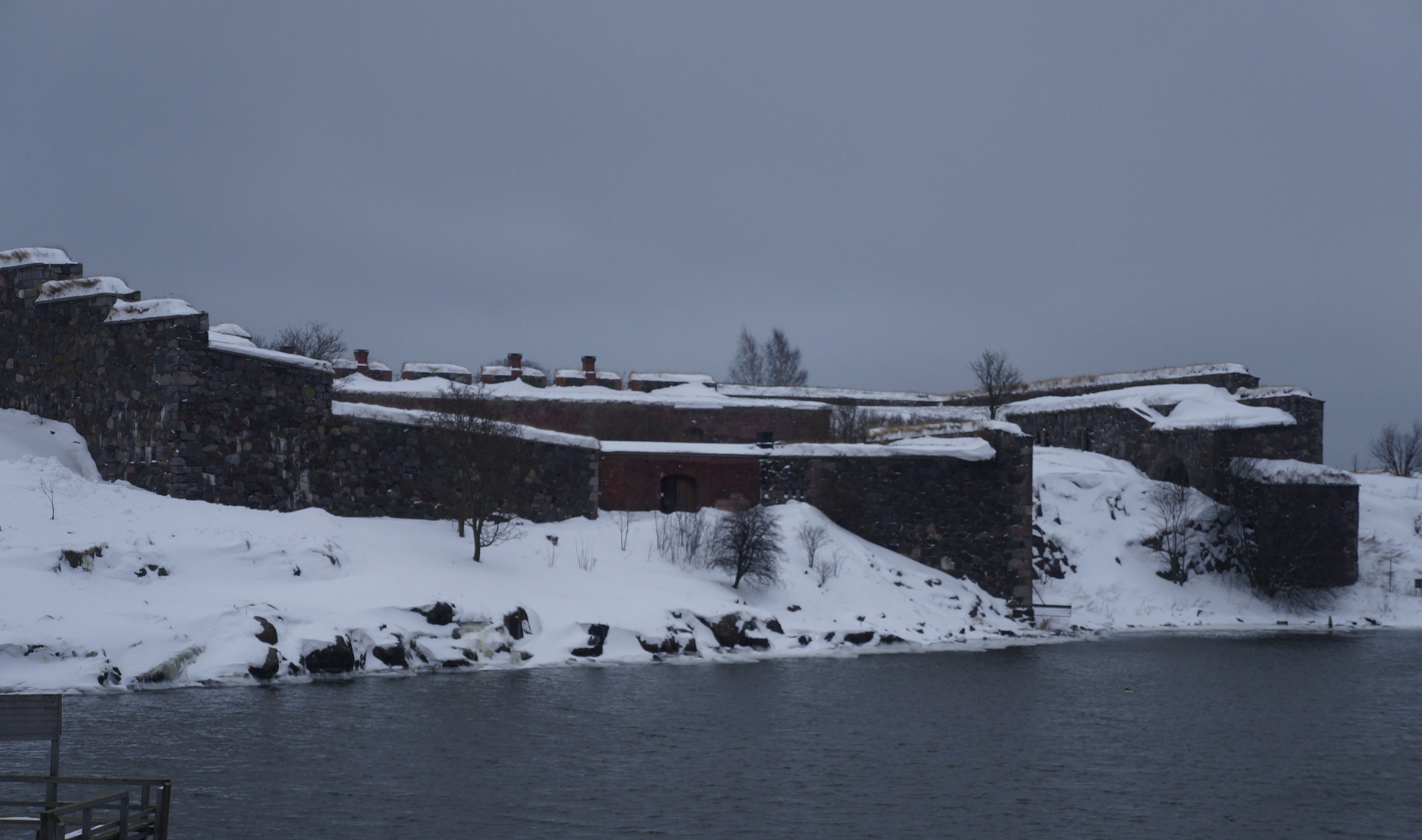
Jani took me on what had to be the coldest, windiest, snow-filled day of the year to the old fortress island of Suomenlinna. We were virtually the only tourists and together, and as we walked throughout this UNESCO World Heritage site in its winter isolation, often in deep snow and whipped by the wind off the frozen coastal water of  the Bay of Finland, we formed a bond of lasting friendship.  I didn’t know then that the cold, white, unforgiving landscape was to set the foundation for insights to come later in my trip.  Winter turned out to my season.

_DSC0766

Best of all, Jani introduced me to the warmth—literally and figuratively—and pleasures of a traditional Finnish sauna. This was the beginning of three unforgettable experiences of the common fellowship of men, the unabashed freedom of enjoying this fellowship and the hot wet body penetrating heat from the wood fired sauna completely naked, the shock of jumping from that heat into the snow and ice, and the deep satisfaction of relaxed and happy muscles that comes at the end.  I bet there’s not a word for “up-tight” in Finnish.

est_ta_sauna8

Later, in Tallinn, I sought out a similar experience on my own, finding another 1920’s wood burning sauna just a few blocks outside the Old Town.  Once the other guys discovered I wasn’t Estonian, they were surprised and delighted that an American had found his way to their local sauna, firing questions at me as fast as I could answer (of course in English.)  They wanted to know how their sauna was different from ones in America; they wanted to know all about my son’s wedding in Finland; they asked whether I thought Finnish girls were prettier than Estonian girls (there being only one politically correct answer;) one guy asked me whether I thought it would be a good idea for Estonia to become the 51st American State!  When I answered it would be a very bad idea, they all burst out laughing telling me it was just a joke, though not such a silly one since Obama had been re-elected.  Would any group of working class guys in the States regale a visiting Estonian, in Estonian, about a recent presidential election in his country?

Before I left, one of the men offered to give my heated body a beat-down with the birch leaf branches used by everyone to stimulate and relax their muscles.  I couldn’t refuse, so proceeded to be whipped and pummeled from head to toe, front to back.  Smelling like a birch tree, I jumped into the ice-cold pool outside the sauna.  I couldn’t have possibly felt any better.  Throughout the evening I also had to politely decline endless shots of vodka, washed down with bottles of beer.

Is this traveling alone?  I would never have sought nor experienced these evenings of friendly fellowship traveling with another person.

Sam’s wedding in Finland, together with the deeply emotional experiences with all three of my sons, was not only the centerpiece of my trip, but coming when it did, was also in many ways the late-blooming centerpiece of my life.  This time we had together at the wedding became the catalyst to the realization—truly a spiritual awakening—that I had when snowshoeing too far out on the treeless, frozen Arctic tundra in the remote north of Finnish Lapland.  What I understood in those three very cold hours was that I had everything I needed, right now, and would ever need, in my life.

_DSC1019

We don’t know where we’re going and we know only a little of where we’ve come from.  We know dates and places, biological and genetic details, events and relationships.  We know all about evolution. We may even have a sense of time passing.

Where we are going always remains a mystery.  That is what, I think, traveling alone can be about if we are open and free of projected outcomes.   It’s not only about the routes and destinations, but more crucially it’s about the unraveling of that future mystery, of seeing a possibility that hadn’t existed before.  We usually don’t see these possibilities living our day-to-day ordinary lives

After Tallinn, my subconscious could not have planned my next, and last, destination better; but then it’s my subconscious. There’s always a reason when the universe speaks.

Berlin amazed, and moved me in ways I hadn’t expected, although coming after the spirit opening experience in Lapland, I was primed for the transformations so literally evoked in this startling, exciting, transformative city.  I saw my own life reflected in the unification of this cruelly divided city, turning it from a landscape of ruin to one of the most vibrant, life-affirming capitals in the world.  You can’t help being here and not be filled with anticipation and possibility.

images

Earlier in December I met a journalist from Berlin in San Francisco who was on his own journey of self-renewal.  It was happenstance that we met—but not a coincidence.  It became another chapter in my story.  We met up in Berlin for coffee and another day for lunch, and shared stories of our lives, our loves, our families, our problems, challenges and solutions, our joys and miseries.  We would never have met, in either city, had we not both been traveling alone.

cafes-einstein-berlin-02

While I was dazzled by Berlin’s great museums, the Pergamon, the Altes, the Neues, the Bodes and Alte Nationalgalerie on Museum Island; the splendid Gemaldegalerie, which took my breath away; the old and quirky Museum of Natural History with its tallest mounted dinosaur in the world and 233,000 eerie specimen jars stored in one dark huge room—and was astounded that all of these museums have been rebuilt from the ravages of WWII over the past twenty years—it was my friendship with my new friend the journalist that stands out as the most meaningful highlight of my week in Berlin.  Like Jani in Helsinki, these friendships were possible because I was on my own and open to letting them happen.

Along the way I met up with two Norwegians for dinner on New Year’s Eve; stood in a crowd of thousands of all nationalities in front of the Brandenburg Gate to watch the fireworks herald the New Year 2013;  joked with taxi drivers, flirted with one particularly attractive waitress at Lutter & Wengen, tried my best to engage with the many Japanese tourists in Lapland, struck up a conversation with the couple next to me at the Berlin Staatsoper, who just happened also to be from San Francisco.

Is this traveling alone?

_DSC1435

The Meaning of Snow

winterImage

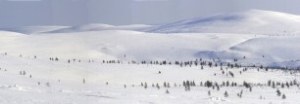
Standing on top of one of the treeless, snow swept Arctic fells in Urho Kekkonen National Park in Finnish Lapland—only eighty miles south of the Arctic Ocean—reoriented my life in a way I didn’t anticipate.  Maybe it was the extreme cold, or the wind, or the solitude in an empty expanse of white.  Maybe because it was Christmas Day.  What’s significant is that my mind changed; what I had thought mattered in the past no longer did.  What I saw in the snow was a different future.

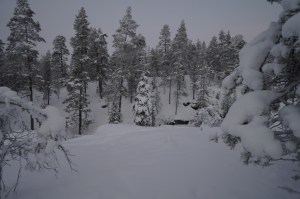
I’m staying in Saariselka, in the far north of Finland.  It’s the northern-most place in all of Europe where there’s any accommodation for tourists.  The temperatures over Christmas this year are no higher than -45 C.  The wind chill out on the fells drops lower by another 20 to 30 degrees.  All of the sparse pines are encrusted in snow.  On top of the fells there are no trees at all.  Snow covers everything in sight.  It’s so cold the snow doesn’t even squeak under foot.

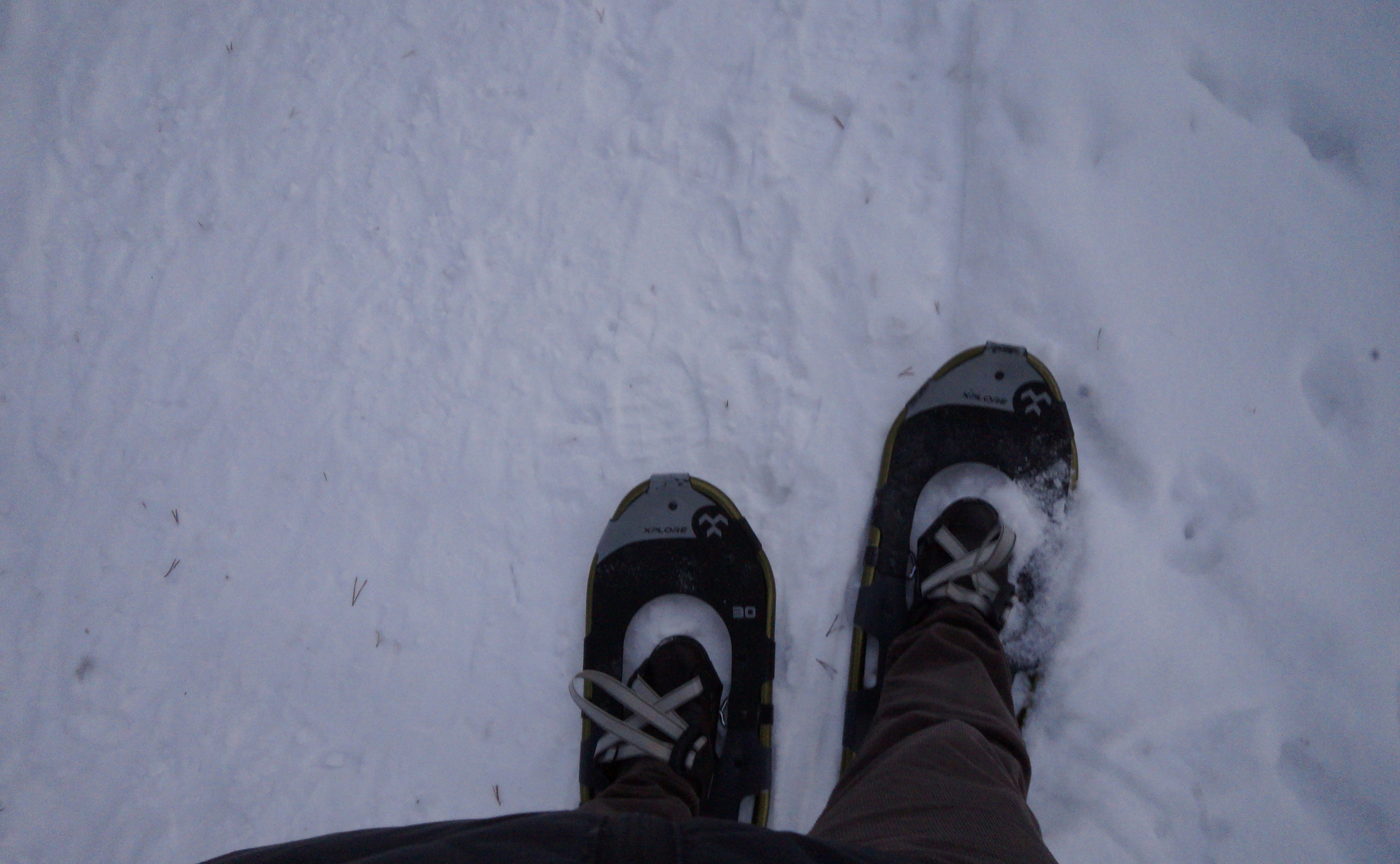
I rented snowshoes to walk out into the park, intending to take the easy 2.5 km route.  Somehow I went the wrong way and ended up on the 12 km “difficult” route across the Arctic fells.  By the time I discovered this I didn’t want to retrace my steps.  I was still deep in the frozen pine forest enjoying the beauty of the trees and pine-covered hills and heavy snow all around me.  I didn’t know what lay ahead.  I’m glad I didn’t because I may have turned back.

_DSC1465

The trail began to ascend the hills, in some places very steeply.  This was my first time on snowshoes and I was surprised how well they gripped the snow as I climbed higher and higher.  The pines began to thin out and wide expanses of empty snow took their place.  I proceeded higher up the fells, one snowshoe step at a time.  I couldn’t have hurried even if I had wanted to. The white vistas spread out in all directions. There were no landmarks but for the trail markers, half hidden in the snow.  There were no other hikers. I began to feel like the Norwegian Arctic explorer Fridtjof Nansen setting out to walk across the frozen tundra to the North Pole.

I was alone in this barren winter landscape.  I didn’t know how far I had gone and wasn’t sure where I was going.  The markers spread out ahead of me, curving up and down the fells.  I couldn’t see where they turned to return to Saariselka.  I assumed they did at some point.   I wore a down parka with thermal underwear, a wool turtleneck and a heavy Finnish sweater underneath so except for my cheeks I wasn’t cold.  Still, the thought crossed my mind how much more romantic it would be for my boys to say their father had frozen to death in Finnish Lapland than, say, having a heart attack on a bus.

At this time of year in Lapland the midday light is only half-light, a flat gray sky blending into the flat white snow.  No icy sun sparkles on the snow—no sun at all.  No blue sky.  No clouds.  Only white in every direction, spreading across the fells, the frozen surface hard and packed by the wind.

After following many hills away from where I had begun to climb the empty fells, I began to worry.  The markers still spread out in front of me.  I wished another hiker had appeared.  I didn’t see any other snowshoe tracks in the snow, though the snow was so frozen I wasn’t digging tracks myself.  I had no choice but to keep going.

Out there on this cold, white expanse I understood the allure of the North.  Everything familiar slips away.  No landmarks or signs of man.  All of the 19th century explorers felt this.  I thought about Bowdoin’s Perry and MacMillan determined to be the first to reach the North Pole.  I now knew why.

arctic-studies-bowdoin-college

I stopped worrying and opened my mind to the cold snow and wonder of it all.  Here I was in the far north of Finland, on Christmas Day, alone on snowshoes with no one in sight, far from where I had started out.  Everything unimportant in my life, past and present, fell away.  My perspective changed.  I can’t explain why, just as I can’t explain falling instantly, chemically, in love.  It just happened without willing it.

What I realized was that I had everything I ever needed, or would ever need, in my life, right now.  The purity of the landscape all around me, the cold wind, the snow, the complete whiteness, filled me with peace.  Whatever I had lost in my life became meaningless.  The cycle of heartbreak came to an end, right there, so far north, hundreds of kilometers above the Arctic Circle.  No more expectations or fears.  Nothing she had given me, and she gave me much, could replace what I had within me in that moment.

_DSC1469

I had only myself.  I had my endless love for my three sons, and theirs for me; the gratitude of being here on this earth when it might not have been; the calm beauty of being alone and not being unhappy.

I’m in Lapland following my son Sam’s wedding in Turku, Finland.  I’ve never experienced anything as beautiful as Sam and Saga’s wedding in Turku’s eight hundred year old cathedral.  Seeing my handsome boy Sam with his lovely bride looking like a princess, with Sam’s brothers David and Adam to one side and Saga’s sister to the other, filled my heart with joy, and my eyes with tears of happiness.  The setting—the entire wedding—was out of a fairy tale.  What I experienced that day grounded, humbled, me to the realities of my life, as it is, not as how I might want it to be.

_DSC1078

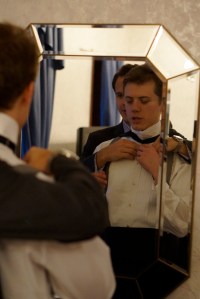
Earlier in the day, Sam, Adam, David and I all met in my hotel room, to prepare and dress for the wedding.  First we spent an hour and a half in the hotel’s traditional Finnish sauna, going from the showers, to the sauna, out into the snow, back into the sauna, back to the snow—laughing and having the best time imaginable.  None of us could remember the last time the four of us had spent an entire afternoon, just us together.  Can you imagine how special it was for me to have my son ask to prepare for his wedding with his brothers and me?  Or watching Adam stand behind Sam knotting Sam’s tuxedo bow tie?  Or David dressing up, taking photos, thrilled to be there?  Or all four of us walking to the cathedral?   Nothing ever will equal this day we had being together at such a special time and in such a special place, for such a special occasion.

_DSC1039

All of this I saw out in the snow walking across those Arctic fells.  I don’t need anything more.  I don’t need most of what I have other than this.  I don’t need to feel miserable anymore.  Memories remain, but distant and white in their own oblivion.

Tomorrow I leave Saariselka and this cold, half-light sky.  I’ll see the Arctic fells in my mind for as long as I live. It’s not likely I’ll ever return here.  What this journey has meant to me, however, is permanent.  My experience of Sam’s wedding is permanent.  These memories of snow are permanent.  They have changed me.  The snow, the cold, austere and barren snow, has affected me as nothing else ever has.   I may look the same; may live day-to-day as I have.  Yet my dreams have changed.  They’re not gone, but set in the context of that vast, empty, white, cold, snow-covered, wind ravaged landscape.

At Home in a Finnish Sauna

Kotiharjun_sauna_neon_sign_2008

A traditional Finnish sauna is different from its American counterpart in nearly every way. The one I visited in Helsinki last evening with Jani, Sam’s wife Saga’s brother, is an old neighborhood institution, best described as a cross between a sauna and a social club.  Beer drinking plays a central role.

You bring your own beer—sparkling water in my case—and towel, pay the 12 Euro entrance fee (there’s an annual fee of 50 Euros, clearly the better deal) and step into the circa 1920’s wooden locker room with maybe thirty to forty very happy guys. Some of the men were playing chess on much used wooden tables under vintage photos of the sauna in earlier times.  Some were drinking their beer in groups of three or four on the wooden benches.  Most of the men seemed to be with friends, out for an evening of good times.  Most were wearing only their towels and the others nothing at all.  There was a lot of joking and laughing and while not raucous, a happy atmosphere of friends together filled the room.

Throughout the evening there was constant coming and going into the showers and sauna.  This in and out is part of the ritual.  First you walk into the large tiled shower room, hang up your towel and scrub down under the hot water.  Mind you this is an old neighborhood sauna—no fancy tile-work or trimmings.  It’s definitely not the Bay Club!  Clean and wet, you then pass into the sauna itself.

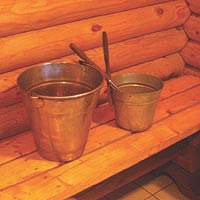
This sauna—the Kotiharjun Sauna, about fifteen minutes from the city center by metro—is one of the very few still heated by an immense wood burning stove, with rocks the size of basketballs on top. The stove is the size of a sedan.  Three tiers of cedar benches line three sides of the room.  The goal is to sit on the top tier where the heat’s most intense.  It’s not dark inside—more half light, like a Finnish winter afternoon.

Unlike American saunas, a Finnish sauna is wet from the steam rising from water tossed in buckets on the hot rocks.  It’s not a steam room but the air inside is hot and moist.  This prevents dehydration.  There is also an intake and outtake to allow fresher—not colder—air to circulate.  The Finns regard American dry heat saunas as deathly.

Now the fun begins.  After working up a hot glistening glow, it’s time for another quick shower and a walk outside in the snow.  At the Kotiharjun, there is a long wooden bench out front extending, at this time of year, into a snow bank.  This bench is actually on the street, though the street’s quiet with few passers-by.  At any given time, there are five or six guys—and women, too, from the women’s sauna on the second floor—sitting outside on the ice in just their towels and bare feet, drinking beer.  The night I was there was bitter cold, the temperature around 10 degrees F.  No matter, we all were out in the surprisingly not frigid-feeling cold, for about ten minutes.

IMG_0056

Then back again inside, to the showers, then the sauna.  Jani and I went from sauna to snow five times during the course of the evening.  A neighborhood public Finnish sauna is not a fast experience.  We were there for over an hour and a half.

One of the remarkable things about a Finnish sauna is the complete unselfconsciousness of all the guys.  I’m told it’s the same for women.  There is nothing whatsoever strange about spending an evening with your friends naked.  There’s no weirdness, no sidelong glances, no bashfulness.  Buff or fat, old or young, everyone is naked and enjoying themselves.

Once anyone there found out I was American they immediately welcomed me, offering me beer, asking me how I liked their sauna, would I come back?  Where in the States would a bunch of naked guys right away include a foreigner in their party?  For that matter, where in the States would a bunch of naked guys in a sauna speak another language fluently?

At my health club sauna in San Francisco—of the abominable dry heat kind—anyone who removes his towel is considered an exhibitionist at best, a weirdo at worse.  Others will walk out.  The fear of being thought gay trumps any naturalness the experience might otherwise have.  No one ever talks, much less jokes with friends.  You go in, bake until you sweat, and leave, without a word.  You look straight ahead and never make eye contact with anyone else.  It’s in no way fun.  Of course there’s also no beer involved!

Just as many Americans might shy away from stepping inside a Finnish sauna, Finns find the American experience mystifying.  A sauna is about relaxation and conviviality.  It’s not a solitary adjunct to a strenuous workout.

I’m never going to step into an American sauna again without thinking about how much better it could be—even without the snow!

A final note about a Finnish sauna experience:  yesterday was my son’s wedding to his lovely Finnish fiancé Saga, in Turku, Finland.  My other two sons David and Adam were also there.  It was Sam’s idea that we all dress for the early evening wedding in my hotel room.  But first, we spent the afternoon in the hotel’s private sauna—dad and his three sons.  We did all the same things as I had done at the public sauna in Helsinki.  From showers to sauna to snow and back again. I can’t remember the last time the four of us spent an afternoon together all by ourselves, especially having as much fun as we had.  Maybe we were too relaxed because by the time we dressed and walked to the cathedral we had only ten minutes to spare before the ceremony!  It was a doubly special day.

_DSC1019

Then

She was the first woman ever to call me “honey.”  She held my hand and said she loved me.  That was then.

Once there was a boy who dreamed of the sea.  He dreamed of a day that was as gray as a corpse.  He saw an endless shore, the horizon receding out beyond the curvature of the earth.  There was only gray water against gray sky.  There were no waves breaking on the gray sand.  There was no inland, only the endless divide between the sea, the sky and the sand.

From somewhere people walked to the water’s edge.  Hundreds of people, monochromatic people.  No color anywhere.  More and more people assembled along the shore.  They all looked up into the sky, beyond the water.  The people were silent.  They stretched out along the water as far as the boy’s eyes could see.  He knew they extended even further, beyond the limits of his sight. He was far away from the people and, wondering why they were there and what they were doing, he walked along the gray cold sand to meet them. He walked a long time and as he watched the horizon he saw more and more people looking to the sky.  He thought they were waiting for a word, a sign, something that would descend from the sky and give them hope.  Something from their god, a god the boy didn’t know.

Slowly the boy approached this vast mass of silent, gray, searching people.  Still no one spoke.  The boy was overwhelmed by the silence, the calm silence of the gray day.  He, too, began watching the sky, listening to the deep silence–a kind of not listening because there was no sound at all.

Without any warning rumble or changing brightness or darkness, a voice that was not a voice but more a limitless sound that filled the entire sky descended on the people.  One word that was not a word, spoken without speech, was heard across this entire world.

That word was the boy’s name.

The boy didn’t know why.  His name falling from heaven had no meaning for him.  He knew no god.

All of the people along the shore slowly turned and looked at the boy.  They knew.

The boy woke up and didn’t know if he had been dreaming.  For more than fifty years the boy remembered this great dividing gray, the people on the shore, the water and his name filling the sky and earth and the peoples’ souls.

She asked me that early day when we were new together what I most wanted in my life.  I answered to have a woman love me as much as I loved her.

There was a night, a long time ago, when that boy became a man.  It wasn’t magical, or filled with joy, or significant beyond the act itself.  The new man said to himself, “I have crossed a line and life will be different now.”  How different he couldn’t begin to comprehend. How could he have known, then, that crossing that line was the beginning of a journey that led down a road of sadness and heartbreak?  That came later.  In between the markers along the way the man did see sunshine, and had blessings, and knew there was something that might assuage the sadness.  It had to be there, somewhere.

What happens when a man at last finds the one thing he has always wanted, and searched for, waiting a long, long time to find this one thing, and then the man loses it?

What dies in that man, as his dream dies?

I see her running towards me, so happy, embracing me, kissing me in the grass, lying next to me on the blanket as we let the music rise up to the stars. 

There are places that retain memories of their past.  The memories lie deep within the landscape. They reveal themselves to those who seek them.  There was once a man who sought such a place, such a memory.

He lived in Barcelona.  From someplace long buried in his consciousness he knew he wanted to see Roncesvalles. It had to have come from reading La Chanson de Roland in 11th grade French class.  He wanted to see that battlefield from so long ago to touch something he couldn’t exactly define.  It wasn’t a literary pilgrimage. It wasn’t a religious journey.  He hadn’t even thought of going there before living in Spain.  The idea came to him one day and he knew he had to go, that there might be something in this place that had an answer to a question he didn’t know.

It was in May when the man set off one morning with only a map to lead him down highways and roads that grew smaller and less traveled along the way.  He stopped in Zaragoza for the night and ate alone in a restaurant well recommended in his Michelin guide.  He wasn’t in a hurry, though only detoured off his route on his way home.

In the morning he continued deep into Navarre, passing small towns and villages with their Romanesque church towers, their old women sitting in the sun.  In late afternoon he approached Roncevalles.  The light was beginning to glow in the early dusk.  He rounded a bend in the road and there was the battlefield, unmarked but unmistakably there.  He stopped his car and walked up the slope, so green with its new grass and flowers.  Dark wooded hills filled the horizon.  Here was the site of the defeat of Charlemagne in 778.

The man started to cry.  It wasn’t the first time he had cried in Spain.  Once, in the great cathedral in Toledo, he sat on a bench listening to an invisible organist play, the sun streaming through the opening in the cathedral’s roof, and cried unable to stop.  That time it was tears of sadness that had begun when he had crossed that line years before.

At Roncevalles his tears also came from his heart, but were tears that flowed into the future, a future he didn’t know beyond knowing it was hopeless.  Like the fallen knight, he fell, too.

Slowly he stood up and walked back to his car.  He drove a short way down the road to a small inn covered in roses and checked into a room.  He was the only guest.  The proprietress eyed him with suspicion as she led him upstairs to a cold and dark room.  That evening he was the only diner in the inn’s dining room.  He ate the most delicious jamon de serrano he had ever had, cut in thick slices from the bone.

He left the village in the morning, stopping to look a last time at the field where Roland had died.  In the morning sun the landscape withheld its secrets.  The man didn’t cry and drove off in his red car, taking a different route home to Barcelona, stopping to see the ancient Monastery of Leyre on the way.

The man knew, though, that Roncevalles had changed him.  Again, he had crossed another kind of line. What came after was already imprinted in his soul.

I remember a time when we sat on the weathered wooden bench above the flowing water, alone with each other, my arm around her, her head on my shoulders. The quiet of this place where monks prayed, where gardens of flowers filled the air with the scent of lilies and roses, surrounded us like a sanctuary.  I had never been happier. Somewhere deep inside, I knew, though, that this place was outside any reality we could hold on to, could keep within us after we left the quiet valley.  No amount of prayers could fill that space between that day and the days that came later.

There came a time when the man the boy had become couldn’t face the hopelessness of his life.  He only saw his life as a long dark tunnel that had no end.  He couldn’t see that there were trees and flowers and children and sunshine outside his tunnel.  Everyday he walked further and further down into the darkness. He had his reasons for this despair.  He mistakenly thought they were real.  He didn’t see his own blindness.

The man had a plan that would end the misery.  He thought about it for a long time.  He worked out all the details, planned for the consequences in all the wrong ways.  Then he tested his plan over and over again and one night he decided it would be the night.

The road twisted though the woods and fields of an endless property.  It was always quiet there.  There were no other cars, as was the plan.  How the man mustered the nerve to do what he did has remained for him a mystery.  His plan didn’t work.  He buried his plan inside as far as he could push it down and never talked about it for a very long time.  It lived there inside like a cancer, spreading upwards and outwards to its inevitable end.

These were not good times for the man.

The night I kissed her for the first time, in the warmth of a spring night, outside the restaurant where the men cheered, I knew I had crossed another line, the line I had always wanted to cross.  That line was love.

There are substitutes for living outside oneself.  Travel.  Wine.  Music. Poetry.  Being alone in a forest.  Swimming in waves.  There was a man who knew all of these substitutes. He sought them out.  There were many others, too.  After a while they became ends unto themselves.  All were addictions the man couldn’t beat.  The man knew that if he only lived life’s substitutes, real life itself would fade away.  The addictions worked until they didn’t work anymore.  There was another night that changed the man’s life, that he hadn’t planned though perhaps he had sought.  Loneliness led to unconsciousness which led to misery which led to tragedy.  The compulsion that led the man from one to the next was beyond his control.  Later he knew, as awful as it was, it had to have happened.  There could have been no other way.  This end was his beginning.

One sunny afternoon we walked through an old part of Tokyo, a section of small shops and makers of rice crackers, and old wooden buildings.  There were shops that made only color pigments and one that made paint brushes once bought by Matisse.  Cats warmed themselves on the stone walls of a cemetery.  We took pictures of each other and shared a dessert in a small ice cream parlor.  We held hands and were in love.  We grew tired by the end of the day and again, I felt the old sadness seep in.  Again, another time and place out of the reality of our lives.  An escape from the realities at home.  A place where our love could be alone.

There was another time when a man suffered a fatal blow to his heart.  Doctors tried to mend it.  They thought it was a disease inside the man’s body, something eating his heart away.  They gave him pills to cure this malady.  Somehow they missed the arrow piercing the man’s chest.  They didn’t see the blood, the open wound.  They weren’t the kind of doctors who looked for guns or knives or arrows.

One night this wounded man was walking home with tears in his eyes and walked directly into a tree, knocking himself unconscious.  Insult to injury. He was lost in so many ways.  And every day he had to see the marksman who had shot the arrow.  He had to face his destiny.  He couldn’t, so he went away.

He went to a place far away from all that he had known before.  It was an old place, a city from the earliest times of the man’s country.  In the city there was the second oldest church in the country of a particular denomination.  It was a beautiful church.  Every day at noon the man went in and sat in the back, on a chair behind the last row of pews.   The stone arches soared above him; the satined glass windows glowed in the sunshine, were dark when it rained.  The man was often the only person there. He had the church all to himself and to his thoughts.  As a non-believer, the man didn’t exactly pray, though this place had been a place of prayer for more than two hundred years.  He wasn’t sad there.  The cool silence was a balm.

In this old stone church the man understood that the wound he had experienced was healing, but the scars would never go away.  A piece of the arrow would remain embedded in his heart forever.  A piece of his true cross. He knew if his wound opened again it would kill him.  He also knew he didn’t want it to ever open.

At the end she told me she had to pursue her personal legend and that pursuit could not include me by her side. What happened after is another story that can’t be told now because it isn’t over. I might be able to tell it someday.  It might never be necessary to tell it.  I may not want to tell it.  It may become irrelevant, a part of the past best left locked inside, like a very small tumor.  Inoperable but not fatal.
In The Air

imgres

Many people dislike air travel.  They become anxious, anticipating all sorts of delays and inconveniences.  They are afraid of missing their flight.  They worry about security lines and being singled out for special, unwanted, pat-downs and luggage checks.  Stories of needless strip searches lurk in the back of their minds, even though such occurrences are exceedingly rare and usually provoked by some suspicious situation.  They’re worried that the plane might go down.  They hate bumps in the sky.  They may get air-sick.

I’ve flown millions of miles—belonging to two airlines’ Million Mile Clubs among more than a dozen other mileage programs—and have never once had such concerns.  Maybe it’s fatalism.

I was sixteen the first time I flew.  With three other swim team members I was flying to Charlotte, North Carolina to swim in one event, a 400-meter free-style relay.  Our coach expected us to set the US National Record in the race, which we did.  Teammate Brad McKean’s mother was our chaperone. I stayed at the house of one of the local Charlotte swim team members.  The day after the race, our picture was in the sports section of the Charlotte newspaper.

My father flew frequently when I was a child.  Flying back then was an exciting, big deal luxury.  He always wore a suit to fly.  Taxis or car services weren’t common in the suburbs of Pittsburgh, so my mother and I would drive my father to the airport and see him to the gate.  I remember waving to him as he walked out to the plane’s stairway.  My memory is that he always wore a hat.

pan am 747

It was an even bigger deal the first time my parents flew together.  They were flying to New York where my dad was attending a business conference.  I can see my mother boarding the plane, wearing a blue suit and heels.  To her dying day, in 2006, she always wore a blue suit and heels on a plane, all the while bemoaning the lack of appropriate dress of the other passengers: “They were wearing blue jeans!”

Throughout my life, my mother always drove to the Allegheny County Airport to pick me up, meeting me at the gate when that was still permitted and outside security afterward.  The airport was famous for the huge Calder mobile hanging in the entrance.  (It still is.)  Having my mother waiting annoyed me when I was in college, but now I look back poignantly at those signs of anticipation and motherly love.

Calder

Pico Iyer wrote earlier this year in The New York Times that the greatest luxury today is being disconnected.  No phones; no internet; no communication beyond having a conversation with another human being.  Flying once provided that opportunity.

For a three-year period I flew monthly from New York to Tokyo, to meet with my Fujitsu clients.  Sometimes it was twice in one month.  The flight lasted seventeen hours.  I looked forward to these long flights.  They represented peace as no other life situation did.  Seventeen hours of quiet, with no questions other than, “would you like another glass of wine?”  I flew business class on Japan Airlines.  Their service was exquisite.

Sometimes my seatmate would initiate a conversation.  I remember on one occasion another guy and I told each other our life stories.  Almost nothing was held back: college romances, the joys of children, the perils and pain of our marriages.  I don’t think it’s unusual that two strangers share these intimacies in mid-air.  We meet, talk and never see one another again.  Another time I sat next to Tom Kelley, the founder of IDEO, and we talked the entire flight.  He gave me an inscribed copy of his latest book The Ten Faces of Innovation as the plane landed at Narita.

Mostly, however, I kept to myself.  I would take several books and hope to read one straight through.  I would sleep—never a problem for me when flying.  I always chose the Japanese meal over the Western option.

These long flights were times out of time.  I could have been traveling to the moon, or alone at sea.  There were trips when I wished the plane would never land.  We would keep going and going into an unknown place in the sky, someplace of ultimate disconnection and quiet.  Oddly, I never fantasized dying.  I just saw myself forever heading away.  I think about this every time I hear David Bowie sing Ground Control to Major Tom.

During the years when I worked overseas, I often flew long distances with my family.  Traveling with small children is a different experience, although in my case my boys were good travelers even when very young.  I remember flying from New York to Barcelona on Easter Sunday when David as three and Sam barely two months old.  Sam slept in the bassinet attached to the bulkhead for most of the flight.  We were flying Swissair and the flight attendants came round giving all the children on board beautifully wrapped Swiss chocolate Easter Bunnies.

There must have been times when the boys were fussy, but I don’t remember any.  Once, though, on a full flight from New York to Pittsburgh, David was sitting in my lap and without warning vomited all over me.  It was Christmas time and every available space was stuffed with gifts and carry-on luggage.  There was nothing to be done except futilely dab myself with cocktail napkins.  And smile.

When we finally returned to the States from Australia my wife and I decided to ease the boys’ transition by taking an extended vacation on the way back.  We first went to Singapore so that David and Sam could revisit all the places that were once familiar to them.  Being four years older than when they last lived there, we wanted to rekindle their memories to be fresh and happy as they returned to the home they no longer knew.

From Singapore we spent a week in Maui.  Because we were moving countries, and not vacationing, we were traveling with twenty-nine pieces of luggage including baby strollers, hand luggage, kids’ knapsacks, plus all of the larger suitcases.  We made porters happy everywhere.  I remember transferring in Honolulu to a smaller plane for the short flight to Maui.  We were a spectacle, much less a logistical nightmare for the agents.  Somehow everything was accommodated.

After Hawaii, my family entourage flew to Los Angeles to spend four days at Disney Land. The boys of course loved every minute.  Among all the photos taken there’s one of David enraptured with Minnie Mouse that captures the joy of childhood.

Eventually the return journey ended at JFK and with that conclusion ended a period of another kind of disconnection.

The life of an expat is not too dissimilar from the isolation and distance of being on a plane and in a foreign place.  In another country we’re never the same person we were at home.  The Japanese even have a term to describe the children of returning Japanese expats: “third culture kids”–problem children who are too Westernized and individualistic.

There’s a scene on Lost in Translation where Bill Murray is alone at night in his hotel room, high above the lights of Shinjuku.  His wife is faxing him plans for some house remodeling.  He knows his marriage is falling apart.  He knows—and feels—he’s very, very far away from his life at home.  He knows his own life is far away from anything he ever wanted it to be.  I’ve stayed at the Park Hyatt where the movie was filmed, and sat alone in my room at night.  I’ve felt the same emotions of inevitability and sadness.  Thinking about the long flight back to New York, I knew it would be a bridge to something I didn’t want to face.  I was grateful that it would last seventeen hours.

I’m writing this on a Sunday flight from San Francisco to New York.  It’s a long domestic flight, although not as long as I like.  Today I’m flying with no dread or painful anticipation.  I’m looking forward to being in New York at Christmas time, my favorite time of year in the city, and to working with my colleagues in our New York office. Later in the week I am returning to California only to turn around the next day to fly to Frankfurt on my way to Sam’s wedding in Finland.  In Germany I’m visiting my good friend Sean MacNiven and continuing the conversations begun in San Francisco a week ago.  We plan to visit the Neander Valley near Dusseldorf and hike in the footsteps of the first Neanderthals.  I’m setting off on a Big Adventure, beginning with a very long, and welcome, flight across the country and ocean. Can’t wait.

imgres-1

Australia: Part Two

Memories unfold episodically. We jumble them up, sorting them out of sequence, insisting that this happened before that when in truth it might have been the opposite.  We also never have the same memories as those of others with whom we may have shared the same experience.  I’m sure I remember Australia differently than my wife at the time did; or as my children, though young, recall their time Down Under.

It’s funny to me that so many of my vivid memories are of times at a zoo or wildlife refuge.  Maybe it’s because these memories are really of my boys, with the zoos as background. Once at the Sydney zoo we stood next to the Kookaburra exhibit and David, six or seven years old, spontaneously sang, “Kookaburra sits on the old gum tree…”  It was a moment of pure uninhibited pleasure.  Another time while having our lunch seated at a picnic table in a wildlife preserve in Healesville, an Emu raced by, snatching a sandwich right from David’s hand.  He howled, not hurt but startled, even as we had a hard time controlling our laughter.


We often took the boys out with other school friend families.  One afternoon we went to the zoo in Melbourne with our Australian friends the Hollands.  Standing in front of a particularly hostile looking leopard, Mr. Holland—I wish I could remember his first name—broke into a dramatic recitation of all verses of “Little Black Sambo.”  And by and by he met a Tiger. And the Tiger said to him, “Little Black Sambo, I’m going to eat you up!”

While today not politically correct, it nevertheless was innocent and charming and the boys loved it.

I remember watching the Fairy Penguins leap from the sea onto the beach at Phillip Island.  And stopping once to picnic under a grove of Stringy Bark Eucalyptus deep in the New South Wales outback, I crept way too close to a pair of four-foot goannas.  Later I learned they could be aggressive– and a goanna bite never heals.

[Memories of zoos jump out from our earlier times in Spain and Singapore, too.  We made a special visit to the Barcelona zoo to see Snowflake, the albino gorilla.  In Singapore the coolest place on the island—cool being relative—was at the zoo, where the chance of a breeze was slightly more likely than in the center of the city.  We often took the boys there as a refuge from the heat and humidity.  The two big attractions were sitting with Ah Meng, a docile Orangutan, and her baby, and being photographed with two gigantic pythons.  Not even a chance to earn a million dollars could have induced me to come within five feet of these monsters.  My wife on the other hand had no fear of snakes and happily posed with both pythons draped over her shoulders, holding a head in each hand.  Our boys squealed with a combination of fear and delight.  Afterwards, Evelyn said it was like holding two particularly heavy handbags.]

Eva Gardner once remarked how appropriate it was to film a story about the end of the world in Melbourne when shooting Neville Shute’s On the Beach.  Her quip was sarcastic, and not especially appropriate to Melbourne. But I felt the same way when I visited Perth, said to be the world’s most isolated “civilized” city.  It was a physical sensation of being very, very far away from anywhere else. Facing the Indian Ocean, looking away from the continent, I could have been on a habitable Mars.  I experienced the same sense of isolation and being alone in the red desert and ranges of Central Australia, where there was only barren, limitless, inhospitable landscape. I know that’s one reason why I became so attracted to Aboriginal painting—legends and histories interpreted through a geography of dots and lines and color and mystery.

There are simple memories, too, from those days: the young Czech couple who baked heavenly cookies and pastries from traditional homeland recipes in their Black Rock bakery; our neighbor’s mentally handicapped son jumping in happiness in front of our sidewalk gates; the old ladies in their white hats and cardigans playing bowls; the Leagues Clubs in every small town that invariably served Chinese food; hopelessly playing cricket on my company’s team.

There was the time when my wife called me at work to come immediately to the hospital because Sam had broken his leg on our backyard trampoline.  The circumstances of his fall were vague, but to this day David insists his mother blamed the break on him, even though we know he hadn’t.  A few days later we left on a beach vacation in Queensland and I can still see Sam sitting in his cast in the sand without a care or concern.  He’s been a happy child since birth.

One Christmas we invited our Swedish friends Margareta and Mats Ogren to have Christmas dinner at our house. Margareta arrived alone.  About a half hour later there was a knock on the door.  We sent David and Sam to open it and in stepped Mats dressed as Santa.  Our astonished boys only saw the “real” Santa and they held that belief for years afterwards—even when they were fearful of not believing.

[Years later we had another encounter with Santa. When Adam was five years old we visited a former college professor friend in Maine.  Our friend had recently married a German author who was jolly, red-cheeked and sported a large white beard.  We had never met him before.  When he walked into the room, Adam fell back spell-bound, and looking up at him, exclaimed, “Santa!”]

I can close my eyes and see the hideous beige and brown carpeting in our rented house, carpeting we attempted to cover completely with oriental rugs.  I see Sam dressed as Paddington Bear and David as Robin Hood for a Guy Fawkes costume party.  I see the possums lined up on the top of our garden walls.  I see golden haired David in his black and purple Haileybury school uniform.  I see the great procession of prize farm animals wearing their ribbons at the Melbourne Show.

Were I to return to Melbourne I wonder what memories would be offered up by the places I knew so well. Would visiting our house on Arkaringa Crescent yield happy or painful memories?  (There were, in fact, hurtful, painful times.) The city has changed a great deal since we lived there, maybe erasing images I have in my mind of what it was like.  After twenty years it couldn’t possibly be the same, though it feels like yesterday. I also know from another time in another city that memories evoked through the lens of an earlier experience can be as real, and in this case, hurtful, as when they were first lived in happiness.

I know my friends in Australia have remained a constant, even those I haven’t seen in all these years.  Janine Rogers, Tim and Andy Macdougal, our next-door neighbor’s son, for a while Cathy Conors, who disappeared after her second marriage.  Tim and Andy, together with their three children Cordelia, Venetia and Hugo, visited us in New York.  We had dinner all together at our favorite Spanish tapas restaurant in the East Village.  I remember their warm and generous hospitality back in Melbourne.  Sherri McIver and I maintain our friendship on daily Facebook posts. Janine remains a close and faithful friend to this day.  We share everything in our lives, some of which has been remarkably, and unfortunately, similar.   I wish I could see Janine in person.  I will someday.

Adam was born in Melbourne.  Moving back to the States when he was one year old, he of course has no memory of his birthplace. I see him in the nursery of Monash University Hospital, a serious baby, as he is today as a young man.  He has never been back to Australia. It’s been a dream to take him there and share the memories of what our lives had been like back when he was born.

Our years in Australia exist for me today as a giant parenthesis in my life.  Professionally it was a peaceful interlude between the disruption of Spain and Singapore and the pressures of New York.  Personally it was a time of discovery, family and friendship.  My memories of Australia are full of happiness. It’s such a saner culture than America’s.  I love the country and miss it today.