Happiness is a Camp on the Russian River

_DSC4193

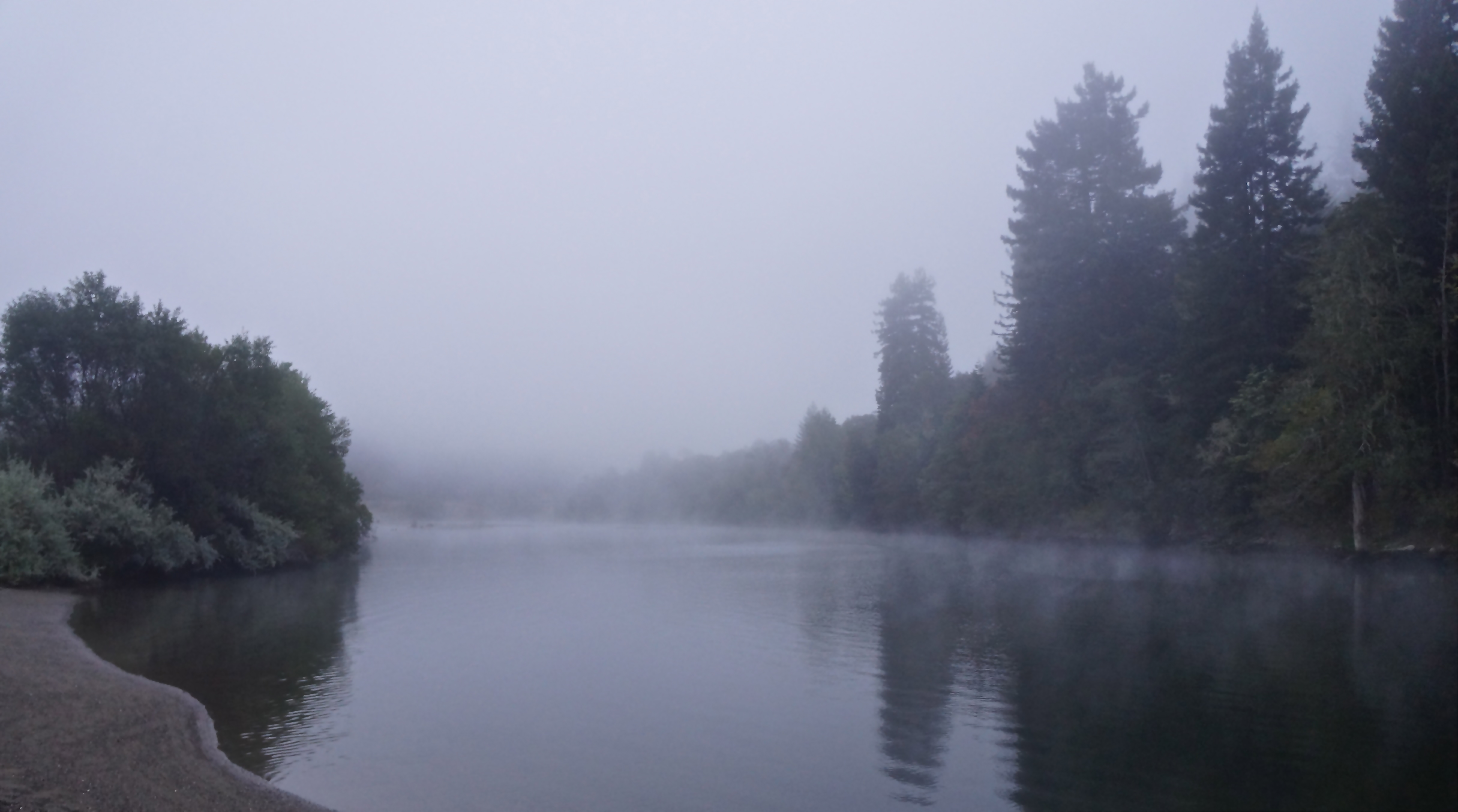
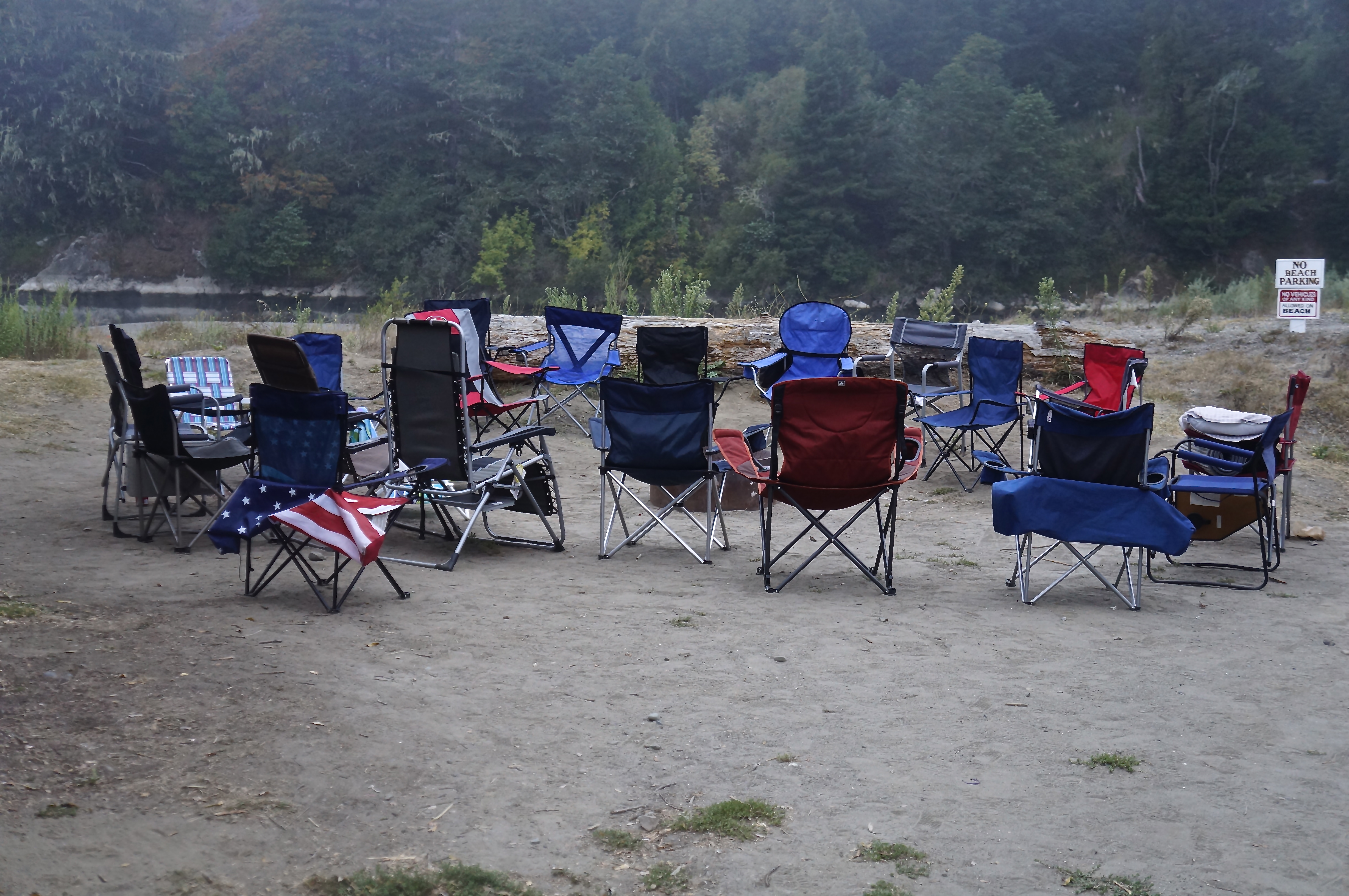
Twenty-nine men around a campfire.  Behind us the Russian River flows gently to its mouth in nearby Jenner.  The river is warm, perfect for swimming.  I swam early Sunday morning, the morning fog still low above the mild water, the surface as smooth and glossy as a pane of glass.  If this isn’t peace I don’t know what is: serenity achieved.

This is the fourth year in a row we’ve camped along this river.  While the weekends aren’t different, the experiences change.  We have grown a year older; our lives have moved on for better or worse; we’re different men than we were the year before.  A core of us has participated since the first camp-out.  A few haven’t been able to make all the retreats.  New guys have joined in.  For the past two years Thomas has raised the meal standards to restaurant level.  This isn’t camping in the wild!

_DSC4050

We sit around the fire each night and share our stories.  We mostly know each other, so listening to the new chapters brings new insights.  Though there’s no knowing what truly stirs inside a man, nothing dire was expressed this year.  We’re holding steady.

My own campfire story was about happiness.  Isn’t that the goal…as we trudge the road of happy destiny?  Another commented that perhaps contentment was a better word.  For me, contentment is happiness, a feeling that all is as right as it’s supposed to be. Happiness is the mean.  There are days that are happier than others, some sadder. Sometimes it’s impossible or inappropriate to be happy. Yet the ability to come back to contented happiness is a worthy process.

_DSC4027

We choose to be happy, or not, every day.  Choosing happiness is a decision that gives us the possibility of creating real happiness in our lives. It’s declarative.  We don’t need to live a past-derived future, colored by those times in our lives when happiness eluded us.  We know those times.  They’re an old story—our old stories.

In my case, I can chart the day when I chose to be happy, without needing happiness for fulfillment, but wanting it for myself as a way to live my life without fear.  The day was December 25th, 2012, and my sons gave it to me.

_DSC1019

The dictionary defines fellowship as “the companionship of individuals in a congenial atmosphere and on equal terms.” We sit here around our fire, companions on equal terms, in a congenial atmosphere. It’s our fellowship, the collective force that binds us in common pursuit.  Together, we’re stronger than any one of us individually.  It’s the way I define a power greater than myself.

_DSC4210

During the day some of us set out on marathon bike rides; others run.  We’re an athletic group. I joined a group to hike in the Armstrong Redwood Forest, where virgin redwoods grow more than 300 feet tall and are as thick as an elephant.  Some have been growing here since Leif Erickson made landfall in the New World five hundred years before Columbus “discovered” it.

_DSC4061

Later, five of us drove to Jenner and watched three sea lions dance together in the water beneath the cliffs, while dozens of seals basked on the nearby sun-warmed sand.  Pelicans flew in strict formation before diving straight down upon an unsuspecting meal. Later, we walked on the beach near Goat Rock, our younger contingent playing football. This, too, is happiness.

_DSC4144

Before Cow Hollow, the only similar fellowship I experienced was in college.  My class at Bowdoin was small enough that I knew every classmate by name.  I still do.  Those four years in Maine stand out as the most special years in my life.  The fellowship I enjoyed there was different from that around the fire here on the Russian River.  We were young men setting out in life together, filled with promise, aspirations, dreams.  Some were realized. Others were derailed by the very reasons we now enjoy a different kind of fellowship at Cow Hollow. It’s an odd kind of continuum.

IMG_3281

I’m gratified that our fellowship doesn’t discriminate by age.  I’m old enough to be some of the guys’ father—well maybe only two!  I learn from them as I hope they may learn from me.

On Sunday morning we didn’t hang around, setting off well before checkout time.  Up and out.  This precious time together was over, until repeated again next September. No one knows the course the year will take.  Some of us will be here again; others won’t.  I hope I’ll be on next year’s retreat. If I’m not, it had better be for a damn good reason!

Here’s to happiness.

_DSC4188

At the End of Nature

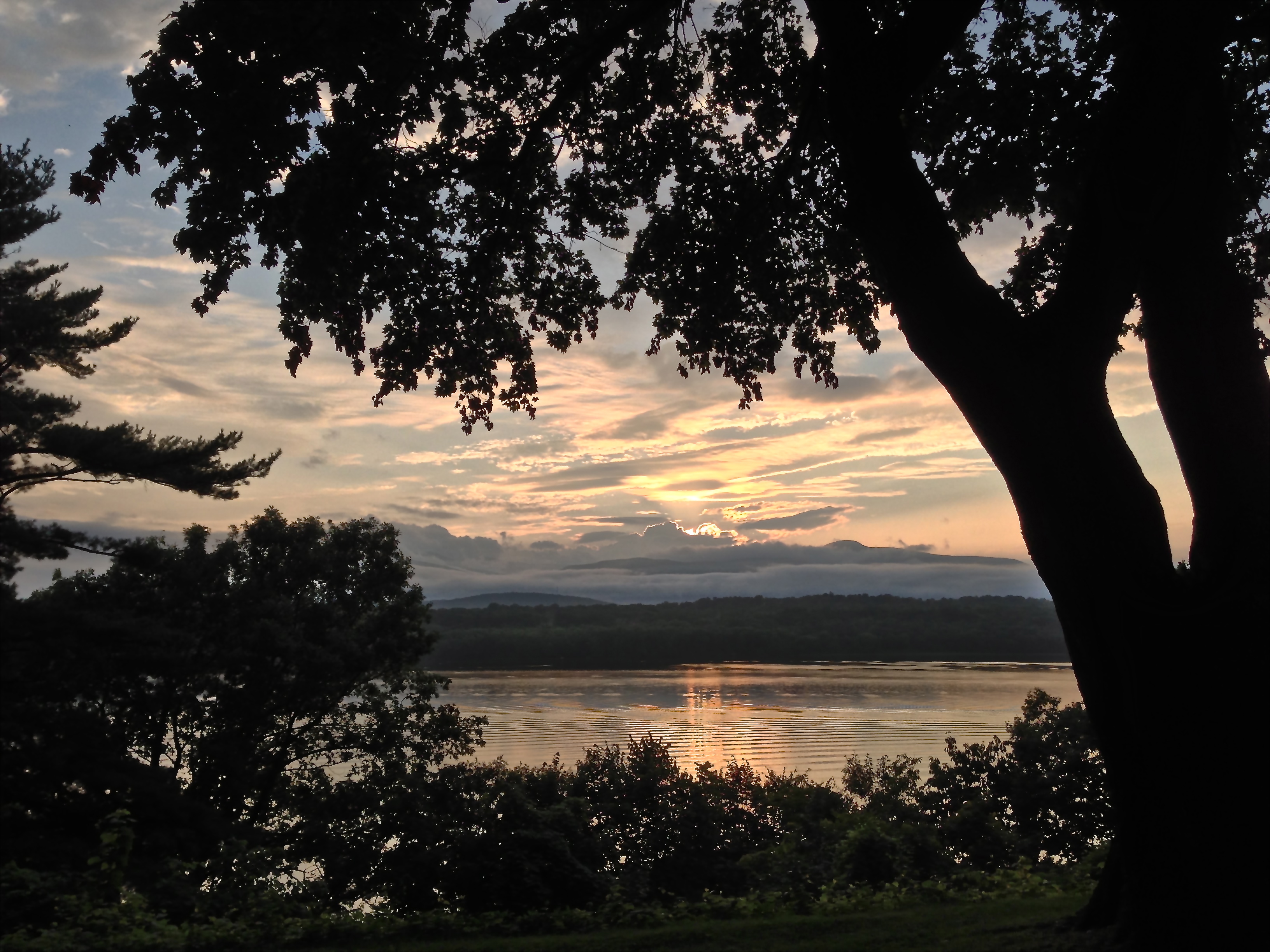
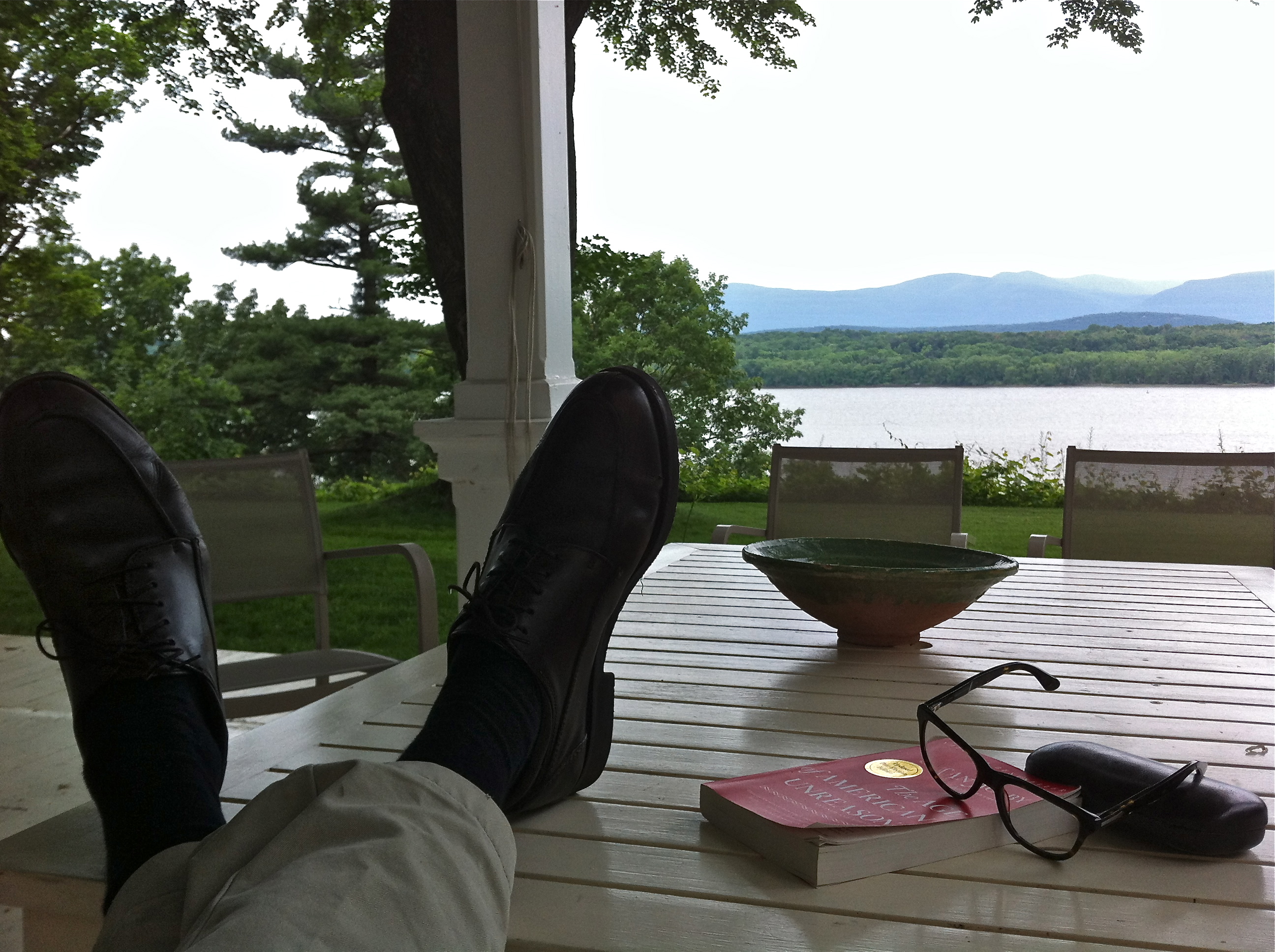
I’ve been sitting on the porch here at Midwood watching the sun play behind the Catskills on the other side of the Hudson River.  It rained earlier in the day, when I was swimming in the river, and now the evening sky is filled with clouds touched with purple and pink and broad swathes of gray.  Every few minutes the light and shadows change—a never-ending panorama of grandeur and beauty.  It’s so peaceful here.  I’m alone this evening and have the house and river to myself.  Our river view  is unique for Columbia County in that there’s nothing built on the opposite shore.  There are only the trees and clouds and mountains, and one tiny green light at the water’s edge, blinking, as out of Fitzgerald.

IMG_3995

Yet, what I’m looking at is not Nature in the raw.  The Catskills have been deforested many times; just behind and south of the green ridge is the town of Woodstock.  The sky’s paint box colors are due to pollutants in the atmosphere.  And someone put the tiny green light out in the water to warn passing boats to steer clear of the shallow inside passage.

While clearing out my storage unit in Hawthorne last week, among my papers I came across a photocopy of Bill McKibben’s forty-nine page article “The End of Nature,” published in the September 11, 1989 edition of The New Yorker.  With eloquence, passion and scholarship, McKibben woke the country to the irreversible damage to the planet, and to our imagination, caused by global climate change.  “Changes in our world which can affect us can happen in our lifetime—not just changes like war but bigger and more sweeping events.  Without recognizing it, we have already slipped over the threshold of such a change.  I believe we are at the end of nature.”

“When I say “nature,” I mean a certain set of human ideas about the world and our place in it.  But the death of these ideas begins with concrete changes that scientists can measure.  More and more frequently, these changes will clash with our perceptions, until our sense of nature as eternal and separate is finally washed away and we see all too clearly what we have done.”

No one listened to McKibben in 1989.  Half the country still doesn’t.  When the article appeared, Christopher Lasch writing in Harper’s called it a “tear-stained” work of “rural piety.”

Since that publication date of September 11, 1989 (made all the more auspicious since that same day twelve years later) the planet is in worse shape.  Everything McKibben wrote about has either become true or is worse than he predicted.  How can this be so in the world’s most technologically advanced country?  It should break the hearts of every rational human being, and cause unrelenting despair.

imgres

I use the term “rational” with reverence.  That half of the American population believes that the Earth was created by God six thousand years ago is a tragedy beyond “rational” comprehension. It denies all that we know of the creation over billions of years of our magnificent oceans, mountains, hills and valleys as lovely as Shenandoah, the cliffs of Mendocino, the rocky coast of Maine.  It denies the extraordinary diversity of all life on Earth, from improbable giraffes to the decorative people of Ethiopia’s Omo Valley, who adorn themselves with pigments, flowers and leaves.  The eternal laws of Nature have been negated by this magical fundamentalism.  The United States is alone among Western Nations with these primitive, destructive beliefs.  If the Bible were actually to be read as a literal document, these Fundamentalists should take heed of God’s warning to Job, “Who shut in the sea with doors…and prescribed bounds for it!  Who can tilt the waterskins of the heavens?”  With man’s great powers today, the sacrilegious answer is, “it’s us, not God.”  I find it hard to understand why the most devout Christians are not the most committed environmentalists.  Shouldn’t God’s Universe be preserved for all Eternity?  The fatalism of Revelations is a crime against nature.

images

Yet it’s not just the religious extremists who undermine our efforts to restore and maintain the planet (even if it were not too late.)  Our government is determined with messianic intensity to “save” the Middle East without even a modicum of committed desire to save the Earth.  There is something extremely wrong with our country’s priorities. The oil business runs foreign policy, along with the Congressmen in their pay.  I wonder how many Republicans really want to explain to their grandchildren how they voted away their natural future for short-term corporate earnings.


And, more locally, what are we to do when those administrators who approve the topics to be taught in Stanford’s School of Continuing Education judge Sustainability in Business Practice to be of insufficient community interest to fill a class?  This isn’t Kansas; this is Stanford! —in one of the most liberal and environmentally aware areas of the United States.  What hope remains?

imgres-1

By choice I have no television, no microwave, no dishwasher; by neurological condition I have no driver’s license hence no car.  I can’t be commended for the latter because if I could drive I would. More damagingly, I fly back and forth across the country at least once a month.  I have flown extensively since a child.  I have more than two million miles on one airline alone.  I am a large part of the problem and only an infinitesimal part of the solution.  I am committed to doing more.

Friday’s rain has passed, clearing up the cloudy atmosphere.  It’s a gorgeous August afternoon here above the Hudson River.  The day could not be more perfect. The sky looks as if it were a Winslow Homer watercolor.   I swam in the warm river, against a very strong current in which I could make only minimal headway.  Floating back with the current was like an amusement park ride. The immense good fortune of living here makes me forget the perils we face.  How could the world be hurdling toward sure disaster when places exist like this house above the Hudson, with the civility and grace lived here, with the friends who visit, with the turkeys who take their evening stroll along the road by the pond, with Roundtop off in the distance and the great river itself flowing from a tiny Adirondack spring to the mouth of New York Harbor.

IMG_4083

A few miles south of Germantown a Stravinsky celebration is taking place at Bard College’s summer music festival.  The Hudson River is cleaner than it was ten years ago, although PCB’s still leak upstream from General Electric’s Hudson Falls plant.  You can’t drink the river’s water and only a limited number of fish are to be consumed per year. Just before getting into the water to swim this afternoon I stabbed my foot on some diabolical rock-hard spiky seedpod. I’m worried now about infection.

IMG_4085

These contradictions in our lives make the reality of the end of Nature difficult to comprehend, much less actively think about. The Hudson with the Catskills to the West looks like real Nature. Neither is likely to go away soon. Today is a storybook summer afternoon, in my favorite East Coast month of the year.  The every seventeen-year cicadas are singing in the trees.  They haven’t heard the news that Nature is over, an idea that’s come and gone.  And yet, as Bill McKibben wrote in 1989, it is.

Overnight the seasons shifted. First the evening sky turned magnolia pink, then deep aquamarine blue. With the rising of the sickle moon, the temperature dropped, bringing that unmistakable crisp night air, a sure sign that autumn is close by.  Fresh sweet corn is over. The flowers and meadows are at their fullest, the lush foliage just beginning to bend towards decay, the end of summer.

images-1

Is this what the end of Nature will look like, spread across the planet on an unimaginable scale?  Acid rain already is killing the old growth forests of Europe.  The Greenland Ice Sheet is melting.  Swiss glaciers are visibly retreating every year.  Monsanto is rewarded for developing genetically modified seeds—a crime itself—with no concern whether the great agricultural plains will be able to support growing them.

Nature as a defining imaginative force, infinite in scope, forever renewable, has ended.  We can barely see the physical reality; yet there are signs everywhere.  Will Nature come to be only in books by Thoreau, Burroughs and Muir?  Claude Levi-Strauss’s great 1955 memoir Tristes Tropiques was aptly, and precisely, titled:  the sad tropics. It’s an irony of natural description that almost everything described is already over, gone.

Nature isn’t the province of a lucky few who can afford or find available the time and place to experience its wonder and beauty.  It’s the air we breathe, the water we drink, the food we consume.  Without these, a sunset is meaningless, the last tiger an irrelevancy. At minimum, the world will become a new wing of the American Museum of Natural History, just next to the dioramas of the Great African Mammals. I will not see this dystopian future in my lifetime; my children only a piece of it.  After that, I can’t predict.

IMG_4162

Outside The Bubble

For those of us lucky few living in San Francisco, traveling outside The Bubble can be an alarming experience. As Herb Caen famously wrote, “San Francisco is seven square miles surrounded by reality.”  Nowhere does this strike home more than a trip to The American South.

images

I’ve recently returned from the Gulf Coast of Alabama where I went to spend a long weekend with my father and his wife.

Once upon a time, this coast was a sleepy backwater of fishermen, pecan farmers and easy living off the land.  All of this life is gone.  Ugly condominiums hastily thrown up over the past twenty years line most of Alabama’s pristine white beach Gulf Shore.  From the beach road there are few openings where you can even see the water. Originally a haven for lesser snowbirds who couldn’t afford or didn’t care for the tonier parts of Florida, the Alabama Gulf Shore today has become the vacation mecca for nearby residents of Mississippi, Louisiana and Tennessee who lack their own expanse of “sugar sand” beaches. This coast isn’t called the Redneck Riviera for nothing.

imgres

Every chain known to man lines the coastal strip, along with local honky-tonk competitors hawking t-shirts, surf boards (I’ve never seen anyone actually surfing), the “best gumbo” in town, bottomless beer bottles, girls in bikinis, fun parks and arcades, even a new zip-line attraction soaring over little more than a parking lot.  The only thing missing is gambling.  You have to drive over to Biloxi to lose your money.

Much like Las Vegas, the coastal tourism industry has spawned a burgeoning local population, which in turn has brought the commercial infrastructure to support the growing needs of a new community.  And, as with my father, those early snowbirds who came to the Gulf Coast thirty years ago to escape the harsh winters of the Midwest, have now retired to golf course enclaves benefiting from low taxes and hot weather.  The occasional hurricane doesn’t seem to dampen anyone’s enthusiasm.

Then there are the churches.  There are miles and miles of roads where every other building appears to be a church. All the usual suspects are well represented: the prevailing Baptists, along with Catholics, Methodists, Lutherans, Presbyterians, Episcopalians, 7th Day Adventists, Pentecostals, Christian Scientists, and countless churches of unknown-to-me sects—the New Life of Christ, Family Revivalists, New Beginnings, Family Tabernacle, White Dove Ministries, Victory Life,–the sects are endless. Most are poor looking with dire signs proclaiming things like “Eternity is a long time to be wrong.”  Fundamentalism appears to be rampant.  Crosses are everywhere. I’ve never seen a synagogue.

church_sign_the_lighthouse_united_pentecostal_1415

Yet there are a few places that resemble the old, original Gulf Coast before it was spoiled by progress sand developers.  Bon Secour National Wildlife Refuge is one such sanctuary:  7000 acres of bird watcher’s paradise, nesting sea turtles, and humid trails snaking under the scrub pines and along the sea-oat dunes, a reminder of what the Gulf Coast once looked like. There are backwater rivers where alligator eyes sparkle at night.  Even in the manicured golf resort community where my father lives, nature breaks in. Osprey, Great Blue Herons and Ibis fish the man-made lakes; alligators occasionally emerge on the fairways, Cottonmouths curl on sunbaked patios.  Gruesomely, by father’s Bichon was taken by a coyote from his backyard.

images-1

Leaving The South turned out to be as depressing as the ruined Alabama coastline.  I was scheduled to depart Pensacola on a noon flight, connecting in Dallas, and arriving at 5:20pm in San Francisco. As we approached the airport I was notified by American Airlines that the 1:00pm flight had been cancelled due to mechanical problems, and I was rebooked to depart at 3:15pm, with my Dallas connection also changed to coordinate with the later arrival.  My new arrival time in San Francisco was 7:45pm.  No problem.

My fellow passengers and I boarded the small American Eagle plane for the 3:15 flight.  Before the plane left the gate, the pilot announced that there was a small mechanical problem, requiring the airport engineer to replace a switch.  The repair would take no more than five minutes.  All good, except that it took over an hour to find this engineer, and during the wait one of the flight attendants had “timed-out.”  She had to be replaced and, adding insult to injury, her replacement was in Dallas and had to be flown into Pensacola.  Dallas!  We were on our way to Dallas.

images-2

We then had to leave the plane.  Because the plane was so small, all carry-on luggage larger than a briefcase had to be valet checked.  We had at minimum a three-hour wait, meaning of course all Dallas connections were missed.  Nearly all of the sixty passengers had connections.

Are we having fun yet?  Oh, no—fun began when we discovered that American Airlines had only one representative supervising two different gates.  So, instead of checking new flights to replace the missed connections, the unfortunate woman had to deal with arriving and departing flights from both gates, running back and forth between the two.  During the intervening minutes, she attempted to take care of us, searching for late connecting flights out of Dallas.  Meanwhile there were passengers who wanted to bag it and just go home.  But they couldn’t because there was no one to take all of the checked bags off of the plane.  These folks were not happy campers.

Outside a gale force tropical monsoon was raging.  Rain was coming down in black sheets obscuring the far side of the runway.  The airport was close to shutting down.

Eventually, the Dallas based flight attendant arrived and our flight was now going to take off.  Only a few people had had their Dallas connections resolved.  At this point the frazzled—but stupendously patient and friendly—AA rep announced, “Please just board the plane and deal with your connections in Dallas.  There’s nothing more I can do.”  This AA rep deserved the highest possible commendation!

I arrived in Dallas long after the last flight to San Francisco departed. American provided a voucher for a night in the airport Ramada Inn, surely the worst one in the Ramada chain.  The only dining option was a 24-hour Denny’s across the highway.

imgres-1

I’m not sure it’s even snobbish to say I’ve never eaten at a Denny’s.  To me it represents the nadir of American restaurants.  My imagination however wasn’t even close to the reality.  Never, ever, have I been to a more woeful, doleful, sorry approximation of a roadside eatery.  I’m willing to entertain the possibility that this particular Denny’s was not representative of the chain in general.  After all, it matched the wretchedness of its near-neighbor Ramada Inn.  Perhaps this was American Airlines’ idea of a joke on its stranded passengers: pay for lodging and a meal, but make the experience as miserable as possible since the circumstances that caused the unexpected overnight were so bad the traveller was never likely to fly AA again anyway.

My Denny’s was vast, empty, cold, not very clean, and staffed by very tired and rundown women.  These ladies—all were women, telling in and of itself—had all seen better, younger days.  Their hearts weren’t in it anymore.  Glacial slowness prevailed.  My waitress lacked affect, expression, much less a smile.  Her speech was as slow as her gait.  I felt badly even ordering.  It seemed possible that this Denny’s was exploiting those who might not have been able to secure a better job.

imgres-2

A Denny’s menu is illustrated with photos of all the food items.  I assume this is because a portion of its clientele can’t read.  Not wanting to consume 1500 calories on any of the entry items, I chose the “healthy choice” option of an avocado and romaine salad, along with a cup of delicious looking chili.  My waitress informed me they were out of avocados, so I switched to the apple and spring mix salad.  When the chili arrived it looked nothing like the picture in the menu.  In fact, it wasn’t really chili at all.  It was chili-flavored broth with a few desultory kidney beans floating around.  The salad, arriving about twenty minutes after the chili, had no apples.  I asked the waitress what happened to this key advertised feature, and she said she didn’t know, perhaps they were out.  AA’s $11.00 coupon was more than sufficient to cover the cost of the meal.  By the time I left, I was the lone diner.

I was booked on the first flight out of Dallas to San Francisco the next morning, departing at 7:00am.  All went smoothly until once on board.  First the safety video had to be played three times because during the first and second showing, a passenger had been in the rest room and the FAA requires everyone to view the safety instructions.  Then, the pilot comes one and begins his message with, “I don’t know how to even tell you this…”  Based on some complicated logistics necessitating the plane’s computer program being updated once a month, and this plane having to proceed on to Tokyo from San Francisco, there was no time to switch out the program so it had to be done in Dallas.  This would take three hours, during which time we had to remain on the plane.  So three times in two days I was on consecutive American Airlines planes troubled with mechanical problems.

Finally we took off, making our way to San Francisco, albeit three hours late.  Despite cold, foggy weather, The Bubble never looked better.  With all the joys of the city back at hand, I was grateful to be home.  I wish I didn’t have to leave again tomorrow morning for two weeks in New York.  At least it isn’t The South.

imgres-3

Books In My Life

This past Friday I sorted through about 2500 books imprisoned for the past three years in a storage unit in Westchester County, New York.  They ended up there following the sale of my house after the divorce.  Sixty-four boxes of these books were donated to the Mt. Pleasant Library in nearby Pleasantville.  I mailed seven boxes back to myself in San Francisco.  My son David helped me sort, load and deposit these boxes at the library, saving my back from breaking—as well as providing emotional support to let go of the past.  We spent a happy day together. I’m immensely grateful for his help.

LibraryPhoto

Nearly twenty-five boxes of books are still in the unit, along with furniture, dishes, a trunk, a large box of letters, tools, framed pictures, and bins of things I no longer remember.  I have no need for any of this, and regret having not disposed of it when I moved out of the house.  Another trip, or two, will be needed to finish the task of clearing the space.

Still, I was sad to give away so many books, collected and read over a lifetime. I once had the antiquated, and absurd, idea that a “gentleman” had his own library, representing evidence of sophistication and learning.  Clearly I had read too many 19th century novels, all of which ended up in the mass give-away.  These books also provided evidence that I was different from my father, a successful engineer who preferred shooting large animals to reading a book.  The only book I remember seeing him read when I was growing up was William Shirer’s The Rise and Fall of the Third Reich, perhaps not so unexpectedly since he had briefly served at the tail end of World War II.  (The war ended as he sat in a ship at Fort Mason in San Francisco shortly after he enlisted.)  I know today in retirement he reads popular fiction in between watching sports on television.  He gave up hunting only a few years ago, although occasionally goes fishing.

imgres-1

I realize there’s a good deal of snobbism in the previous paragraph.  My thousands of books are serious books: literature, history, politics, poetry, art, culture.  I would no sooner buy a drug store novel than a bag of fried pork rind.  The books I saved are all valuable to some degree, a few very much so.  I was an English major in college, and obtained a master’s degree in Anglo-Irish literature.  The only gun I ever touched was an over-and-under shot-gun for shooting skeet, a “manly” sport mandated by my father who was a champion skeet shooter. (I hesitate to admit I enjoyed the sport, and the tweedy country club trappings that went along with it.)

imgres

Giving away so many of my books, while so evidently a necessity, touched memories and emotions I’ve harbored for decades.  There goes Middlemarch, unwisely assigned by Miss Wilson in 9th grade! There goes all of senior year in high school’s English class, great novels taught by Sewickley Academy’s one Ph.D., Dr. Robb, our cynical, heavy smoking, Smith and Yale educated, much-loved teacher. I won the English Prize at graduation, and achieved the highest verbal SAT score in the class (while objectively a high score, the distinction wasn’t much, given we were only fifty in the class.)  The evidence started early.

imgres-2

Giving away my college books was harder.  I associated each book with a class and a professor and a time in my life that was academically filled with happiness while personally painful. The books from five English courses I took with Larry Hall; from all three courses with Franklin Burroughs, Bowdoin’s soft-soften Southern professor who taught me Chaucer and Milton. Among the books I saved are two he wrote.  More difficult yet were the books from C. Douglas McGee’s Literature as Philosophy course, the most influential course of my college experience.  In truth I own nearly all of these in finer editions than I had in school: George Santayana’s The Last Puritan, Thomas Mann’s Dr. Faustus and The Magic Mountain, D. H. Lawrence’s Women in Love.  In my final paper I wove Elliott’s Little Giddings together with my mother’s attempted suicide, the first time I told anyone in the four years since it occurred in front of me. Learning this, Doug and his second wife Phoebe gave me much-needed solace and remained friends for the rest of their lives. Doug’s sterling ship captain’s whistle, engraved “CDM Bowdoin Alumni College ’65  Tace Explicuit”, which Phoebe gave me after Doug died, is one of my fondest treasures.

IMG_3547

In league with my ideas about a gentleman’s library were my notions of “the collected works” of favorite authors.  Hence, fourteen Jane Austin novels, in handsome turn of the century heavy buckram, rows of Henry James, Sir Walter Scott (how could I have endured reading all of those!); from my junior year thesis on the Bloomsbury Group, all of Virginia Woolf, E.M.Forster, Leonard Woolf, Katherine Mansfield, Lytton Strachey (I kept my first editions of Eminent Victorians and Elizabeth and Essex), G.E.Moore’s Principia Ethica, memoirs by John Maynard Keynes, Ottoline Morrell, Vita Sackville-West, Clive Bell, and all the other hangers-on.

The only collected works I still shelve in San Francisco are a fine twelve volume edition of The Golden Bough and every book written by the English travel writers H. V. Morton, Patrick Leigh Fermor, Jan Morris, Colin Thubron, Simon Winchester, Wilfred Thesiger, among many, many one-offs.  (All of Freya Stark went to Pleasantville.)

IMG_3536

Art books posed no psychological burden.  I felt a twinge giving away books with which I was specifically associated, such as Aperture photography books from when I was managing editor, or Corinth Press books published by my friend Eli Wilentz, owner of the sadly long gone 8th Street Bookstore in Greenwich Village. I kept all of my Jargon Society books, published by Jonathan Williams, to give to Bowdoin College. I was treasurer of the Jargon Society for many years, and through Jargon gained my friends Paul and Nancy Metcalf, Paul, an author himself, being Herman Melville’s great grandson. (Paul’s mother Eleanor Melville Metcalf discovered the manuscript of Billy Budd in a trunk.)  I couldn’t bear to part with anything published by my friend Leslie Katz’s Eakins Press.  These will have to go on another day. Eli, Jonathan, Paul, Nancy and Leslie have been dead for many years.

Still left at home are all my books from my time in Dublin, a thorough survey of everything of note written in English in Ireland.  Oh yes, among these are all the books written by the Anglo-Irish lady co-authors Somerville and Ross.  Who can’t be delighted by Experiences of an Irish R.M?  All of these remain because I harbor the wish to someday teach a course in Anglo-Irish Lit.  (Stanford Continuing Studies turned down my proposal, requiring a Ph.D., not just an M.A.)

IMG_3546

This parting with my books in storage also lifted a weight I no long need to carry.  I don’t need all of this evidence, other than what I know, and how I behave as a result of reading these books.  The physical books aren’t evidence of anything other than vanity. In truth I shouldn’t have saved any or spent money shipping them across the country.  They will eventually have to be given away.  The idea that my sons want to inherit my carefully composed, now smaller, library is ridiculous.  Maybe a book or two, but not the thousand or so, I’m embarrassed to confess, I still retain.

I’m at a point in my life wanting less of everything.  Anyone who sees my apartment knows instantly I have too much of everything. Many things have gone.  Books sold to Russian Hill Books or donated to Friends of the Library, clothes, odds and ends, dishes, unused kitchen equipment to the Town School Thrift Shop, clothes consigned to Goodbyes, eBay and Craigslist sales. (eBay has been especially helpful and lucrative.)  Helping Adam and Rachel furnish their new apartment helped all of us.

Much more remains to go. I’m getting more ruthless and less sentimental.  Things aren’t life.  I want my life to be lighter, freer.  I want to feel the lightness, the unclogging of drawers and cupboards, the extra space, a little emptiness.  Two glass fronted sets of shelves filled with almost fifty years of collected treasures—my own small Wunderkammer—present a problem I haven’t resolved in my heart much less solved in reality.  Their day will come, and when it does I’ll know that my old, past derived, life is gone and a new surprising one can emerge.

Yet some books will be saved, and enjoyed, for many more years.  In the current issue of Harper’s, Mark Kingwell writes in an essay on the future of physical books, “ Books are my friends when nobody else can be; they offer a form of intimacy nothing else does. They do not make me a better person, but they give respite from the incessant noise of existence.”

imgres-3

Forty Years: There and Back

I

I’m traveling back forty years to a time caught between fours years of some happiness, some doubt, some trauma, some fear, some deep joy in all that had been lived in this small college in Maine, to plans for a future defined, at least for a while, by the intermission of more school, across the ocean, before the uncertainty of what comes next becomes real.  I didn’t, and couldn’t, know what these next forty years would bestow.
images-2

Forty years.  They’re unimaginable.  Not yet a lifetime.  But there won’t be forty more.  I wouldn’t want them again. I have everything I need in my life, now; I have things I want, too.  There’s no desperation anymore, no despair, no need to prove, to regret a past that’s gone. It’s just a story I created, lived like chapters in an old book long since closed. What these forty years have given me is the certainty that the future that doesn’t exist yet need not be feared, only anticipated with intention and curiosity.

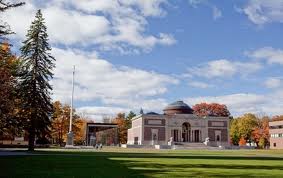
How could I have known on graduation day in 1973 that everything that unfolded over forty years was contained in that day, in me, as on a map tucked in my suit jacket, never consulted yet always with me.  As hard as I try to think of that day—it must have been warm, maybe hot, outside on the lawn spread in front of the art museum—I can’t remember many details.  I know my mother was there, my father wasn’t. He never explained the unspoken decision he made not to face my mother, whom he had recently divorced.  She wouldn’t have had him there, regardless of what I wanted. It was my graduation but her arrangement. I think my aunt and uncle Dolores and Albert were there, too.  After the ceremony we had an awkward lunch with Evelyn, her sister and parents.  Nothing could be expressed.  It was the end of the only happiness we ever would have.

images

But in sex, we were superbly ill suited.  Our parents objected, which was in part the point of the union.  A merger of conflict.  Each of us wanted to reject a past defined by parents and culture, one that had sown seeds of misery, misunderstanding, and abandonment, each in its own unhappy way.  Each of us had something the other wanted, or thought we wanted, to replace what we had and sought to leave behind. The tragedy of this longing was that our desire wasn’t for each other, but what we stood for.  Oh, we craved inescapable desire, but not in love.

Our relationship was difficult over the next few years.  I went to Ireland, Evelyn to New York.  We didn’t speak or write.  I returned and our passion again blinded the reality of an unsustainable future.

Forty years have passed since that day in June to which I’m traveling today.  My plane from San Francisco is 37,500 feet somewhere over Iowa; we have 1107 miles to go. I’ll land in Boston and go on to Maine tomorrow.  It’s a long trip, going back forty years.  There are very few registered from my class I’ m curious to see.   Evelyn will be there, another reason I should have stayed home.  At Sam’s wedding in December she neither spoke to me nor acknowledged my presence.  Another divorce playing it’s sorry song in a place I love against a backdrop of events that occurred forty years ago.

The intervening years exist as moments, possibilities for something good and true to emerge from the wrongness we lived: three sons, each brilliantly lit in immeasurable joy –something we achieved together, not to be discounted.  My life was lived in three places at once.  There was the beautiful life with my boys; my life in marriage, the best choice off a bad menu; and the quiet life I created within myself.  Two plus one never equaled three.

Wounds do heal; scars fade. It has taken a long time to understand that what happened over forty years were things that just happened, that’s all.  They hold no more meaning than that.

More years passed.  More stories written out of needs defined by loss.  Hopes found, only to disappear.  That’s the problem with hope.  It creates an expectation for a future that can’t ever be achieved because it wasn’t real in the first place.  When we so badly need something born of hope, the inevitable crash is devastating.

All of this lifted on the Arctic ice of Lapland.  I have everything I need—my sons, and our love, are all I need to live a fulfilled life.  I found freedom that Christmas Day 2012.  Freedom from hope.  Freedom to want things for myself born from desire, not from loss.  What I saw so clearly in that vast expanse of white was that it’s not a matter of a glass half full, half empty; there’s no glass at all.  There’s only now.

images-5

Maybe this trip to my 40th Bowdoin reunion is another kind of freedom, yet to be discovered.  I can’t predict what the next few days will hold.  I’m staying with a friend from that time forty years ago, a friend born from a faculty friendship, maintained and grown over all these years. I’m lucky to have made such friends.  I’m lucky we’re both still around to enjoy our friendship.  Unattended by our former mates and families, our friendship has deepened.  It’s easier to share now. The losses we have experienced create a backdrop to our sharing. We’re calmer, more at peace with ourselves.  I’m looking forward to the days ahead.

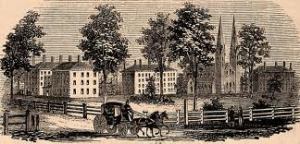
Thomas Wolfe wrote we never can go home again.  Of course we can’t, but there are things that never change. Hawthorne and Longfellow still graduated in the famous class of 1825. I graduated in the class of 1973. Maine Hall stands as it did when I was a freshman.  I watched David and Adam graduate on the same lawn, on similar sunny days.  It’s a choice to love what I had then, still carried within me, not as a millstone but as a beacon of light.  When I told Brenda that I had always wanted to live in a lighthouse, she said let’s do it!  So we’re staying in the Point Arena lighthouse on the Mendocino coast over the 4th of July.  Another beacon of light, shining on the possibility of a future that doesn’t yet exist, but free, totally free, of these past forty years.

II

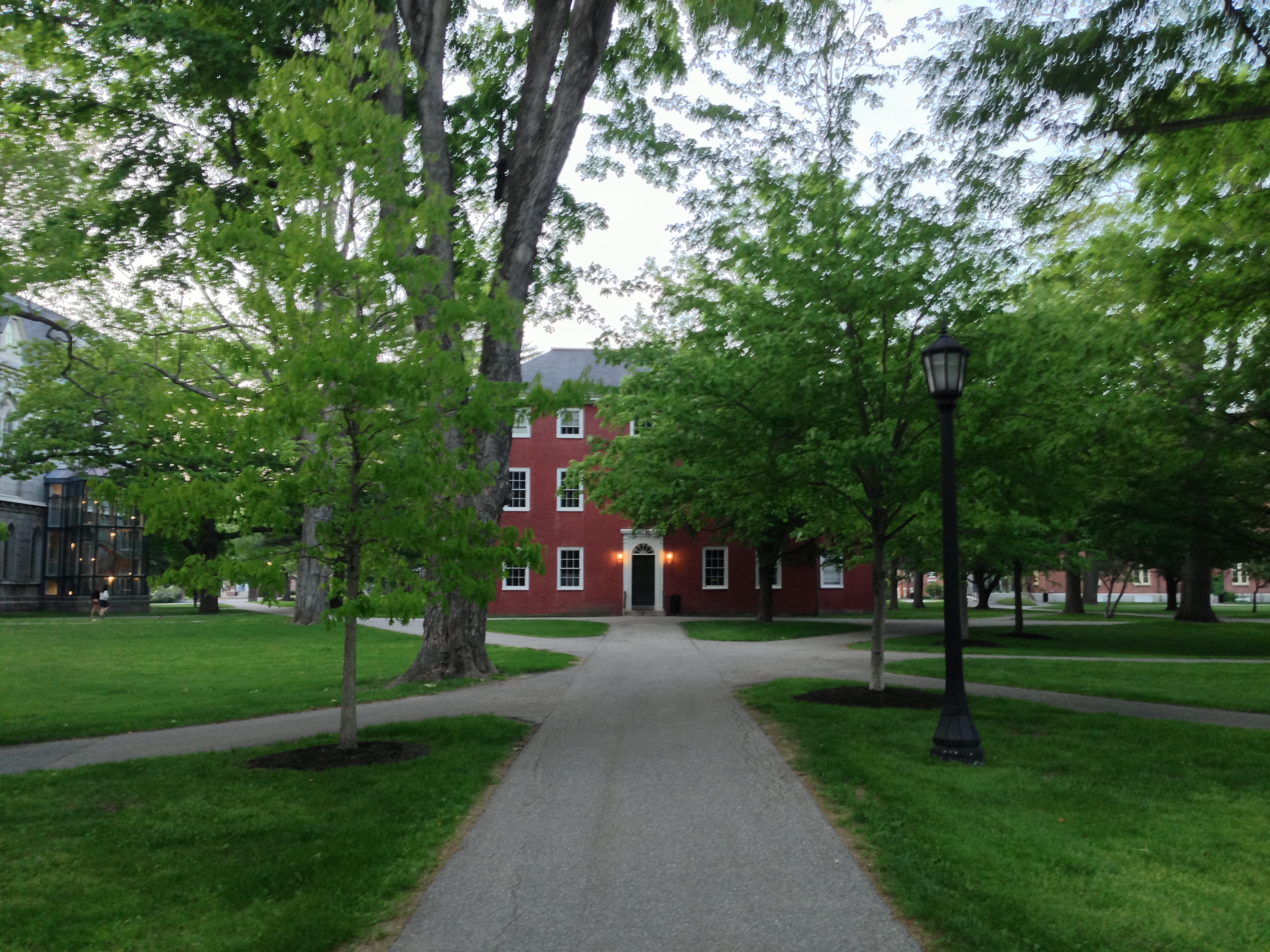
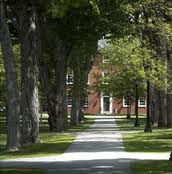
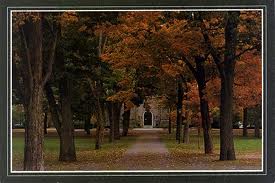
I’m again on a plane 36,000 feet above the ground, nosing into Nebraska, this time returning to San Francisco from the long weekend in Maine.  The reunion’s over: forty years becoming forty-one. The guys I had little interest seeing are now long lost buddies.  We had a terrific time.  Maybe it was the glorious summer weather, the blue sky over the green campus, the warm evenings.  Few college campuses can match Bowdoin’s New England perfection.  As sentimental as it sounds, I can barely look down the long pathway leading to Massachusetts Hall without tears welling up.  There are too many memories of those irreplaceable four years.
images-1

For his 50th reunion, Longfellow composed Morituri Salutamus: Poem for the Fiftieth Anniversary of the Class of 1825 in Bowdoin College. We who are about to die, salute you.  It was the cry of Roman gladiators in the arena to their emperor; it was Longfellow’s farewell to his beloved college.

O ye familiar scenes,—ye groves of pine,

That once were mine and are no longer mine,—

Thou river, widening through the meadows green

To the vast sea, so near and yet unseen,—

Ye halls, in whose seclusion and repose


Phantoms of fame, like exhalations, rose

And vanished,—we who are about to die,

Salute you; earth and air and sea and sky,

And the Imperial Sun that scatters down

His sovereign splendors upon grove and town.

Nothing marred the delight of the past four days. Not even Evelyn, who managed an unavoidable “Hello, Niland.”  Many times I wished I had remained more in touch with these classmates from forty years ago. The bond with Bowdoin we shared is the one that has most endured. Sixty from our class of two hundred twenty came back to Brunswick for the reunion.  Most I recognized immediately; a few I needed to read their nametags before greeting by name.  Some showed the passage of forty years more than others.  All of us have mellowed. We all enjoyed seeing one another.  Still, my best friends were missing: Stuart and Bill.

Staying with Cynthia possessed its own special place in the weekend.  I met Cynthia and John Howland my first semester freshman year when I took Chuck Huntington’s ornithology course.  John, a biochemistry professor at the college, would accompany the class on our weekly field trips up and down the Maine coast.  His department friend Sam Butcher would also come along, beginning yet another special friendship. On Sunday night, Cynthia, Sally and Sam Butcher and I had dinner together, forty-four years later.  I know we felt the loss of John, who passed three years ago. The most erudite of any of us, John had always entertained us with his wit, his broad knowledge of everything, his warmth, his often funny views on Bowdoin.  I miss John.  It remained unspoken at dinner that we all miss John.

Cynthia’s new house on Water Street in Brunswick sits on the bank of the Androscoggin River, just downstream from the hydroelectric falls and resulting churning water and across from the Bowdoin Mill in Topsham.  Eagles nest nearby, fishing up and down the river.  Gulls and cormorants sun themselves on the rocks.  In the mornings, a few fishermen were out casting for what we assumed to be striped bass.  Cynthia reported that on occasion a sturgeon could be seen jumping in the river.

The Bowdoin Mill on the Androscoggin River

Listening to the waterfall at night, the house dark and silent but for a ticking clock, was magical.  Given history, how lucky I am to be alive and able to return to these friends, to this place I love.

Another special faculty friend from my time is also gone: Doug McGee.  Another loss.  Doug and his second wife Phoebe were close to me when I could be close with no one. They were the first, and only, people I told about the awful events that occurred at home on Christmas my freshman year.  It took four years, not until I attended Doug’s great Literature as Philosophy class.  I told my story in the final paper I wrote, using lines from Little Giddings as my metaphor:

What we call the beginning is often the end
And to make and end is to make a beginning.
The end is where we start from.

We shall not cease from exploration
And the end of all our exploring
Will be to arrive where we started
And know the place for the first time.

That year, Doug, too, was experiencing his own rebirth.  We formed a bond that lasted until both Doug and Phoebe were gone.  It’s hard walking past their house on Maine Street, across from the campus, without feeling sad.

I’m glad I returned for the reunion.  I plan to stay closer in touch with my classmates.  I’ll never have friends like these again.  I never have, but have often failed to remember.  No more.

For age is opportunity no less

Than youth itself, though in another dress,

And as the evening twilight fades away

The sky is filled with stars, invisible by day.
images-3

Midwood

IMG_2151

Midwood sits on a bluff above the Hudson River, just north of the border between Dutchess and Columbia Counties in New York.  The river, so much a part of Midwood’s history, flows downstream, wide and straight at this expanse. The rose-tinted house looks across to the Catskill Mountains, Round Top in the center of the skyline.  Woodstock lies somewhere over those hills. The distant view from the back porch is almost unique among the great Hudson River houses, being devoid of any buildings marring the serenity of the picture spread out against the sky.  At night a single green light blinks from the opposite shore.

IMG_2259

The privilege of participation in the life of Midwood is immeasurable. The warmth of family, hospitality, generosity and civility must be among the last remnants of a time when such qualities still exist and are valued. Whether it can last into future generations is in question.  Without doubt it will never be the same. One extraordinary woman maintains more than this house, this place where grace and comfort pervade every room, every vista, every path that leads to a view Constable might have painted. She maintains a tradition grounded in culture, conversation among old friends and new, books and art, liberal beliefs, children and grandchildren, morning expeditions along the river, lunches on the lawn, dinners in the dining room surrounded by luminous bookshelves.  The city is far away, both by miles and gentility. Yet Midwood remains a beacon, pointing toward something larger than ourselves.

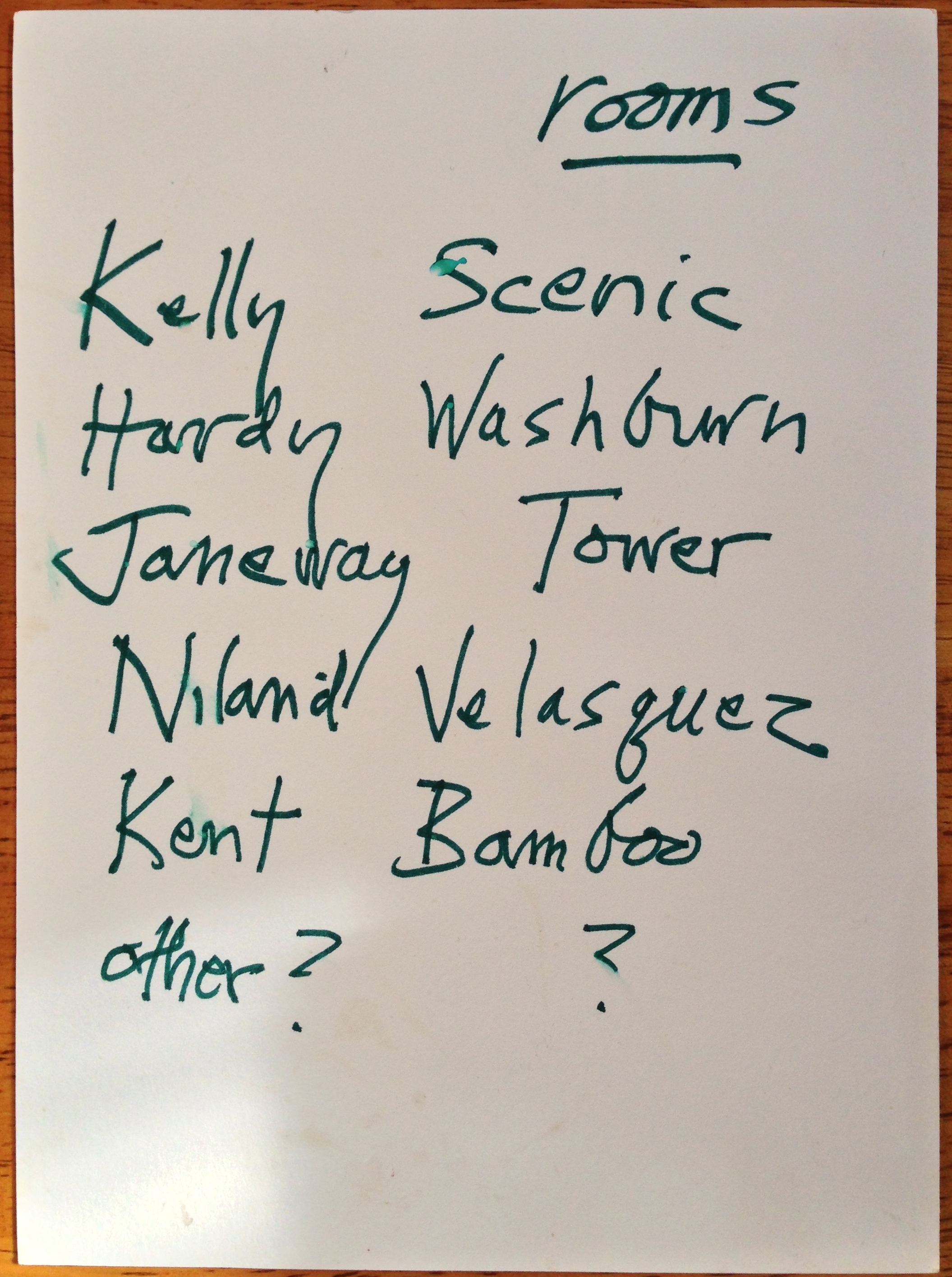
Where can we go from here?  Every time I leave Midwood I wonder if there will be a next time.  Will I sleep again in the upstairs silence of bedrooms named Velazquez, River View, Washburn?  I live far from the Hudson Valley, on the other side of the country.  The hills and farms and architecture of Columbia Country, so rich in the nation’s history, reside in memories of that house and the times spent under it’s great blanket of happiness.  Every time I’m there I feel like a fugitive landed in a more perfect place.

IMG_3251

Three hours south another world jars us back into reality.  Driving down the leafy Taconic Parkway it emerges in stages; countryside yields to Westchester suburbs, to the chaos of the Bronx along the highway, to the sudden skyline of towering Manhattan.  Depending upon the approach, the Hudson reappears on the Upper West Side, though the jumbled wharfs and apartment buildings of New Jersey on the opposite shore are as far from Midwood’s harmony as the moon.  The life of the great city slowly marks the passing of something more than a long weekend away.

manhattan-skyline

I’m lucky that six and a half hours in the air away from New York I can land in a city as beautiful as San Francisco, serene in its own toy-city isolation from the rest of America. No other city replicates or can even approach the astonishing liberal openness of these hills sliding into the Pacific Ocean.  I’ve heard that George W. Bush never set foot in the city during the eight years of his administration.  Barack Obama visits frequently.  In its own urban atmosphere, San Francisco might be a citified image of Midwood’s heritage and beauty.  The Bay is as historical and embracing as the Hudson River.  It’s an odd comparison. Snow never falls on San Francisco and the Bay never freezes over with ice.  Fog rarely covers Columbia County; lazy, hot mid-summer afternoons rarely occur in the City-by-the-Bay.

I’m returning this time from Midwood’s tranquility to greet another special warmth and joy: it’s called love. From the doorway of the South End Club walked a woman named Brenda. She walked into my life.  She lives in my future.

376144434_ca15a04c9f_m

Life has many surprises and many mysteries.  We never know where love comes from. Or where it goes. It breaks hearts…and creates unimaginable happiness.  To wrap our arms around love, and our beloved, is to experience something removed from all the drama, activity and potential misery of the world.

L1080126

Memories of Midwood, friends in New York, love in San Francisco, reside alongside many blessings. My boys give me infinite pleasure, as far and deep as the sea.  Sam is graduating from law school today.  His marriage in Finland last December to his lovely Saga was out of a fairy tale. It seems like yesterday his yellow hair was as bright as sunshine, glowing in the sunlight of Australian beaches.  David is a grown man, husband and father.  His life is busy, too busy, with all the responsibilities of family, teaching, more school. His enthusiasms–photography, headphones, gear, anything that can be researched and enjoyed–keep him in order and balance.  Adam is poised in that precious moment between student and the grown-up life of work, graduate school, maybe marriage. He’s working his first job in the neuro research lab at Nielsen. He and Rachel moved a week ago into their own, first-time, apartment in Oakland.  They’re thrilled.

Where can I go from here?  Large challenges remain.  Life passes.  My children grow.  Midwood resides in memory.  I hope to be there again.  I hope to walk in the late August tangle of asters and Queen Anne’s lace spread through the meadows, summer at its fullest, on the edge of autumn and the edge of time.

_DSC0079

The legacy of Midwood lives in what I can take from that graceful place and share in my own life.  It’s the only repayment I can give: to offer my own experience of a life well-lived, providing a safe haven from the everyday burdens we all experience, especially to those who can never experience that life on the banks of the Hudson River.  I can give this in my fellowship with other men, with my colleagues at work, with my children, with the woman I love.  We can never know what comes next.  We don’t need to know.  All we have to do is take what we have and create a new future that doesn’t exist today.
Thank you Midwood.

IMG_2154

So Long Facebook

Last week I deactivated my Facebook account as a personal protest against Mark Zuckerberg’s creation and support of Fwd.Us, an essentially conservative political lobbying group, ostensibly driving immigration reform.  The group advertises policies and positions advocated by the likes of Marco Rubio and Lindsey Graham.  Many serious liberal organizations, from the Sierra Club to MoveOn, have condemned the group and ask that companies in disagreement with Zuckerberg’s political movement pull their advertising from Facebook.  Several high profile backers have also withdrawn their support, including Elon Musk, founder of Tesla and SpaceX  and David Sacks, the CEO of Yammer.

One might argue that Zuckerberg’s private initiatives have nothing to do with Facebook, the social platform he created, runs, and from which he has become one of the richest young men in the world.  I argue that they are two sides of the same coin.  Facebook has long been criticized for its purposeful erosion of privacy. In my view, the site has shifted from a place where people (“friends”) connect and share their lives, to a pure marketing play designed to better match their users to advertisers.  Social goals have become subservient to marketing goals.

One practice that supports this argument is the new tactic of suggesting “Likes” in users’ news stream. Of course, when you “like” (and perhaps when you don’t “like”) the new sponsored page, you are adding to your demographic profile for better advertising targeting.  Obviously this serves the needs of advertisers at little expense to users beyond annoyance.  But I am annoyed—even being in the business of finding appropriate audiences for advertising campaigns.  Facebook can only exist because it derives revenue from advertisers (same for Google.)  I get this and yet have regarded Facebook as a private domain.  Interrupting my private space with marketing is an invasion I don’t accept.  Maybe Facebook should implement an opt-in series of questions, like OKCupid, designed to define users more precisely.  People could decide whether to answer questions or not, thereby setting their own limits with transparency on all sides.

Part of me thinks I’m cutting off my nose to spite my face by deactivating Facebook.  I like posting on Facebook.  I like sharing photos of my kids and places I’ve been. I like seeing my friends’ posts.  I like connecting to friends around the world whom I very rarely see.

About a year ago I read Robin Dunbar’s book How Many Friends Does a Person Need?  The answer is 150, based on anthropological research into the cognitive limit to the number of people with whom one can maintain stable social relationships. It’s now known as Dunbar’s Number.

images-4

Robin Dunbar wasn’t thinking about Facebook when he developed his thesis.  But it led me to wonder if having more than 800 Facebook friends was realistic or even consistent with my use of the network.  I decided it was not, so pared down my number of friends to 160—as close as I could get to the 150 goal.  The first 500 were easy.  These were not friends by any traditional definition: people I may have met at a conference, former business associates, friends of friends.  The next 100 were more problematic because these were people I did know, but in some defined and limited context which wasn’t of lasting interest.  The final 40 were hard choices.  My criteria, at this stage, were to cut anyone who had never commented on one of my posts, or didn’t share regularly themselves.

It’s these 160 remaining friends whom I’m going to miss by not being on Facebook.  It dawned on me however that these friends were my friends long before Facebook arrived, and will remain so whether I’m on the site or not.  It even pushes me to go back to more personal forms of communication.  I’m not interested in the friends and families of my friends, unless there’s an opportunity for an old-fashioned introduction along the lines of, “Come over on Saturday and meet my friend Sue.  I think you’ll ready hit it off.”

Many of my 160 Facebook friends are people I see all the time.  I enjoy seeing the photos they post—a visual scrapbook of their everyday lives. When we get together they don’t pull out an album and show the latest photos taken at the Bay to Breakers race, though they might have posted one on Facebook.  Still, I’ll see these friends and hear all about their lives first hand.

I worry about staying connected with my Facebook friends whom I don’t see all the time—or ever.  They’re in Germany, Australia, the Netherlands, France, Japan, Austria, Canada, Chile, England; or other parts of the United States.  The onus will be on me to remain in touch.  It goes back to what makes a friend a true friend, someone with whom we share real parts of our lives, not just ephemeral details that come and go.

images-2

What I want my friends on Facebook to know is that they are still my friends—real friends, not only social network friends.  In many ways, social media has both connected us to people and disconnected us at the same time.  We have become disconnected from real human interaction and caring.  I know someone who tallies the number of birthday wishes she gets on Facebook as evidence of something—even when Facebook provides a notice of all your friends’ birthdays!  Even if you forgot, or never had an intention of calling or even sending a card, the reminder makes it possible to spend 25 seconds and send birthday greetings.  Is that affection?  Sentiment need not be a public comment on someone’s Facebook wall.

I think back to how I have used Facebook to communicate my own emotions.  I regret many of these posts.  What drove me to unwrap often painful feelings in front of hundreds of other people, most of whom were not real friends?  Those few who were my friends understood what I was writing and asked me to stop, mostly to spare myself.  In a miserable way, each post had an intended target audience in mind.  Facebook wasn’t the platform to carry those messages.

It’s a good thing I like letters and cards sent the old-fashioned way.  I love the feel of different papers, the touch of letterpress printing, the way an envelope is lined.  I have hundreds of postcards from around the world.  I have collected hotel stationery from every continent.  I have engraved stationery, hand printed stationery, stationery I illustrate myself.  If I wrote every day I would end my life with reams of unused stationery.

So, my friends: please don’t think I’ve reverted to Luddite childishness.  You’ll still receive my emails, maybe my tweets.  And occasional written correspondence.

So long Facebook. I wish you well.

images

Ads of Our Times

“ Historians and archeologists will one day discover that the ads of our times are the richest and most faithful daily reflections that any society ever made of its entire range of activities.”  Marshall McLuhan

images-3

If McLuhan is correct—and I believe that he is—how dismayed he would be at the debased and irrelevant advertising we see today.  As a reflection of our society, he would say we have the advertising we deserve, advertising that does, in fact, reflect the shoddy moral attitudes of our times.  It’s a sad assessment.

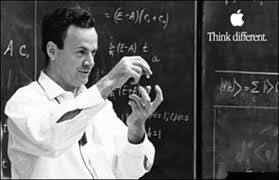
There was a time in my own career when advertising aspired to be more than simply the engine driving sales for products or services.  Of course that’s what the majority of clients want.  Creative agencies have had other goals: to create advertising that becomes an iconic reflection of a moment in time, a page in the history of ideas, a symbol so powerful that it becomes inseparable from the brand it advertises.  There are ads that resonate in our memories long after they crease to exist in the media.  “Think Small,” “We Try Harder,” “Think Different” are slogans that still link immediately to the brands they once supported.

images

I don’t own a television.  When I travel I channel surf from one abomination to the next.  In one evening last week I saw three different commercials that either directly referred to, or dramatized, defecation.  I realize I must sound like some out-of-touch curmudgeon, but honestly, toilet humor?

I work with two of the best creative directors in the industry.  Both are friends.  Paul is the only copywriter to have won AdWeek’s Writer of the Year Award twice.  Steve Jobs once said that our art director Marcus was one of the most elegant art directors in the business.  These are brilliantly talented men.  Nonetheless, we have shared a client that consistently takes the best of their work and turns it into the worst.  While minor in the scheme of things, one classic example was when this client directed Paul to find a superlative adjective to modify the noun “unique.” When we pointed out that “unique” doesn’t take an adjective,  they nevertheless insisted.  So Paul suggested “utterly unique,” only slightly less ungrammatical. The response back was, “Utterly.  That’s an odd word.  We’ve never used it before.  It might stand out.”

Given the drift towards mediocrity and worse, is it any wonder that traditional advertising is losing its influence year by year?  More creative and memorable advertising is found on YouTube, websites, in social media.  It’s shared on Facebook.  Dollar Shave Club has successfully disrupted the razor blade category with its price-cutting proposition communicated by one of the best online video ads out there.  No traditional advertising launched the brand.

images-1

Still, the decline in television advertising is a double-edged sword.  Advertising pays for programming.  As ad revenues decline, so does the quality of network content.  In depth news reporting and educational programming  are nearly things of the past,  freely available on a regular basis solely on PBS.  For families who cannot afford cable, PBS is their only option.  (If Republicans had their way, there would no government funding for public radio or television. Mitt Romney joked–on PBS–“I like Big Bird,” but was more than happy to deny its access to millions of households.)  Network entertainment programming is as bad as the advertising that supports it. “Desperate Housewives…” of whatever city?  The Kardashians?  “My Shopping Addiction”?  I can imagine the nightmares children must have from watching most episodes of “Law & Order: Special Victims Unit.” Even porn may be less damaging than repeated images of mangled, blood splattered, acid burned, broken women.  Reality doesn’t always have to be shown on TV.

There’s no turning back the clock.  We have the advertising our society deserves and demands.  We have the programming most of the country wants to watch.  I can choose not to watch. I can contribute to NPR. I can subscribe to the daily paper edition of The New York Times.  I can tell myself I’m occupying the moral high-ground.  Still, advertising is all around me, around everyone. It’s part of pop culture. We can neither avoid nor escape it.

We could choose never to buy the products supported by offensive advertising.  It’s an act of will worth considering.

images-2

Sand Dollars

urb-0411-1

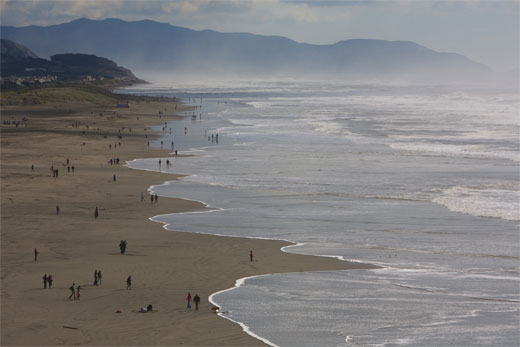
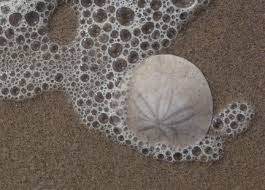
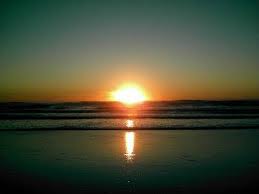
We walked hand in hand finding sand dollars on the beach.  The sun’s last flames of pink and orange stretched just above the gray Pacific’s horizon.  A few surfers still tried to catch the receding waves.  Early springtime melted into early evening and early affections, as gentle as the soft white spume left on the wet sand: Ocean Beach in late March marking a time to begin, to feel the heart’s beat again.
imgres-1

These perfect sand dollars we find are talismans, protecting us from harm for this moment, here on Ocean Beach.  We’re creating the possibility of a future that doesn’t yet exist. Not yet.

imgres-2

Here we are on the Western edge of the country, facing the sunsets.  I grew up facing sunrises.  I once had a summer job as a night watchman at a country club in Sewickley Heights where we lived.  The clubhouse was on a hill and looked out over the golf course directly eastward.  I would sit outside before dawn and watch the first pink glow appear on the horizon.  The sun would pop up and the magic disappeared.  Time to go home.

images

Bowdoin College’s symbol is the Sun.  It’s the first college in the country to have the sun shine on it every morning. For nearly two hundred years the school’s alma mater began with the delicious double pun, “Rise sons of Bowdoin…”  With the arrival of women, the line was changed to “Raise songs to Bowdoin…”  A generation of graduates mourned.

images

These are simple thoughts, warm thoughts, like sunshine.  Walking on the beach in the last rays of sunshine is peace; contentment; happiness–an end in itself, without an outcome, just being together now, in a moment of grace.  There isn’t any other.  This is what it means to be alive.

images-1

The Future That Doesn’t Exist

In a future that isn’t past derived, where does memory fit in?  The past weighs us down, thwarts progress, and embeds stories that cause us to behave the way we do.  Events long in our childhood change the way we see the world forever.  And yet can the past really be banished?  Does memory count for nothing?

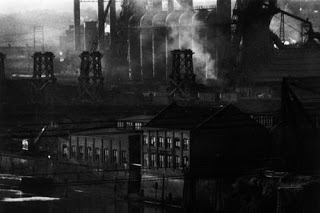
I grew up in Pittsburgh, where my father was an executive in the steel industry.   Steel was still the vital financial backbone of the city when I was a child.  The soot and smoke hadn’t yet cleared to make way for unemployment and a remarkably transformed economy. The descendants of  Eastern European immigrants who worked in the mills lived their lives far from the leafy hills of the exclusive distant suburbs.  I remember being taken to the big Jones & Laughlin mill on the South Side of Pittsburgh, along the Monongahela River, to see the giant cauldrons of molten steel pour their liquid fire into moulds for girders. I imagined this was what a spewing volcano looked like.

smith

My father is descended from a long line of Pennsylvania coal industry people, going back to the beginnings of the State.  There were land grants in the old Rimersberg Courthouse in Clarion County signed by William Penn. (My former wife used to ask, “well, where’s that land today?”)  Memories of this industrial childhood formed my worldview  for decades.  Against my father’s wishes, I never wanted to be part of that industrial legacy.  I associated steel with everything my father did: he shot skeet and pheasants, hunted big game, fished big fish.  Having failed at football I became a swimmer to his distaste.  I wanted to play the violin and he said no, I had to play the clarinet–just like Benny Goodman!  He said the violin was a sissy instrument, not for boys.  Fearing I might be one of those sissies he became the Scoutmaster and I became an Eagle Scout.  Because I read compulsively I knew there was another world beyond the smokestacks and the Duquesne Club.  My father wanted me to go to Penn and become a lawyer. Instead I went to Bowdoin and became an English major.  I loved that Hawthorne and Longfellow had graduated together in the famous class of 1825.

images

Can I excise these memories from my brain?  Cut them out and toss them into a past that no longer exists, to create a future that doesn’t yet exist?

“But the fact is that writing is the only way in which I am able to cope with the memories which overwhelm me so frequently and so unexpectedly. If they remained locked away, they would become heavier and heavier as time went on, so that in the end I would succumb under their mounting weight. Memories lie slumbering within us for months and years, quietly proliferating, until they are woken by some trifle and in some strange way blind us to life. How often this has caused me to feel that my memories, and the labours expended in writing them down are all part of the same humiliating and, at bottom, contemptible business! And yet, what would we be without memory? We would not be capable of ordering even the simplest thoughts, the most sensitive heart would lose the ability to show affection, our existence would be a mere never-ending chain of meaningless moments, and there would not be the faintest trace of a past. How wretched this life of ours is!—so full of false conceits, so futile, that it is little more than the shadow of the chimeras loosed by memory. My sense of estrangement is becoming more and more dreadful.”

W.G. Sebald,  The Rings of Saturn.

Oliver Sacks in his new book Hallucinations writes about “false” memories–vivid memories of events and experiences that never happened, or happened to someone else.  Maybe we assimilated something we read, or were told, into our own memory bank and it became as real as if it had actually happened to us. “We, as human beings, are landed with memory systems that have fallibilities, frailties, and imperfections–but also great flexibility and creativity.  Confusion over sources or indifference to them can be a paradoxical strength: if we could tag the sources of all our knowledge, we would be overwhelmed with often irrelevant information.”

My own first memory must have been when I was  three or four years old. It was a summer day and I was mowing our lawn with a tiny toy lawnmower.  I remember exactly where I was on the lawn and that I was wearing a bright green polo shirt and white shorts.  I was happy.  Why such a completely unimportant and ordinary situation should be my first memory is a mystery.  It’s so banal  I assume it’s real.  Later, from the same time, I remember my mother carrying me to a neighbor’s during an electrical storm.  I know this came after mowing the lawn. Neither seem to have influenced future behavior, although I have always liked lawn mowing and enjoy thunder and lightning.

Other later memories may be concoctions of real events and imagined responses.  When I was sixteen, and already a champion swimmer, my father drove me to a swimming meet in Cleveland. I was to swim one event and was expected to win. Instead I came in second, by less than half a second.  The boy who won set the National Record for the event. My father met me at the locker room and told me he hadn’t driven me here for me to come in second. He didn’t talk to me during the entire ride back to Pittsburgh.  I’m sure he made that remark, but could he possibly have been so callous as not to speak to me?  Or is this a story I made up–with full legitimacy in my mind–adding to my inventory of injustices at his hand that I’ve carried, among so many more, to build the case he never loved me?

images-1

Over the years, these stories filled more volumes that the works of Thackeray. All this perceived pain came to an end last Saturday.  Encouraged to take the initial step towards establishing an authentic relationship, I called my Dad and talked to him for the first time in thirty-five years about how all of these experiences came to haunt me and determine the future of how badly we related to one another. The call was easy, the conversation difficult and emotional. We both cried.  Memory had served neither of us well.

Creating a future that doesn’t exist demands leaving the past in the past.  A past derived future only creates more of the past. There can’t be a future.  All we have is this moment right now, and the next one, and the next one.  Once when my boys were small we were all sitting at our dining table when David, aged around nine, said he would do something “later.”  Adam, still in his high-chair, looked up and said, “Later means never.”  When a three-year old understands this, why can’t most adults?  When do we lose this intuitive understanding that now is all the time we have?

Time to grab the day and make the future happen.

images-2